
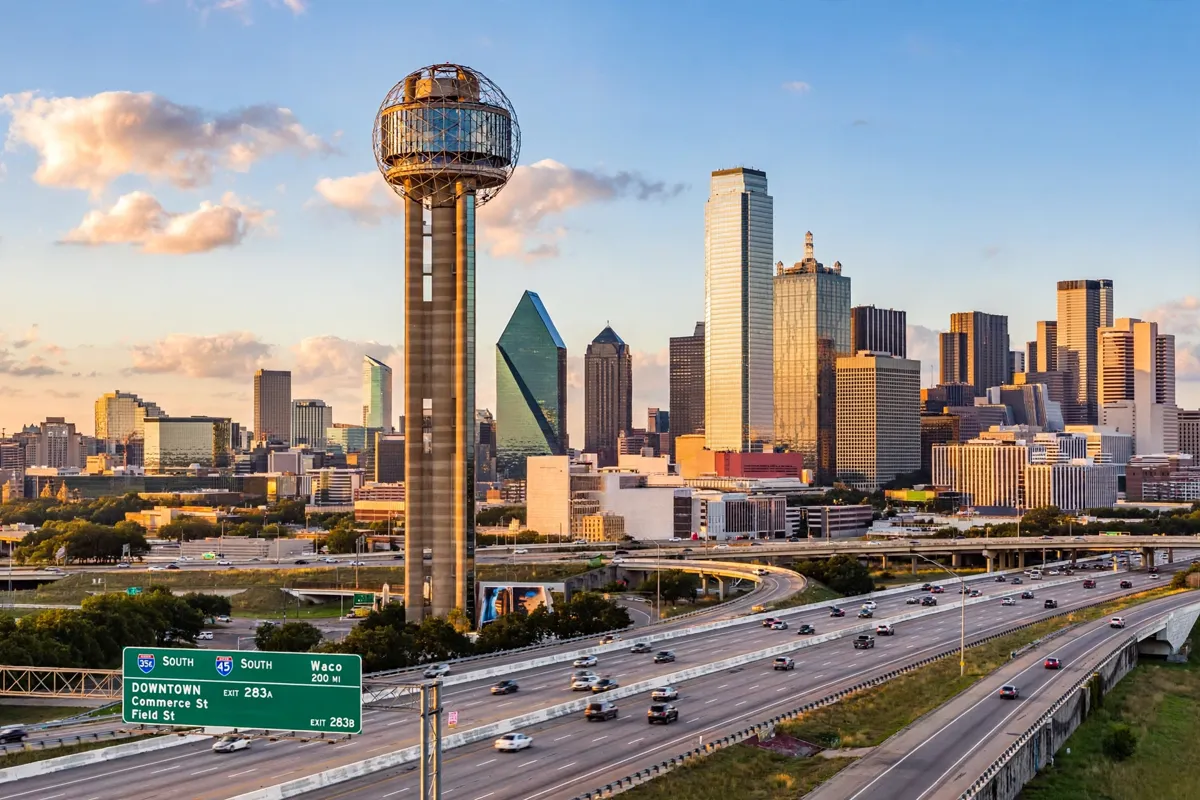

Got a missed call from a 469 number and wondering where it came from? Short answer: Dallas, Texas. Area code 469 covers Dallas and the eastern half of the Dallas-Fort Worth Metroplex, from the fast-growing suburbs north of the city down to the Ellis County towns south of it.
There is one twist that catches people out. 469 does not have its own patch of map. It sits directly on top of the original Dallas code, 214, and shares the exact same ground with 972 and 945 as well. Four codes, one territory. So a 469 number is just as much a Dallas number as a 214 number — it usually just means the line was opened after July 1999, when 469 went live.
This guide covers where 469 reaches, which cities and counties it includes, what time zone it runs on, how to dial it from anywhere, how it ended up sharing Dallas with three other codes, and what to do when a 469 number looks like a scam.
469 Area Code at a Glance
| Detail | 469 area code |
|---|---|
| Location | Dallas and the eastern Dallas-Fort Worth Metroplex, Texas |
| Time zone | Central Time (CST, UTC-6; CDT, UTC-5 in summer) |
| Shares its area with | 214, 972 and 945 (overlay complex) |
| Went into service | July 1, 1999, as the first Dallas overlay |
| Exchanges in service | 786 (NANPA) |
| Rate centers | 43 |
| Carriers holding exchanges | 48 |
Where Is Area Code 469?
Area code 469 covers Dallas itself and most of the eastern half of the Metroplex. The region runs on Central Time, and it stretches across six counties — Dallas, Collin, Denton, Rockwall, Ellis and Kaufman — plus the eastern edge of Tarrant County, where Arlington, Bedford, Euless, Grapevine, Southlake and Colleyville sit closer to Dallas than to Fort Worth. Dallas Fort Worth International Airport is inside the area too.
Because 469 is an overlay, it does not stop at a neat line on a map. A 469 number can turn up anywhere in the region. But the cities where most 469 numbers were issued fall into four clear groups.
North of Dallas: the Collin County boom towns
This is where the growth is. Plano, Frisco, McKinney, Allen, Prosper, Celina, Anna and Melissa sit up US 75 and the Dallas North Tollway, along with Little Elm and Princeton on the northern edge. Frisco and McKinney hold some of the fastest-growing populations in the whole Metroplex, and a large share of new 469 numbers land here.
East of Dallas: toward Rockwall and Kaufman County
Heading east along I-30 and US 80 you hit Garland, Mesquite, Rowlett and Wylie, then Rockwall, Royse City, Forney, Terrell and Kaufman. Sunnyvale, Crandall and Seagoville sit in this stretch too. These are the established inner-ring cities on one side and the newer commuter towns on the other.
South of Dallas: into Ellis County
Down I-35E the code reaches Cedar Hill, DeSoto and Lancaster, then Waxahachie, Midlothian, Red Oak, Ennis, Ferris and Palmer. Waxahachie is the biggest town in this group and the county seat of Ellis County.
West and northwest: Irving, Grand Prairie and the airport
To the west, 469 covers Irving, Grand Prairie, Carrollton, Coppell, Farmers Branch, Lewisville, Flower Mound and The Colony, plus Richardson on the north side. Grand Prairie holds more 469 exchanges than any other rate center — 178 of them, about 23 percent of the code’s total. Dallas itself is next with 139, then Plano with 69 and Frisco with 60.
Where 469 stops
The edges matter as much as the middle, because the codes change fast out here. Sherman and Denison, just past Anna to the north, are not in 469 — they use 903 and its 430 overlay. The city of Denton uses 940. And Fort Worth itself, along with most of the western Metroplex, uses 817 with its 682 overlay. The 469 area ends just west of Grand Prairie and Irving, where 817 and 682 take over.
Main ZIP codes in the 469 area code
| ZIP code | City |
|---|---|
| 75035 | Frisco |
| 75070 | McKinney |
| 75013 | Allen |
| 75078 | Prosper |
| 75009 | Celina |
| 75165 | Waxahachie |
A ZIP code is only a rough guide — ZIP boundaries and phone boundaries do not match exactly — but these are the ZIPs where 469 numbers are most common.
What Is an Overlay? 469, 214, 972 and 945
An overlay is what phone planners do when a region runs out of numbers but nobody wants to change their number. Instead of splitting the map in two and forcing half the region to change area codes, they lay a new code directly on top of the old one. Existing numbers keep their code. New numbers can get any code in the group. And every local call has to be dialed with all ten digits, because the seven-digit number alone no longer says which code you mean.
Dallas now has four codes sharing one map:
- 214 — the original Dallas area code, from 1947. Today it is an overlay for the whole region, just like the rest.
- 972 — split off for the suburbs in 1996, then folded back into an overlay for the whole region in 1999.
- 469 — introduced on July 1, 1999, as the first overlay code laid over both of them.
- 945 — the fourth code, approved by the Public Utility Commission of Texas on February 27, 2020, with assignments available from January 15, 2021. New 945 numbers are only handed out once the existing codes run short.
For anyone calling or doing business in Dallas, the practical point is simple: all four codes are Dallas numbers. A 469 number is no less local than a 214 number, and the cost of the call does not change between them. What does change is the dialing — ten digits, every time, even for the house across the street.
What Time Zone Is the 469 Area Code In?
The whole 469 region runs on Central Time — CST (UTC-6) in winter and CDT (UTC-5) in summer. Daylight saving time runs from the second Sunday in March to the first Sunday in November, like the rest of the United States. Dallas is one hour behind New York and two hours ahead of Los Angeles.
That matters more than it sounds. A 469 number on your caller ID does not mean the caller is in Dallas right now — a mobile number travels with its owner — but the code’s home time is Central, so it is the clock to check before you call back. A call at 3 a.m. Dallas time is a small red flag: real people and businesses in Dallas rarely dial in the middle of their night.
| Calling from | Best time to call (your time) |
|---|---|
| Central Time | 9 a.m. to 5 p.m. |
| Eastern Time | 10 a.m. to 6 p.m. |
| Mountain Time | 8 a.m. to 4 p.m. |
| Pacific Time | 7 a.m. to 3 p.m. |
Texas law also sets calling hours for telephone solicitors: no sales calls before 9 a.m. or after 9 p.m. on weekdays and Saturdays, and not before noon or after 9 p.m. on Sundays. A sales call outside those hours is breaking Texas law, whatever number it shows.

How to Dial a 469 Number
Ten-digit dialing has been mandatory across the Dallas region since 1999, and there is no seven-digit shortcut. Dial the area code on every call, even a local one.
| Calling from | Dial |
|---|---|
| Local call in the Dallas region | 469-XXX-XXXX (10 digits) |
| Long distance in the U.S. or Canada | 1-469-XXX-XXXX |
| Calling from abroad | Exit code + 1-469-XXX-XXXX (for example, +1 469 XXX XXXX) |
From most countries the exit code is 00 or 011, then 1 for the United States, then 469 and the seven-digit number. If you are saving a Dallas contact in your phone, store the full +1 469 number — it works from anywhere in the world, and it stops your phone guessing which country you mean.
The History of Area Code 469
Dallas has one of the messiest area-code histories in the country. The city tried an overlay, switched to a split, then went back to an overlay — all within about three years. Here is how it unfolded:
- 1947: Area code 214 is born as one of the original 86 North American area codes. It covers northeast Texas, from a line just west of Dallas to Waco and the Arkansas and Louisiana borders.
- 1953: Most of Tarrant County is combined with part of area code 915 to form area code 817, the Fort Worth code.
- 1990: The entire eastern portion of 214 is split off as area code 903, covering Tyler, Longview, Texarkana and the rest of East Texas.
- September 14, 1996: The territory outside Dallas and Dallas County is split off as area code 972. The plan had first been announced as an overlay, but after regulatory review the Texas Public Utility Commission switched it to a split: central Dallas kept 214, the suburbs moved to 972.
- December 5, 1998: The line between 214 and 972 is erased. The Commission orders the two codes merged into a single overlay, and ten-digit local dialing becomes mandatory across the region.
- July 1, 1999: Area code 469 is laid over both codes as the first Dallas overlay. An earlier January 1 date had circulated in the industry — NANPA later had to correct it. The real launch was July 1.
- January 15, 2021: Area code 945 joins as the fourth overlay, after approval in February 2020. Its numbers are only assigned once the existing codes are exhausted.
- April 2026: NANPA’s latest forecast puts the next Dallas run-out in the third quarter of 2035 — later than the 2023 projections, which had suggested a fifth code would be needed around 2032.
The 1999 change is the one that still shapes daily life in Dallas. Before it, your area code told people roughly where in the Metroplex you lived. After it, neighbors on the same street can hold four different codes, and the code on a number says more about when the line was opened than where it sits.
Who Holds 469 Numbers?
Phone numbers are issued by rate center — a billing area named for its main town. It is the unit NANPA uses to hand out blocks of numbers, and 469 has 43 of them. A rate center is not a map of where people live. It is where the number was issued, and it is why Grand Prairie, a city many people outside Texas have barely heard of, holds more 469 exchanges than Dallas itself.
In total, 469 has 786 exchanges in service — blocks of 10,000 numbers each — held by 48 carriers. The biggest holders are the names you would expect: T-Mobile with 117 exchanges (15 percent), AT&T Mobility with 86 (11 percent), Lumen, formerly Level 3, with 71 (9 percent) and Verizon Wireless with 71 (9 percent). What stands out is the rest of the mix. About 38 percent of 469’s exchanges sit with internet and wholesale carriers — the companies that supply numbers to calling apps and VoIP services. That is almost as many as the wireless carriers hold, and it helps explain why this code shows up so often in complaint data.
Is a 469 Call a Scam?
Not by itself. 469 has been issued in North Texas for more than 25 years, and millions of ordinary Dallas homes and businesses use it. But the numbers say this code attracts more than its share of unwanted calls. Since 2022, the FCC has logged 1,348 complaints about 469 numbers, enough to rank it 25th out of 714 area codes. The FTC recorded 2,247 Do Not Call reports for 469 between March and June 2026, and 48 percent of them were robocalls. In the 30 days to October 6, 2026, another 922 unwanted calls showing a 469 number were reported to the FTC, 58 percent of them robocalls.
The most common complaint is the simplest one: calls that hang up with no message. The pattern fits the carrier mix. Scammers favor cheap VoIP numbers, and 469 has plenty of them. They also spoof local codes, so the number on your screen often belongs to a real Dallas resident who never made the call. A report about a 469 number is a report about scammers using the code, not about its residents.
A few habits keep you safe:
- Do not call back an unknown 469 number just because it called you. If it mattered, they will leave a message or try again.
- Check the local time first. A call in the middle of the Dallas night is a warning sign.
- Never share codes, passwords or payment details with a caller you did not expect, even if they sound official. Banks, the IRS and tech companies do not ask for them by phone.
- Let unknown numbers go to voicemail and search the number before you return the call.
- Report it. Unwanted calls go to the FTC at the National Do Not Call Registry, and scam calls can be reported to the FCC. Register your own number on the National Do Not Call Registry and on the Texas No-Call List, which the Public Utility Commission runs — telemarketers must stop calling a listed number more than 60 days after it appears.
Is 469 a Country Code?
No. No country uses +469. Area code 469 is dialed as +1 469 from abroad, where +1 is the country code for the United States and Canada. The confusion usually comes from +46, which is the country code for Sweden — so a number starting +46 9 is Swedish, not Texan. If a caller ID shows +469 without the 1 after the plus, it is not a Dallas number at all.
So the next time a 469 number pops up, you know what you are looking at: Dallas and the eastern Metroplex, on Central Time, in a four-code overlay that has been running since 1999. The code itself is ordinary. What matters is the call behind it — and now you know how to check that too. For more area code guides, see our guide to the 786 area code for Miami, and the 561 area code guide for Palm Beach County, Florida.
Where is area code 469 located?
Area code 469 is in Dallas, Texas. It covers Dallas and the eastern half of the Dallas-Fort Worth Metroplex, including Plano, Frisco, McKinney, Irving and Grand Prairie. It shares the same area with area codes 214, 972 and 945.
What time zone is the 469 area code in?
The 469 area code is in the Central Time zone — CST (UTC-6) in winter and CDT (UTC-5) during daylight saving time. Dallas is one hour behind New York and two hours ahead of Los Angeles.
Is 469 a Dallas area code?
Yes. 469 is a Dallas area code. It went into service on July 1, 1999, as the first overlay on the original Dallas code, 214. A 469 number is just as local as a 214 number.
How do I dial a 469 number?
Dial all ten digits — 469 plus the seven-digit number — for every local call in the Dallas region. From elsewhere in the U.S. or Canada, dial 1-469-XXX-XXXX. From abroad, dial your exit code, then +1 469 and the number.
Is a 469 call a scam?
Not by itself — 469 is an ordinary Dallas area code used by millions of homes and businesses. But it does draw more than its share of robocalls: the FCC has logged 1,348 complaints about 469 numbers since 2022. Do not call back an unknown 469 number, never share codes or payment details with an unexpected caller, and report unwanted calls to the FTC.
