
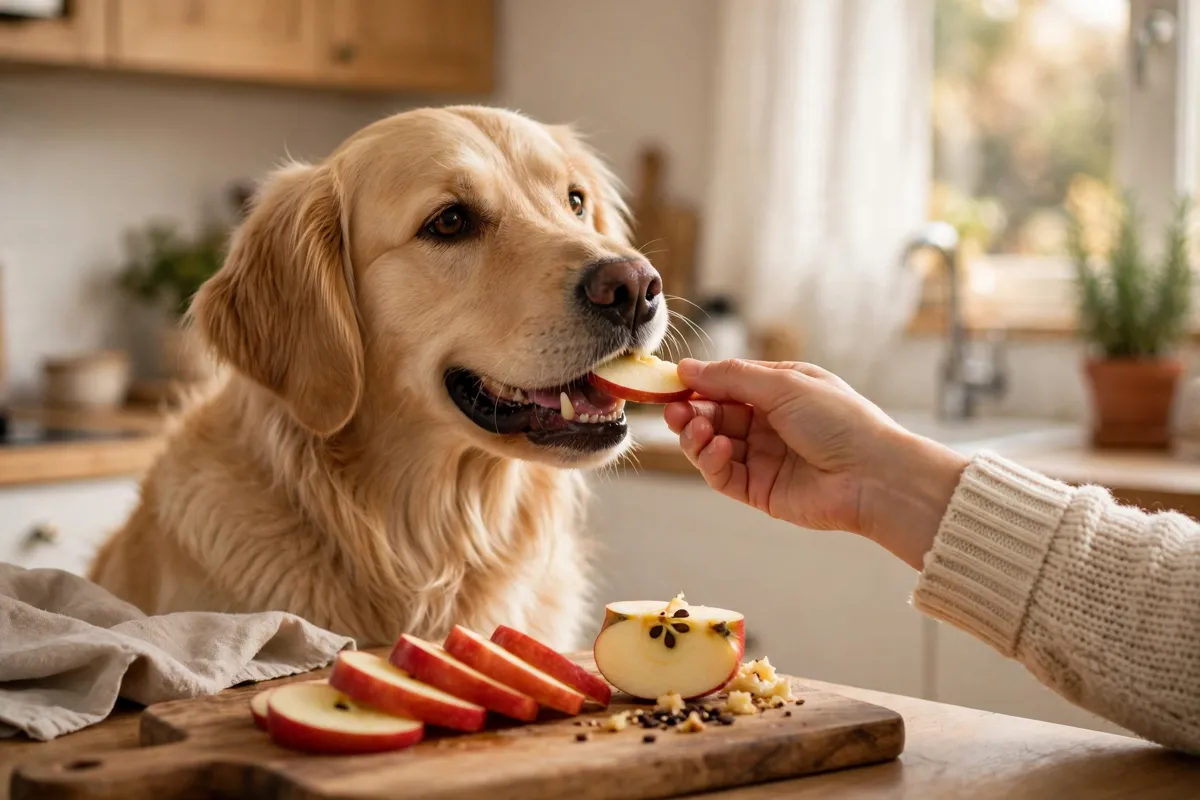

Your dog is watching you slice an apple. Ears up, eyes locked on your hand, tail doing that hopeful little thump against the floor. You want to share — but should you?
Yes, dogs can eat apples. Fresh slices are a safe, low-calorie treat for most dogs — the American Kennel Club lists apples among the fruits dogs can eat. But only the flesh is safe. The core, the stem and the seeds need to come out first, and the portion needs to stay small. Get those two things right and an apple is one of the easiest human foods to share with your dog.
The Short Answer: Yes, With Three Rules
If you remember nothing else from this guide, remember these three rules. They are the same rules every veterinary source agrees on, from the American Kennel Club to PetMD’s veterinary guide.
1. Remove the core, the stem and every seed. The flesh is the only part your dog should eat — the seeds hold a compound that can release cyanide, and the hard core can choke a dog or block its gut.
2. Serve small pieces. Cut the apple into thin slices or bite-size cubes, about 1 inch wide and a quarter inch thick. Dogs do not always chew properly, so a swallowed piece should be small enough not to cause trouble.
3. Keep it a treat, not a meal. Apples should stay within the 10% rule: all treats together should make up no more than 10% of your dog’s daily calories. The other 90% should come from a complete, balanced dog food.
That is the whole answer. The rest of this guide covers the questions that follow: how much is safe for your dog’s size, which apple foods are fine and which are not, and what to do when your dog grabs a whole apple off the counter.
Why Apples Can Be a Good Treat for Dogs
Apples are one of the few human snacks that are actually good for most dogs, not just harmless. A whole medium apple has about 95 calories and less than half a gram of fat, according to USDA FoodData Central. A couple of slices is a light reward, which makes apples a smart pick for a dog watching its weight.
Here is what a few slices give your dog:
Fiber, mostly in the skin. A medium apple carries about 4.4 grams of fiber, much of it in and just under the skin. It supports regular digestion and helps your dog feel full — but too much at once is exactly what causes gas and loose stools, which is why portions matter.
Vitamin C and antioxidants. Apples supply vitamin C and plant compounds such as quercetin, which support normal immune function — a bonus on top of regular food, not a reason to feed apples.
Vitamin A, water and crunch. Apples contain vitamin A, which supports vision, skin and coat health, and the fruit is roughly 85% water, so a few slices add a little hydration on a warm day. Gnawing a crisp slice can scrape away a little plaque from the teeth, but the effect is small and it is no substitute for brushing — the American Kennel Club says the same in its own guidance.
One honest note: your dog does not need apples. A balanced dog food already covers its nutrition. Apples are a nice extra — a healthy, cheap treat that most dogs genuinely enjoy — not a health food your dog is missing out on.
The Parts of an Apple Dogs Should Never Eat
When vets say apples are safe for dogs, they mean the flesh. Three parts of the apple are not safe, and they are unsafe for different reasons. Knowing which is which keeps you calm if your dog ever eats one of them by accident.
Apple seeds: the cyanide question, answered honestly
Apple seeds contain amygdalin, a compound that releases hydrogen cyanide when the seeds are chewed, crushed or digested. That sentence sounds alarming, and it is the reason every guide tells you to remove the seeds. But the dose matters, and most guides never give it to you.
Here is the honest scale. A single apple holds roughly 5 to 10 seeds, while a dangerous dose for a medium-size dog is estimated at many hundreds of thoroughly chewed seeds. The seed coat is tough, so a seed swallowed whole often passes through without releasing much cyanide at all. A stray seed or two is very unlikely to cause poisoning — but the real danger is repeated access: a dog that crunches through several cores, raids a bag of apples, or eats fallen fruit under a tree every day. Remove every seed, every time, and the risk drops to nothing.
If your dog does eat a large number of chewed seeds, watch for dilated pupils, heavy drooling, bright red gums, rapid or difficult breathing, weakness, staggering or collapse — these can start within 15 to 20 minutes and are a medical emergency. Call your vet, the ASPCA Animal Poison Control Center at (888) 426-4435, or the Pet Poison Helpline at (855) 764-7661 right away.
The core and stem: the bigger everyday risk
Vets see far more trouble from cores than from seeds. The core is tough and fibrous, and its shape is the problem: it can lodge in the throat and choke a dog, or get stuck further down and block the gut. Small dogs and puppies are most at risk. The stem is the same story on a smaller scale — hard, indigestible, easy to swallow whole. Cut the whole core out, not just the seeds, and throw the stem away with it.
The skin: safe, with one condition
Apple skin is safe for most dogs and holds much of the fruit’s fiber and antioxidants — no need to peel. Two caveats: wash the apple well first, since conventionally grown apples can carry pesticide residue and wax on the skin, and peel it for a small dog, a puppy, or a dog with a sensitive stomach, since the skin is tougher than the flesh.
How Many Apples Can Dogs Eat?
There is no single serving that fits every dog — it depends on size, weight, activity level and health. One thin slice, about one-eighth of a medium apple, is roughly 12 calories. That number sets the treat budget: a moderately active 50-pound dog needs roughly 700 to 900 calories a day, leaving about 70 to 90 calories for all treats combined. Four apple slices fit inside that budget — but only if apple is not stacked on top of biscuits, chews and table scraps the same day.
| Dog size | Weight | Apple per day | About |
|---|---|---|---|
| Toy breeds | Under 10 lbs | 1 to 2 thin slices, cut into small bites | 12 to 24 calories |
| Small dogs | 10 to 25 lbs | 2 to 3 thin slices | 24 to 36 calories |
| Medium dogs | 26 to 50 lbs | 3 to 4 slices (up to about half an apple) | 36 to 48 calories |
| Large dogs | 51 to 90 lbs | 4 to 6 slices (up to about three-quarters of an apple) | 48 to 72 calories |
| Giant breeds | Over 90 lbs | Up to about 1 small apple, cored | Up to about 95 calories |
PetMD’s veterinary guide gives a similar chart, with pieces about 1 inch wide and a quarter inch thick and the same 10% limit. The numbers above blend its serving sizes with USDA calorie figures, so you can see both the portion and what it costs your dog’s treat budget. A few slices several times a week, or a small daily serving, is fine for most healthy dogs. Too much fiber and sugar at once brings gas or loose stools, so spreading apple across the week is gentler than one big serving — and if your dog has diarrhea, skip apple until stools are normal, then restart with one slice.
How to Serve Apples to Your Dog, Step by Step
Preparing apples for your dog takes about a minute. The same care you put into prepping food at home applies here: wash, cut, check, serve.
Step 1: Wash the apple. Rinse it well under running water and give it a scrub. This removes dirt, bacteria and most pesticide residue from the skin. Skip soap and commercial produce washes, which can leave residues of their own.
Step 2: Cut out the core and stem. Quarter the apple and slice the core out of each quarter. Check the flesh around the core carefully — a seed or two can hide in small pockets. Pick out every seed you can see.
Step 3: Cut bite-size pieces. Slice the flesh into thin pieces or small cubes that suit your dog’s mouth. For a dog that gulps its food, cut thinner slices or dice the apple small.
Step 4: Peel it if your dog needs it gentler. Most dogs handle the skin fine. Peel the slices for a puppy, a small dog, a senior with sore teeth, or a dog with a sensitive stomach. Dogs without teeth often do best with grated or mashed apple instead of slices.
Step 5: Serve it plain. No caramel, sugar, butter, chocolate, spices or sweetened toppings. If you add peanut butter, check the label first: it must be xylitol-free, plain and unsalted. Peanut butter is calorie-dense and high in fat, so a thin smear is plenty.
First time? Follow the 24-hour test
If your dog has never had apple before, do not start with a full serving. Offer one small slice, then wait 24 hours and watch for loose stool, gas, vomiting or itching. If everything looks normal, work up to the amounts in the chart. Introduce only one new food at a time — if a loose stool appears, you want to know the cause, and if you changed three things at once, you will not.
Every Apple Form: Safe or Not
Most questions owners search are really about one specific form of apple. Here is every common form in one place.
| Apple form | Safe for dogs? | What to know |
|---|---|---|
| Fresh raw slices, skin on | Yes | Best choice: core, stem and seeds removed, washed, bite-size |
| Peeled raw apple | Yes | Gentler for puppies, small dogs and sensitive stomachs |
| Frozen apple slices | Yes | Cooling treat and enrichment; cut small for gulpers |
| Plain cooked or baked apple | Yes | Fine if nothing is added: no sugar, butter, cinnamon or nutmeg |
| Plain unsweetened applesauce | Yes, in small amounts | Read the label: no added sugar and no xylitol |
| Dried or dehydrated apple | Sometimes | Only unsweetened and sulfite-free, in much smaller amounts — drying concentrates sugar 4 to 5 times |
| Freeze-dried apple | Yes, in small amounts | Unsweetened, with no added fruit juice or sugar |
| Apple pie, crumble, caramel or candy apples | No | Sugar, fat, spices, and sometimes nutmeg or xylitol |
| Apple juice and cider | No | Concentrated sugar, fiber removed; hard cider contains alcohol |
| Crab apples and fallen fruit | Not recommended | Seeds, stems and moldy or fermenting fruit add risk |
| Whole apple or core | No | Choking and blockage risk, plus seeds that release cyanide |
One more question that comes up constantly: red or green? All common varieties are safe when prepared the same way — Granny Smith, Gala, Fuji, Honeycrisp, Red Delicious, Pink Lady and Golden Delicious. Green apples are more tart and slightly lower in sugar, a marginally better pick for diabetic or overweight dogs, though the difference is small. Let your dog’s taste decide.
Two forms deserve a closer look. Apple pie is the one people ask about most: the flesh itself is not the problem, it is everything around it. The added sugar and fatty crust are too much for a dog, and if the pie includes nutmeg, that spice carries a toxin called myristicin. In small doses it may cause mild stomach upset; in very large doses it can cause hallucinations, high blood pressure and seizures, according to the Pet Poison Helpline. Keep pie for the humans.
Xylitol deserves its own warning. The U.S. Food and Drug Administration warns that even small amounts of this sweetener can cause a dangerous drop in blood sugar and liver failure in dogs. It turns up in sugar-free applesauce, baked goods and “lite” products, so read the label on anything apple-flavoured before your dog gets a taste.
My Dog Ate a Whole Apple — What Now?
It happens fast: you turn away for a second and your dog has the whole apple, core and all. That is rarely an immediate emergency, but act promptly — there are two separate risks, cyanide from crushed seeds and choking or a blockage from the hard core and stem. Here is the playbook, in order.
1. Take the apple away. Remove what is left so your dog cannot keep eating the core and seeds.
2. Check for choking. Gagging, pawing at the mouth or struggling to breathe means a piece may be stuck. If your dog is choking, get to a vet right away.
3. Work out what was eaten. Flesh and skin alone is very different from a crunched core. Note your dog’s size and roughly how much core and seed material is gone — the first thing a vet will ask.
4. Do not make your dog vomit at home. Only induce vomiting if your veterinarian tells you to.
5. Watch for blockage signs for 24 to 72 hours. Repeated vomiting, straining without producing stool, a hard or painful belly, loss of appetite or lethargy are urgent. Most medium and large dogs pass one core within a day or two with nothing worse than a soft stool; toy breeds and puppies are most likely to have a core lodge.
6. Call your vet when in doubt. If your dog is small, ate several cores, or shows any symptom above, call your veterinarian or the ASPCA hotline. The call costs nothing; the wait can cost a lot.
Dogs Who Should Skip Apples
Most dogs can eat apples. A few groups need a vet’s sign-off first — or should skip apples entirely. If your dog is in one of them, ask your vet before offering a slice.
Dogs with diabetes
Apples contain natural sugar that can nudge blood glucose, so diabetic dogs should have only small amounts, if any, and only with your veterinarian’s approval — at a consistent time relative to meals and insulin, and ideally a tart green apple, which is slightly lower in sugar than a sweet red one.
Dogs with pancreatitis
Apples are low in fat — a whole medium apple has less than half a gram — so plain fresh apple is one of the few treats that fits a low-fat plan, and it beats cheese, meat scraps or peanut butter. But the rules are strict: wait until your dog has fully recovered from an episode and is back on its regular diet, never add new foods during a flare, ask your vet first, start with one thin peeled slice, and watch for vomiting, belly pain or loose stool over 24 hours. Keep it plain — no peanut butter, yogurt or pie, since added fat is what matters.
Dogs with kidney disease or on prescription diets
Dogs with kidney disease are often on carefully balanced diets, and any extra treat can throw that balance off — ask your vet before adding apples to a prescription diet.
Dogs that gulp their food
Apples may be a bad choice if your dog swallows food without chewing. Even bite-size pieces can choke a gulper, so thinner slices, diced pieces scattered through a slow-feeder bowl, or a different healthy snack may be safer.
Senior dogs and dogs without teeth
Hard slices are no fun for a dog with dental pain or no teeth — grated or mashed apple spread thin on a lick mat turns one slice into several minutes of licking.
Dogs with sensitive stomachs
Start with peeled slices — the skin holds much of the fiber, the part most likely to upset a sensitive stomach — and introduce apple slowly. Repeated vomiting, diarrhea, itching, facial swelling, weakness or coughing mean stop feeding apples. Trouble breathing, choking, collapse or severe weakness need immediate veterinary attention, not at-home monitoring.
Can Puppies Eat Apples?
Yes. Puppies can have a small taste of cored, seeded apple once they are reliably eating solid food, usually from about 8 to 12 weeks — a thin slice or two, cut into tiny pieces, is plenty. Cutting the fruit small matters more for puppies, since pups gulp and are more prone to choking, and peeling the slice makes it easier still. During teething, a frozen apple sliver tucked inside a puppy chew toy gives a pup something cold to work on. As with adults, treats stay within the 10% rule, with the rest of a growing puppy’s calories coming from a complete puppy food. Start with one piece and watch for a day or two before offering more.
Three Easy Apple Treats for Dogs
Plain slices are fine, but a little effort turns apple into a longer, more interesting treat. These three use nothing but dog-safe ingredients.
Frozen apple yogurt bark
Spread plain Greek yogurt on a parchment-lined plate, sprinkle finely diced apple and a few blueberries over the top, then freeze until firm and break into pieces. The yogurt must be plain and xylitol-free.
Apple and pumpkin Kong parfait
Layer small apple pieces and plain pumpkin puree inside a rubber chew toy, then freeze it for a few hours. It takes much longer to eat than a handful of slices. Use plain pumpkin puree, not pumpkin pie filling, which is sweetened and spiced.
Baked apple chips
The American Kennel Club’s own method: bake thinly sliced, cored apple slices at 200 degrees Fahrenheit for two hours until completely crispy. No sugar, no cinnamon, no oil. They keep well in a jar — but drying concentrates the sugar, so a few chips equal a whole slice or more.
Crab Apples and Fallen Fruit: The Seasonal Risk
Crab apple flesh is not toxic, but crab apples are small enough that dogs eat them whole — seeds, stems and all — and the ASPCA lists crab apple seeds, stems and leaves as toxic, like other apple trees. Fallen apples bring a second problem: rotting fruit can ferment and grow mold, which can upset the stomach or cause tremors. If you have apple or crab apple trees, pick up windfalls daily and keep your dog from grazing under them. A dog that snacks on fallen fruit every day gets exactly the repeated seed exposure that matters, plus whatever mold is growing on the fruit. This is the one apple risk that catches owners by surprise, because nobody served the dog anything. The tree did.
The Bottom Line
Yes, dogs can eat apples — and for most dogs, a few fresh slices are one of the healthiest treats you can offer. Wash the apple, cut out the core and stem, pick out every seed, and keep the serving small. That is the whole job. If you are travelling with your dog by train or heading out for the day, a few slices in a small container make an easy snack on the road — just pack them plain, the same way you would serve them at home.
Every dog is different, and this guide is general information, not veterinary advice. If your dog has diabetes, pancreatitis, kidney disease, a sensitive stomach or any condition that needs a managed diet, talk to your vet before offering apples — or any new food. A thirty-second question at your next visit settles it for your dog specifically.
Can dogs eat apple seeds?
No. Apple seeds contain amygdalin, which releases cyanide when the seeds are chewed. A stray seed or two swallowed whole is very unlikely to harm a dog, but always remove every seed before serving — a large amount of thoroughly chewed seeds can be dangerous, and there is no reason to leave them in.
Can dogs eat apple cores?
No. The core is tough and fibrous and can choke a dog or block its gut, especially in small dogs and puppies. If your dog swallows a whole core, watch for vomiting, straining or a painful belly for 24 to 72 hours and call your vet if any appear.
Can puppies eat apples?
Yes, once they are reliably eating solid food, usually from about 8 to 12 weeks. Offer one or two tiny peeled pieces, cut small, and watch for a day or two before offering more.
Can dogs eat green apples?
Yes. Green apples, including Granny Smith, are as safe as red varieties when prepared the same way — core, stem and seeds removed. They are more tart and slightly lower in sugar, but the safety rules do not change.
Can dogs eat applesauce?
Plain, unsweetened applesauce is fine in small amounts. Always read the label: many store-bought versions add sugar, and sugar-free versions may contain xylitol, which is toxic to dogs.
