
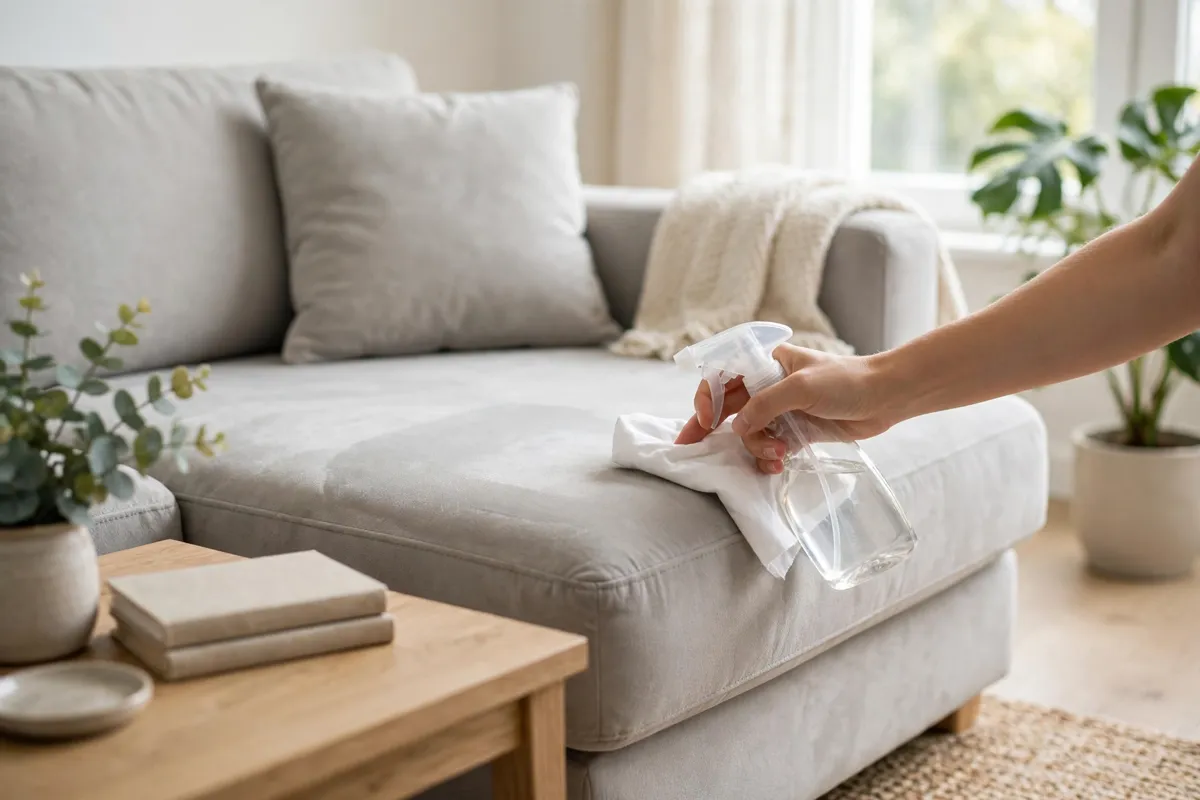

A microfiber couch looks almost indestructible. It shrugs off spills that would ruin a cotton sofa, survives kids, dogs, and red wine, and still looks decent years later. Then one day you clean it — and make it worse. A faint ring appears where the water dried, the cushion goes stiff, and a spot you tried to lift turns into a darker patch that will not go away.
Almost every time, the same mistake is behind it — the wrong liquid for that couch. Every couch carries a code on its tag, and that code decides what may touch it. Get the code right and the job is easy; get it wrong and plain water can leave a permanent mark. Here is how to clean a microfiber couch by its code — the method, the stains people actually get, and whether you can steam it or wash the covers.
What microfiber actually is
Microfiber is a fabric woven from ultra-fine synthetic fibres, usually polyester, nylon, or a blend. Each fibre is far finer than a human hair, which is why the fabric feels soft and suede-like while resisting wear. Spills sit on the surface instead of soaking straight in, so microfiber resists stains better than cotton or linen — but the fibres lie in a direction, the nap, and show every change in it. A damp patch dries at a different speed from the fabric around it, so the nap lies differently and light bounces off it differently. What you see as a “water stain” is often just fibres lying the wrong way, or minerals left as the water evaporated.
Step 1: find your cleaning code
Before any liquid touches the couch, find the tag — usually under a seat cushion, along the frame, or on the underside of the sofa. It carries one of four codes, and the whole job hangs on it.
| Code | What it means | What you can use |
|---|---|---|
| W | Water-based cleaners only | Mild detergent foam or a water-based upholstery cleaner |
| S | Solvent only, no water | A mild water-free solvent or dry-cleaning product |
| W/S (or S-W) | Either is safe | Water-based foam or a mild solvent — start with the gentler one |
| X | Vacuum only | No liquid cleaner of any kind — brush and vacuum only |
The code is a fabric-industry convention, printed by whoever wove the cloth. On an S-coded couch, even plain water can leave rings. On an X-coded couch, every home remedy is off the table, and a stain means calling a professional.
What if there is no tag?
Tags go missing — cut off during delivery, faded, or hidden somewhere you cannot find. Do not guess. Look the couch up first — the manufacturer’s site or the retailer usually lists the care code for the model. If that fails, treat the fabric as S-coded, the stricter rule, and patch test before anything else. Put a few drops of cleaner on a hidden spot, press a white cloth against it, and let it dry fully. If colour shows on the cloth, or the fabric changes, stop. If a W-coded couch has ringed on you before, treat it as S-coded — some W fabrics ring anyway, because the ring is an optical effect of the nap.
What you will need
- A vacuum with an upholstery attachment
- Clean white cloths, so you can see at once if dye is transferring
- A soft-bristle brush for the finish, a spray bottle, and a fan to speed drying
- A cleaner that matches your code: mild dish soap and distilled water for W, a water-free solvent for S
- Baking soda, for odours
Use distilled water for every rinse and mix — tap water leaves mineral deposits that show as pale rings on darker microfiber.
The method, step by step
1. Vacuum and brush first
Take the cushions off and vacuum the whole couch — seats, backs, arms, seams, and the space under the cushions. Loose dirt turns into sandpaper the moment you start rubbing, so get it out first. Then brush the nap lightly, going with the grain. Blot up any wet spill with a towel first.
2. Patch test in a hidden spot
Even with the right code, test first: put a little cleaner on a spot nobody sees, press a white cloth to it, and let it dry completely. If the cloth picks up colour, do not use that cleaner on the visible parts.
3. Clean by your code
For a W or W/S couch: mix a few drops of clear, dye-free dish soap into a cup of distilled water — less soap than you think. Too much soap is a common reason microfiber looks blotchy afterwards, because the residue attracts dirt. Lightly mist the stain or work the foam on with a soft brush. Blot from the outer edge inward, then rinse by dabbing with a cloth dampened with clean water. This Old House’s step-by-step guide covers the same water-based routine, with the same warning to keep the cloth barely damp.
For an S couch: apply solvent to a white cloth, never poured straight onto the sofa. Blot and gently rub in small circles from the outside in, turning the cloth to a clean section as it picks up grime. Work in sections — solvents evaporate fast — and keep the room ventilated, solvents away from flames and heat.
For an X couch: stop at the vacuum and brush. No liquid, no foam, no spray. A stain here is a professional’s job.
4. Dry it completely — and quickly
This is the step most people rush, and it causes most rings. Ethan Allen’s care guidance allows at least six hours for a spot-cleaned area to dry; Rug Doctor’s microfiber guide suggests four to six hours after machine cleaning. Run a fan, open the windows, and stand loose cushions on their edge. Do not sit on the couch until it is fully dry, and never use a hair dryer on hot — cool air only.
5. Brush the nap back
Once the fabric is completely dry, it may feel stiff or look matted — the fibres got tangled while wet. Brush gently with a soft-bristle brush or a fine-tooth comb, in one direction, to lift the nap back. Go easy: a wire brush or aggressive scrubbing can damage delicate fibres.

Stain by stain: what works for each one
| Stain | W or W/S couch | S couch |
|---|---|---|
| Grease and body oil (armrests, headrests) | Blot, then mist a few drops of dish soap in a cup of water and blot, repeating until it lifts | Rubbing alcohol or a water-free solvent on a white cloth, blotted in small circles |
| Water ring | Re-dampen the whole ring area with a mild soap solution, feather outward, rinse, dry fast with a fan | Lightly mist rubbing alcohol on a cloth and work over the whole ring, feathering out past the edge |
| Coffee, juice, food | Blot fast, then the mild soap solution and a clean-water rinse | Solvent on a cloth, blotting from the edge inward |
| Pet urine | Blot up what you can, then an upholstery-safe enzyme cleaner, following the label | Enzyme cleaner only if the label allows it on solvent-only fabric — otherwise call a pro |
| Ink or dye transfer (new jeans) | Patch test first, work gently — dye spreads easily | Patch test first; if the mark is large or bright, call a pro rather than scrubbing it deeper |
| General odour | Sprinkle baking soda, leave 15 minutes or overnight, vacuum thoroughly | Same baking soda routine — it needs no liquid at all |
For fresh grease, sprinkle cornstarch over the spot for 30 to 60 minutes to pull the oil up, then vacuum and clean what is left. For stuck-on food or gum, press a zip-lock bag of ice cubes on it until it hardens, lift it off, and treat the stain underneath.
Water rings: why they happen and how to fix them
A water ring is the complaint that brings most people to this search, and it is the one most guides explain worst. Microfiber dries unevenly: the edge of a wet patch dries last, leaving a visible boundary — minerals from the water, plus fibres lying in a different direction. The fix sounds backwards: even the patch out. On a W or W/S couch, dampen the whole ring area with a very mild solution — one or two drops of clear dish soap in two cups of distilled water — feathering outward past the ring so there is no hard border. Follow with a cloth dampened with distilled water only, to remove the soap. Blot dry, aim a fan at it, and brush the nap once dry. On an S couch, use rubbing alcohol on a cloth instead of water.
Prevention is simpler: dry fast with a fan, never let a damp patch air-dry slowly, and use distilled water for every rinse. If a shadow remains, repeat a light, broader pass rather than concentrating more product on the same small spot — that is how the hard edge forms.
The rubbing alcohol warning nobody mentions
Almost every guide tells you to clean an S-coded couch with rubbing alcohol. Good advice, with a catch none of them print: the rubbing alcohol you buy is usually 70 percent isopropyl alcohol — which means it is 30 percent water. It is not fully water-free. The furniture makers do not actually recommend it: Bassett and Ethan Allen specify a mild, water-free solvent or a dry-cleaning product for S-coded fabric. That does not mean rubbing alcohol never works — it often works fine — but treat it as a choice to test, not a default. This manufacturer-sourced guide lays out the same caveat in full, with the Bassett and Ethan Allen wording behind it. Ask the maker if you can, patch test, use a small amount, and ventilate the room.
Can you steam clean a microfiber couch?
Sometimes — and the tag decides. If the tag reads W or W/S, steam cleaning is possible: vacuum first, test the steam on a hidden spot, then work in slow, overlapping passes on a low or medium setting with a cotton-covered tool. If the tag reads S or X, do not steam it. Steam is water, and water is exactly what those codes forbid. Even on a W/S couch, check with the manufacturer first — Bassett does not recommend hot-water extraction or steam on its W/S fabrics at all. If you use a portable spray-and-extract machine on a W-coded couch, follow Rug Doctor’s rule: make at least one or two dry passes, without pressing the solution button, between each wet pass, and never over-wet the fabric. The suction pulls the water back out before it can soak into the padding.
Removable covers and the washing machine
Some microfiber cushions have zippered covers. Can they go in the wash? Only if the cover has its own care tag that says so. Bassett advises against taking zippered covers off for separate cleaning unless the cover carries its own care instructions. If the cover’s tag does allow machine washing, use a cold, gentle cycle with mild detergent, and hang it to dry — never tumble dry on heat, which can shrink the cover or set the fibres stiff. With no tag on the cover itself, clean it in place using the method for your couch’s code.
Mistakes that ruin a microfiber couch
Most ruined microfiber is not ruined by the stain. It is ruined by the cleaning.
- Soaking the fabric — saturating the cushion can damage the backing and padding underneath.
- Scrubbing instead of blotting — rubbing spreads the stain and can permanently distort the fibres.
- Bleach or strong whitening sprays — they can discolour and weaken the fibres.
- Acetone, nail polish remover, or paint thinner — they can melt synthetic fibres or strip colour.
- Coloured cloths or sponges — dye transfers to the fabric. White cloths only.
- Heat — hot hair dryers and steam on the wrong code flatten the nap and can set rings.
- Mixing ammonia and bleach — never. The combination releases toxic vapours.
How often should you clean a microfiber couch?
Microfiber rewards small, regular resets more than occasional deep cleans. Vacuum weekly with the upholstery attachment, brush the nap monthly, and wipe the armrests and headrests before they look shiny — that is where body oil builds up first. Rug Doctor suggests a thorough deep clean once or twice a year, more often with pets or kids. After a deep clean, you can spray on a fabric protector made for microfiber, once the fabric is fully dry. Reapply after every deep clean, and check the label matches your couch’s code first. And if you are decluttering your living room, cleaning the couch is the highest-impact step — it is the biggest surface you sit on every day.
When to call a professional
Some jobs belong to a pro: your tag says X and there is a stain; the stain has soaked through to the foam, or the smell is coming from inside the cushion; or the stain is dye transfer, ink, or an unknown chemical, and it is large. A musty smell that keeps coming back deserves special attention — it usually means the padding stayed wet long after the surface felt dry, and covering the smell does not remove the source. A certified cleaner, or a mould remediation specialist if it is damp inside, is the right call. If you have tried twice and the fabric now looks stressed, rough, or faded, stop and hand it over. Ask whether the cleaner has experience with microfiber and uses low-moisture methods.
The short version: read the tag, use the liquid it allows, use less of it than you think, dry it fast, and brush it back. Do that, and the couch will keep the soft, even look that made you buy it — even after the kids, the dog, and the Thanksgiving dinner left their marks on it.
Can I use water on a microfiber couch?
Only if the tag says W or W/S. On S or X fabrics, water can leave rings or damage the fabric, because the material is not colourfast to water. Check the tag under the cushions first.
Can I clean a microfiber couch with rubbing alcohol?
Many guides suggest it for S-coded fabric, but the furniture makers only specify a mild, water-free solvent. Rubbing alcohol is usually 70 percent isopropyl — 30 percent water — so ask the maker, use a small amount, ventilate the room, and test a hidden spot first.
How do I get water stains out of a microfiber couch?
On a W or W/S fabric, dampen the whole ring area with a very mild soap solution, feather outward past the ring, rinse with distilled water, and dry it fast with a fan. On an S couch, use rubbing alcohol on a cloth instead. Once dry, brush the nap.
How long does a microfiber couch take to dry?
Ethan Allen allows at least six hours for a spot-cleaned area, and Rug Doctor suggests four to six hours after machine cleaning. A fan, open windows, and cushions stood on their edge help. Do not sit on it until it is completely dry.
Can I steam clean a microfiber couch?
Only if the tag allows water and the furniture maker agrees. Bassett does not recommend hot-water extraction or steam on its W/S fabrics, and S and X fabrics should not get water at all. When in doubt, ask the manufacturer or an IICRC-certified cleaner.
