
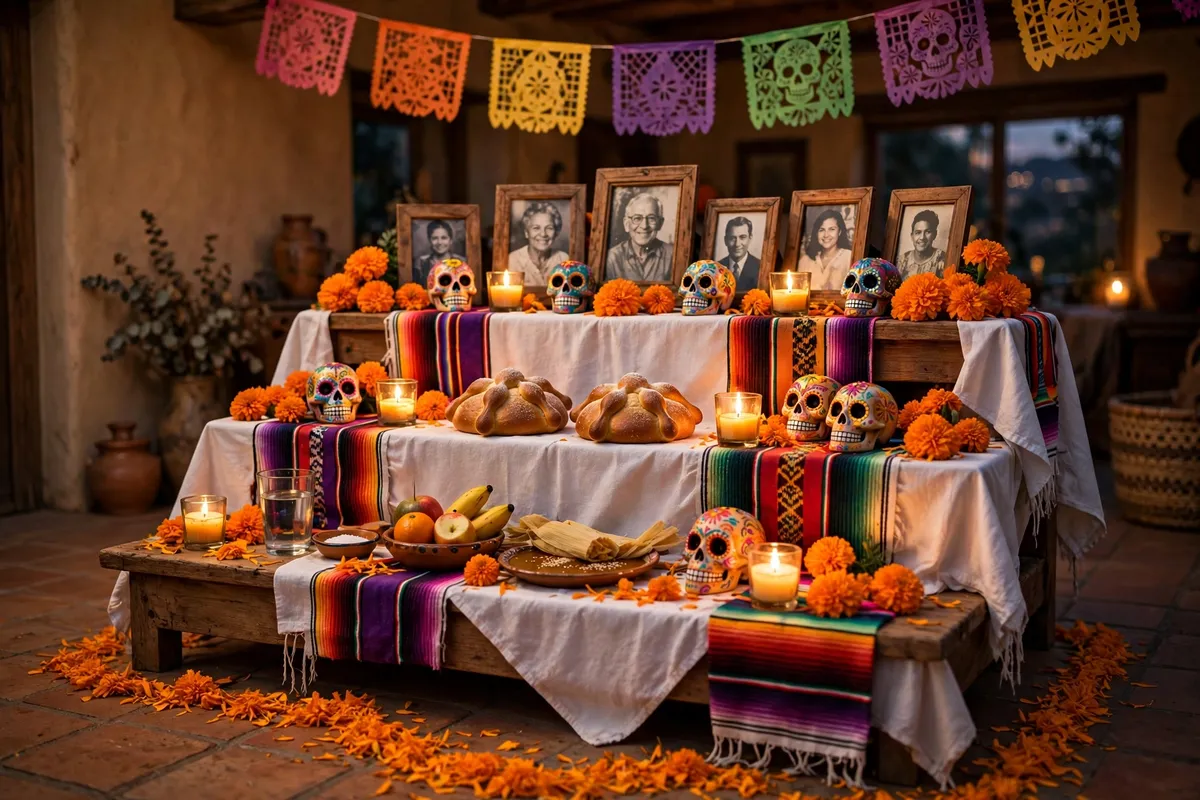

If you have ever seen a photo of a Day of the Dead altar — candles glowing, orange marigolds everywhere, framed photographs on the top shelf — you have seen an ofrenda. It is one of the most recognisable sights in Mexican culture, and one of the most misunderstood outside it. It is not a shrine to death. It is a welcome home.
An ofrenda is the altar a family builds to receive the souls of people they have lost, for one night a year. Every object on it has a job: to guide the dead back, feed them, refresh them, and remind the living who they were. This guide explains what an ofrenda is, what goes on it and why, how the levels work, and how to build one yourself.
What Is an Ofrenda, Exactly?
The word itself is simple. Ofrenda is Spanish for “offering”. The altar is the offering — the food, the flowers, the candles, the photographs — laid out for the dead. Mexicans also call it an altar de muertos, an altar of the dead. The two names mean the same thing in everyday speech: ofrenda stresses what is offered, altar stresses the structure it sits on.
The ofrenda belongs to Día de Muertos, the Day of the Dead, celebrated on November 1 and 2. The belief behind it is that on those nights the souls of the dead return to the world of the living for a visit. The family builds the altar so the returning soul can find the house, recognise who is waiting, eat, drink, rest, and feel at home. As Britannica puts it, the ofrenda is a decorated altar set up in homes that “honors and welcomes the deceased with photos, candles, flowers, food, and other decorations”.
That welcome is the whole point. The ofrenda is not about fear or mourning. Families talk, laugh, cook the dead person’s favourite dishes, and tell stories while they build it. The tone is closer to a reunion dinner than a funeral.
When Do You Build an Ofrenda?
Ofrendas are usually set up by October 31 and taken down after the holiday ends on November 2, though families vary and some keep theirs up a few days longer. The two days of the holiday are not the same, and that is a detail many short guides leave out.
November 1 is for children. It is called Día de los Inocentes (Day of the Innocents) or Día de los Angelitos (Day of the Little Angels), and it honours infants and children who have died. Their ofrendas are lighter: sweets, toys, small white candles, no alcohol.
November 2 is for adults. This is Día de los Muertos itself, the day for deceased grown-ups. The altar changes accordingly — heartier food, the person’s favourite drink, sometimes a bottle of tequila or mezcal for an adult who enjoyed it in life.
Some families build one altar and adjust it across the two nights. Others build two. Either way, the rhythm is the same: build before the souls arrive, keep the candles lit while they are here, and clear the altar once they have gone.
The Levels of an Ofrenda
An ofrenda can be a single flat table, but most are built in steps or levels, and the number of levels means something. The three common forms are two, three, and seven — and here is something worth knowing upfront: sources disagree on exactly what each level of a seven-level altar stands for. The readings below are the most widely repeated ones, and families and regions interpret them differently. That variation is part of the tradition, not a mistake in it.
Two levels: heaven and earth
The simplest traditional form. The upper level holds the photograph of the person being honoured, along with any religious images. The lower level holds the offerings — the food and drink, the material welcome. If you are building your first ofrenda, two levels is a completely valid and beautiful choice.
Three levels: heaven, earth, and the underworld
The most common home version. The three levels are often read as heaven, earth, and the underworld — or, in Catholic terms, heaven, purgatory, and earth. The top level holds the photo and saints, the middle holds the food and drink, and the bottom holds salt, water, and the things for purification and refreshment.
Seven levels: the soul’s journey
The full, most elaborate form, usually seen in churches, schools, and public squares rather than homes. The seven steps are read as the seven stages a soul must cross to reach its rest — some Catholic interpretations link them instead to the seven deadly sins. One widely repeated reading assigns each level a theme: the saint at the top, then the souls in purgatory, then salt for purification, then pan de muerto, then the favourite foods, then the photographs, and finally a cross at the base. Other families order them differently, and the local reading is the one that counts.
What Goes on an Ofrenda? Every Item and What It Means
Every object on an ofrenda does a job. Here is what you will find on most of them, and why each thing is there.
The photograph
The single most important item. A framed photo of the person being honoured sits at the top, in the place of honour. It does two things: it tells the returning soul this altar is theirs, and it tells the living exactly who they are remembering. Some families cover the face of anyone still alive who appears in a group photo. In recent years, it has also become common to include photographs of pets.
Marigolds (cempasúchil)
The bright orange flower is the signature of the ofrenda. Its Nahuatl name, cempohualxochitl, means “twenty flowers”, and it is also called flor de muerto, the flower of the dead. The strong scent and vivid colour are believed to guide souls to the altar — families scatter the petals in a path from the door to the ofrenda so the dead can follow it home. Botanically it is the Mexican marigold, Tagetes erecta. No other flower substitutes for it.
Candles
One candle for each soul being remembered is the usual rule, and their light is said to guide the dead to the altar and light the path home. Some families set the candles in the shape of a cross to mark the four cardinal directions. White candles are common, and children’s ofrendas use smaller ones. Keep them in sturdy holders and never leave them burning unattended — a real safety note, not a symbolic one.
Water and salt
A glass of fresh water is placed on the altar to quench the thirst of a soul after a long journey. It also stands for purification. Salt is placed nearby, sometimes in the shape of a small cross, for the same reason: it purifies the spirit and is said to keep the soul from being corrupted on its way back and forth. A washbasin, mirror, soap, and towel sometimes appear on the lowest level so the returning soul can refresh itself on arrival.
Pan de muerto
The bread of the dead is baked only for this holiday. It is a sweet bread flavoured with anise and orange, round like a skull, with dough strips on top shaped like bones and a small knob for the skull. It is placed on the altar as food for the journey — and it is also eaten by the living, which is part of the celebration.
Sugar skulls (calaveras de azúcar)
Skulls made of sugar, brightly decorated, sometimes with the name of the person who died written on the forehead. They are a reminder of death and, at the same time, of the sweetness of life. Children often receive sugar skulls with their own names on them as gifts during the holiday.
Papel picado and copal incense
Two items that work as a pair. Papel picado — tissue paper cut into banners with skeleton figures and patterns — represents the wind, because air passes through its cut-outs. Copal incense, resin from the copal tree, is burned so its rising smoke carries prayers upward and cleanses the space. Together with food (earth), water, and candles (fire), they complete the four elements on the altar.
Favourite food and drink
This is where the ofrenda gets personal. Families cook the dishes the person loved in life: mole, rice, tamales, pumpkin, seasonal fruit — oranges and apples are common for their scent — and the person’s favourite drink. For an adult, that might be tequila, mezcal, or atole; for a child, a favourite soda or chocolate milk. The point is not a set menu. It is that the food is theirs.
Personal items
A favourite book, a piece of clothing, a tool from a trade, a toy for a child. These are not mandatory, but they are what makes an ofrenda unmistakably about one person rather than about the dead in general. If you visit a family’s ofrenda, these are the objects to look at longest — they are the biography.
The Four Elements on One Small Table
One elegant idea ties the whole altar together. The ofrenda carries the four classical elements, each represented by something on it. The Smithsonian’s National Museum of the American Latino describes the same arrangement, and it is the quickest way to check whether an ofrenda is complete:
| Element | What represents it | What it does |
|---|---|---|
| Earth | Food, especially pan de muerto | Feeds the returning soul |
| Water | A glass of water | Quenches thirst; purifies |
| Fire | Candles | Lights the way home |
| Air (wind) | Papel picado | Carries the wind through its cut-outs |
If you remember nothing else about an ofrenda, remember this table. Any altar with food, water, a flame, and paper banners has the four elements covered.
Ofrendas for Children Are Different
A child’s ofrenda is its own thing, not a smaller copy of an adult’s. The differences are practical and tender at once. Toys replace the bottle of tequila. Sweets and the child’s favourite snacks replace the mole and the heavy dishes. The candles are smaller, often white, and the flowers are sometimes white too. The tone is gentler: the altar is meant to welcome a little soul who died young, and the family builds it with the child’s tastes in mind — a favourite toy car, a doll, a small stuffed animal.
In Pátzcuaro, in Michoacán, the custom is especially distinct: on November 1 of the year after a child’s death, the godparents set a table in the parents’ home with sweets, fruits, pan de muerto, a cross, and a rosary.
How to Build an Ofrenda Step by Step
You do not need to be Mexican, and you do not need to be an expert, to build a respectful ofrenda for someone you have lost. You do need to build it with care and to understand what you are doing. Here is a simple order that works for a first altar.
Step 1: Choose a spot and a surface
Pick a stable table, shelf, or dresser in a room where the altar can stay undisturbed for two days. Choose somewhere the candles can burn safely — away from curtains and paper banners — and where the family will actually gather around it.
Step 2: Build the levels
Use sturdy boxes or stacked books under a cloth to make two or three levels. Cover everything with a clean cloth — white linen is traditional, and in Mexico the top is often draped with a serape, a long colourful woollen shawl. The cloth marks the space as set apart.
Step 3: Place the photograph on top
Put the framed photo of the person you are honouring on the highest level, with any religious image your family uses beside it. This is the anchor of the whole altar. Everything else is arranged around it.
Step 4: Add water, salt, and candles
Set a glass of fresh water and a small dish of salt on the altar, and one candle per person being remembered. If you are using real candles, place them in glass holders and keep them away from the papel picado.
Step 5: Lay the marigold path
Scatter marigold petals from the door or entrance of the room to the altar, and arrange fresh marigolds around the photo. If fresh cempasúchil is not available where you live, use the brightest orange marigolds you can find — the colour and scent are what matter.
Step 6: Set out the food and personal items
Finish with pan de muerto, the person’s favourite dishes and drink, a sugar skull or two, and one or two personal objects. Hang papel picado above or around the altar, light the copal if you have it, and light the candles on the evening of October 31 or November 1.
Then spend time with it. An ofrenda is not a decoration you finish and walk away from. Sit with it, tell a story about the person, eat the pan de muerto. That is the ritual working as intended.
What Happens to the Food After November 2?
This is one of the questions people ask most, and it has a simple answer: the family eats it. Once the holiday ends and the altar is taken down, the food is shared among the living — the pan de muerto, the fruit, the dishes that were cooked. Nothing is wasted.
There is a belief behind the sharing. Many families say the dead do not eat the food itself but take its essence, its flavour and its warmth, leaving the physical food behind for the living. The offering ends as a shared table — the same instinct behind any big family meal, which is why our Thanksgiving dinner planning guide starts with getting everyone around one table.
Ofrendas Look Different Around Mexico
There is no single national template, and the regional differences are one of the best parts of the tradition. A few examples show how local an ofrenda can be:
- Oaxaca: ofrendas are often decorated with alebrijes, the brightly painted papier-mâché creatures that bring colour and life to the altar.
- Michoacán: sugar skulls and papel picado feature heavily, and the lakeside town of Pátzcuaro is famous for its all-night vigils beside the graves.
- Veracruz: on the coast, seashells, fish, and seaweed are added to represent the sea in the lives of local communities. Veracruz also holds the Guinness World Record for the largest Day of the Dead ofrenda.
- Mexico City: alongside home altars, the city builds grand public ofrendas in its squares and museums, some of them several storeys tall.
That variety is the point. An ofrenda in a small village and an ofrenda in a Mexico City museum are both real ofrendas. What they share is the structure — photo, light, flowers, water, food — not a fixed shopping list.
Visiting an Ofrenda: A Few Respectful Rules
If you are invited to see a family’s ofrenda, or you come across one in a public place, a little etiquette goes a long way.
- Ask before photographing a family ofrenda. A public ofrenda in a square is made to be seen. A family’s altar in their living room is personal. Always ask first.
- Do not touch the objects. The food, the photos, and the personal items belong to a specific person and a specific family. Look, do not handle.
- Do not treat it as Halloween decoration. Day of the Dead falls right after Halloween — October 31 to November 2 — but it is a separate tradition with its own meaning. It is a reunion, not a haunted house. If you want the Halloween side of the season, our guide to Halloween costume trends covers that instead.
- Be quiet around it. Families pray, talk to the dead, and remember. A low voice and a moment of stillness cost nothing.
- If you are offered food from the altar, accept it. Sharing the food after the holiday is part of the tradition, and refusing can feel like refusing the welcome.
Where the Tradition Comes From
The Day of the Dead blends pre-Hispanic ritual with Roman Catholic influence. Indigenous peoples of Mexico honoured their dead long before the Spanish arrived, and the Spanish brought All Saints’ Day (November 1) and All Souls’ Day (November 2), which gave the celebration its dates. How much of the modern holiday comes from each side is genuinely debated — some scholars trace a strong Aztec line, others see it mainly as a local expression of the Catholic Allhallowtide season. The honest version is that it is a fusion, and the ofrenda shows it: copal, food, and marigolds from Indigenous practice; candles, saints, and crosses from Europe.
In 2008, UNESCO inscribed the Day of the Dead on its Representative List of the Intangible Cultural Heritage of Humanity, recognising it as practised by the Indigenous communities of Mexico. It is a tradition that has survived conquest, migration, and commercialisation — and it is still built, one family table at a time, every November.
That is what an ofrenda is: a table, a photo, some flowers, a lit candle, and a meal for someone who is gone but not forgotten. If you build one, build it slowly, build it for a named person, and build it with the food they actually loved. The dead, the tradition says, will know the difference.
What is an ofrenda?
An ofrenda is a decorated altar that families build in their homes for Día de Muertos, the Day of the Dead, on November 1 and 2. The word means “offering” in Spanish. The altar welcomes the souls of deceased loved ones back for a visit, with photographs, candles, marigold flowers, food, and water laid out for them.
When is an ofrenda built and taken down?
Ofrendas are usually set up by October 31 and taken down after the holiday ends on November 2, though families vary. November 1 honours children who have died (Día de los Angelitos), and November 2 honours deceased adults.
How many levels does an ofrenda have?
Most home ofrendas have two or three levels. Two levels stand for heaven and earth; three add the underworld. The full traditional form has seven levels, read as the seven stages a soul must cross to reach its rest — though families and regions interpret the seven levels differently.
What do you put on an ofrenda?
The essentials are a photograph of the person being honoured, marigolds (cempasúchil), candles, a glass of water, salt, pan de muerto bread, papel picado, copal incense, sugar skulls, the person’s favourite food and drink, and a personal item that belonged to them.
Is an ofrenda the same as Halloween?
No. Day of the Dead falls right after Halloween, on November 1 and 2, but it is a separate Mexican tradition. Halloween is about the spooky and the playful; an ofrenda is a reunion — a family welcoming back the people they have lost, with food, flowers, and light.
