
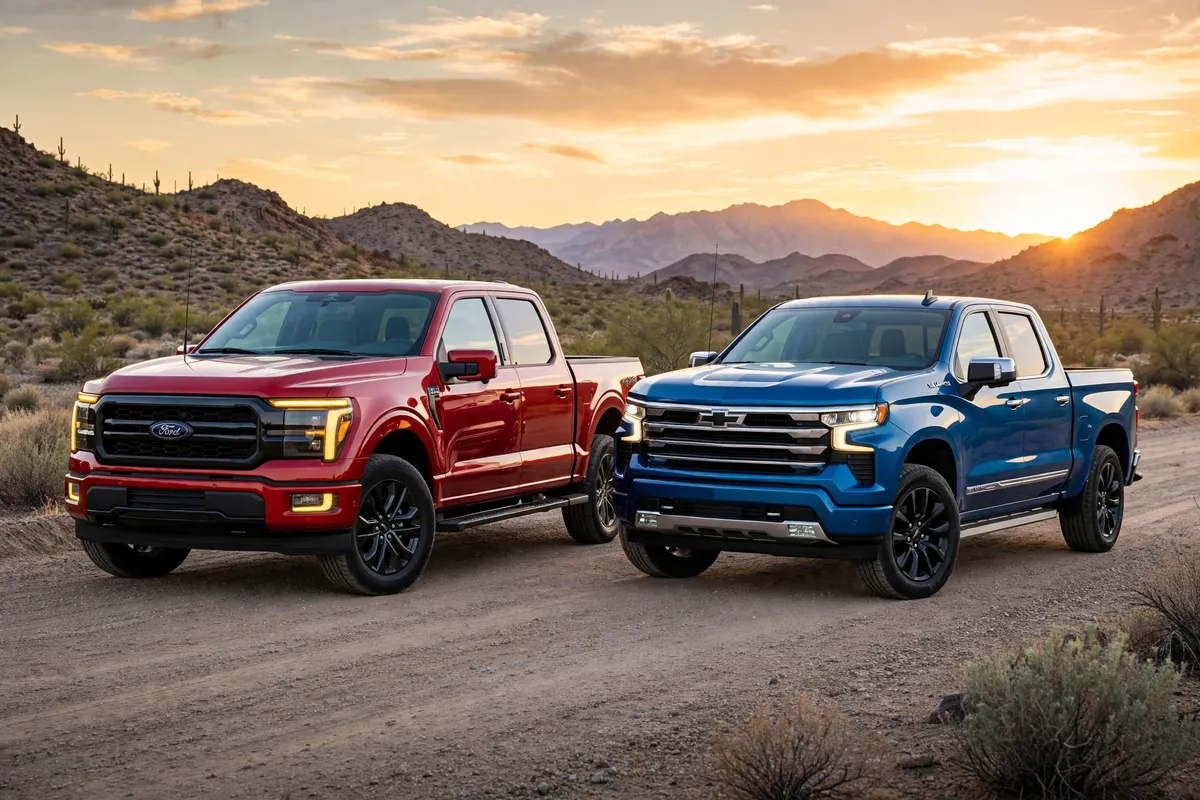

Ask ten Americans which is better, Chevy or Ford, and you will get ten different answers — and at least one story about a truck that ran for 300,000 miles. The rivalry is older than the interstate highway system, and it is still the argument that fills truck forums, dealership lots and family barbecues. But most of the articles ranking for “chevy vs ford” right now are not much help. The top result still talks about 2019 safety ratings and cars like the Spark, Sonic and Fiesta — all discontinued years ago. Others give you a verdict with no numbers behind it, or a spec sheet with no idea what the numbers mean for a real buyer.
This guide does it differently. Every figure below is a 2025 or 2026 number, checked against the makers’ own figures, dealer comparisons that cite them, J.D. Power’s published studies and Ford’s own sales release. Trucks, SUVs, electric trucks, sports cars, reliability, resale and the honest sales story — then a verdict by buyer type, because there is no single winner here. The right answer depends on what you drive, tow and pay for.
The rivalry in short
Ford came first. Henry Ford founded the Ford Motor Company in Dearborn, Michigan, in 1903. Chevrolet followed in Detroit in 1911, and it is now General Motors’ biggest brand by sales. Ford launched the F-Series in 1948; Chevrolet built its first pickup in 1918. A century later, the two brands still build their identities around the same things: full-size trucks, big SUVs and the idea that an American vehicle should work hard and last.
The scale is enormous. Ford’s F-Series has been America’s best-selling truck line for 49 straight years, and General Motors sells more vehicles overall in the United States than Ford does. The full sales story — including the footnote most comparison pages skip — is in the sales section below.
Trucks: F-150 vs Silverado 1500
For most buyers, the Chevy vs Ford question is really one question: F-150 or Silverado 1500? These are the two best-selling vehicles in the country, and they are closer than the shouting suggests. Here are the 2026 numbers, each maker’s own published figures as checked in a 2026 comparison of the two trucks in September 2026.
The head-to-head numbers
| 2026 model | Ford F-150 | Chevrolet Silverado 1500 |
|---|---|---|
| Starting price (before destination) | About $39,585 (XL) | About $36,900 (Work Truck) |
| Maximum towing | 13,500 lb | 13,300 lb |
| Maximum payload | 2,440 lb | 2,260 lb |
| Engine choices | Four gas + one hybrid | Three gas + one diesel |
| Best highway fuel economy | 23 mpg combined (PowerBoost hybrid) | Up to 28 mpg highway (Duramax diesel) |
| Maximum bed volume | About 77.4 cu ft | Up to 89.1 cu ft |
Prices exclude the $2,795 destination charge at both makers, and they move during the model year — the F-150’s starting price was quoted anywhere from about $37,000 to about $40,000 across 2026, so treat any single figure as a snapshot, not a promise. Maximum towing and payload apply to one specific configuration each, not to every truck on the lot.
Engines: turbo V6s against old-school V8s
The two brands have opposite engine philosophies, and this is where personal taste matters most. Ford bets on turbocharging. The F-150 offers a 2.7-litre EcoBoost V6 (325 hp), a 5.0-litre V8 (400 hp), a 3.5-litre EcoBoost V6 (400 hp, 500 lb-ft of torque) and a 3.5-litre PowerBoost hybrid (430 hp, 570 lb-ft). Chevrolet keeps it simpler and more traditional: a 2.7-litre turbo four (310 hp, 430 lb-ft), a 5.3-litre V8 (355 hp), a 6.2-litre V8 (420 hp) and the 3.0-litre Duramax turbo-diesel (305 hp, 495 lb-ft).
Neither approach is wrong. Ford’s turbos give you big torque low in the rev range and a wider spread of choices, including the only hybrid of the two. Chevrolet’s V8s are simpler, proven over decades, and easier to understand — and the Duramax diesel is the only diesel in the half-ton class, which matters if you tow long distances and care about fuel stops.
Fuel economy: diesel wins the highway, hybrid wins the city
The Silverado’s Duramax diesel returns up to 28 mpg on the highway, which Chevrolet calls best-in-class, and it still tows up to 13,300 lb. The F-150’s PowerBoost hybrid is EPA-rated at 23 mpg combined and tows up to 11,600 lb — and it can be ordered with Pro Power Onboard, up to 7.2 kW of exportable power that turns the truck into a job-site generator. If your driving is mostly highway miles with a trailer, the diesel is hard to beat. If it is mixed town driving with tools to run, the hybrid makes more sense. The Silverado has no hybrid 1500, and the F-150 has no diesel. That single difference decides the fuel-economy question for a lot of buyers.
Towing: Ford’s lead is real but small
Ford’s maximum tow rating of 13,500 lb beats the Silverado’s 13,300 lb by 200 lb — a gap that matters on paper and almost never matters on the road. Both trucks tow well past 13,000 lb only in one specific configuration, with the right engine, axle and tow package. If you tow a 7,000 lb travel trailer, both trucks do it comfortably, and the things that actually matter are the trailer brake controller, the tow mirrors and how stable the truck feels at highway speed — not 200 lb of headline capacity. Check the rating on the exact truck you are buying, on the door sticker, not in a brochure.
What you actually pay
The Silverado undercuts the F-150 at the entry point by roughly $2,700 before destination, and that gap narrows fast once you start adding packages. A well-equipped crew-cab 4×4 of either truck lands in the $55,000 to $65,000 range, and top trims push past $70,000 — the Silverado ZR2 tops out near $71,800, while the F-150 Raptor climbs past $79,000. At the very top, Ford has the higher ceiling. In the middle, where most people buy, the two trucks cost almost the same once comparably equipped, and the real price is set by incentives, trade-in value and the dealer’s willingness to move — which is why timing a big purchase matters, and why dealers discount hardest around holiday sales weekends like Black Friday and model-year changeover. The same timing logic that applies to buying a laptop at the right moment applies here, just with bigger numbers.
Off-road: Raptor vs Trail Boss and ZR2
Off the pavement, the brands split again. Ford’s F-150 Raptor is the high-speed desert runner, with turbo power and FOX shocks built for rough ground at speed. Chevrolet answers with the Silverado Trail Boss — a 2-inch factory lift, off-road tyres, skid plates and upgraded shocks — and the ZR2, its most serious off-road trim. The Raptor is the more extreme machine and the more expensive one; the Trail Boss is the better value if you want a truck that works on weekdays and plays on weekends. Neither is a substitute for a proper off-road test drive on the kind of ground you actually drive.
SUVs: Tahoe vs Expedition
The truck fight gets the headlines, but the family SUV fight is where many buyers actually decide. The 2025 Chevrolet Tahoe and Ford Expedition are both three-row, body-on-frame SUVs that seat seven or eight, and they split the honours almost evenly.
The big-SUV numbers
| 2025 model | Chevrolet Tahoe | Ford Expedition |
|---|---|---|
| Starting price | About $59,000 | About $62,320 |
| Maximum towing | 8,400 lb | 9,600 lb |
| Maximum cargo space | 122.9 cu ft | 108.5 cu ft (123.1 cu ft in Max) |
| Third-row legroom | 34.9 inches | 36.5 inches |
| Engines | 5.3L V8, 6.2L V8, 3.0L diesel | 3.5L twin-turbo V6 (400–440 hp) |
The Expedition tows 1,200 lb more and gives third-row passengers more legroom. The Tahoe carries more cargo in standard form, costs about $3,000 less to start, and offers the Duramax diesel with up to 28 mpg on the highway. The Expedition Max, the long-wheelbase version, erases the Tahoe’s cargo advantage with 123.1 cu ft of its own. If you tow a boat and carry adults in the third row, take the Expedition. If you want maximum cargo, a diesel, and the lower starting price, take the Tahoe. And if you need even more room than the Tahoe, Chevrolet’s Suburban — the long-wheelbase Tahoe — has no direct Ford equivalent short of the Expedition Max.
Electric trucks: Silverado EV vs F-150 Lightning
This is the one comparison where the gap is not close. The 2026 Chevrolet Silverado EV offers up to 493 miles of GM-estimated range with its Max Range battery, charges at up to 350 kW, tows up to 12,500 lb and starts at $54,895 for the fleet Work Truck, with the retail Custom trim at $57,990 including destination — figures confirmed in a detailed 2026 comparison of the two electric trucks. The 2026 Ford F-150 Lightning tops out at about 320 miles of range, charges at up to 150 kW, and starts at $63,345 for the retail STX trim — the cheaper Pro is fleet-only. The Silverado EV also has a midgate that extends the bed past nine feet, and Super Cruise hands-free driving that keeps working while you tow.
The Lightning has two things going for it: it looks and feels like a normal F-150, which many buyers prefer, and it carries more payload — up to 2,235 lb against the Silverado EV’s 1,800 lb. But the bigger story is that Ford has put the Lightning on hiatus while it reworks the truck into an extended-range model, while GM keeps expanding the Silverado EV line, adding a Trail Boss off-road trim for 2026. One more thing changed for every EV buyer: the federal $7,500 tax credit for new electric vehicles ended on September 30, 2025, and has not been revived, so neither truck qualifies for it any more. On range, charging, towing and price, the Silverado EV wins this round clearly.
Sports cars: Mustang vs Corvette
Here the old comparison pages are actively misleading. They still line up the Ford Mustang against the Chevrolet Camaro — but Chevrolet ended Camaro production with the 2024 model year, and the last car rolled off the line in December 2023. There is no 2025 or 2026 Camaro, new or used-only. The real sports-car matchup now is the Mustang against the Corvette.
They are different cars at different prices. The Mustang has been in continuous production since 1964, and it is the affordable American performance car — a typical used example lists for around $44,000, and it holds its value well. The Corvette is Chevrolet’s mid-engine flagship, a much more expensive and faster car, with a typical used listing around $72,000. A November 2026 scan of live dealer listings found a 2023 Mustang listed at about 93% of a 2026’s price, and a 2023 Corvette at about 91% — both hold value well, the Mustang slightly better. If you want a fun daily driver you can afford, it is the Mustang. If you want the fastest car either brand sells, it is the Corvette, and Ford has nothing at that price point to answer it.
Reliability: what the data actually says
This is where Chevrolet has the clearer edge — and where the top-ranking pages are the most out of date. The AutoNation article at the top of Google still quotes old J.D. Power figures: 115 problems per 100 vehicles for Chevy against 146 for Ford. Those numbers are years old. In J.D. Power’s 2025 U.S. Vehicle Dependability Study, which measures problems after three years of ownership, Chevrolet scored 169 problems per 100 vehicles and Ford scored 208, against an industry average of 202. Chevrolet is better than average; Ford is slightly worse than average.
The same pattern shows up in initial quality. In J.D. Power’s 2025 Initial Quality Study, Chevrolet scored 178 problems per 100 vehicles in the first 90 days — third among mass-market brands — and General Motors won the most model awards of any maker, five, including the Silverado and Tahoe. Ford won four model awards, including the F-150, Mustang and Super Duty. Ford did post the biggest year-over-year improvement of any brand in the 2025 dependability study, so the gap is closing, but on the latest published numbers Chevrolet is the more reliable brand overall. Both brands back their trucks with the same warranty: 3 years or 36,000 miles bumper-to-bumper and 5 years or 60,000 miles on the powertrain. For safety tech, Ford’s Co-Pilot360 and Chevrolet’s Safety Assist both bundle automatic emergency braking, lane-keeping help and blind-spot monitoring, and both brands offer hands-free highway driving — Ford’s BlueCruise and GM’s Super Cruise.
Who actually sells more
Sales are not the same as quality, but they tell you something real: how many people voted with their money, and how easy it will be to find parts, dealers and used examples later. Ford’s F-Series has been America’s best-selling truck for 49 straight years, and in 2025 it outsold its nearest competitor by almost 250,000 trucks, according to the 2025 full-year sales round-up. That streak is real, and it is why the F-150 has the bigger dealer network, the bigger aftermarket and the easier resale.
But the full picture is more balanced than Ford’s headline suggests. General Motors sells more vehicles overall than Ford in the United States, and Chevrolet is GM’s biggest brand. Add the Silverado and its GMC Sierra twin together and GM sold 925,656 full-size trucks in 2025 — more than the F-Series. So if you hear “Ford sells more trucks,” the honest version is: Ford sells more of one nameplate, and GM sells more full-size trucks in total. Neither fact makes one truck better. They just explain why both brands can afford to keep improving these trucks year after year.
Resale value and cost of ownership
Resale is close, and it depends heavily on trim. Full-size trucks hold their value better than most vehicles, and both the F-150 and Silverado are strong here — the Raptor and the Duramax diesel versions tend to hold value best on each side. For sports cars, the numbers are clearer: a November 2026 scan of live dealer listings found a three-year-old Mustang keeping about 93% of a new one’s price, and a three-year-old Corvette about 91%. Over five years, though, the picture flips for the old muscle-car pair — CarEdge data puts the Camaro at 38% depreciation over five years against 57% for the Mustang, helped by the Camaro’s rarity after production ended. The lesson is that resale depends on which model, which trim and which timeframe you measure, and any article that gives you one number without saying how it was measured is guessing.
Running costs are close too. Both trucks need the same basic maintenance, both drink similar amounts of fuel in V8 form, and both have huge dealer networks, so parts and service are easy to find. The diesel Silverado costs more at the pump per gallon but goes further per tank; the PowerBoost hybrid saves fuel in town but adds complexity. Insurance and tyres cost roughly the same for comparable trims. Over five years of ownership, the difference between the two trucks is measured in hundreds of dollars, not thousands — which is why the buying decision should rest on the truck itself, not on a spreadsheet.
The verdict: which brand for which buyer
There is no overall winner, and any article that declares one is selling you a slogan. Here is the honest split:
Buy Ford if…
You want the highest maximum towing and payload numbers, the widest choice of engines, or the only hybrid half-ton truck. You want the best-selling truck with the biggest dealer and aftermarket network. You tow heavy and want the F-150’s 13,500 lb rating and 7.2 kW of job-site power. Or you want a Mustang, the affordable sports car that Chevrolet no longer answers.
Buy Chevy if…
You want a diesel half-ton, the best highway fuel economy, or the lower starting price. You want the more reliable brand on the latest J.D. Power numbers. You need maximum cargo space in a big SUV, or the longest-range electric truck on sale. Or you want the Corvette, the fastest car either brand makes.
If you are still torn
Drive both, back to back, on the same day, with the same trailer or the same family load if you can. The spec sheets say these trucks are nearly identical. The seats, the visibility, the infotainment screens and the way each truck rides loaded are not identical at all, and they are the things you will live with every day. Price the exact configuration you want at two dealers of each brand, and compare the out-the-door number — not the starting price, not the monthly payment, the total. That is the number that decides it.
Buying used? What to check
Both brands make trucks that run past 200,000 miles with proper maintenance, and the used market is full of good examples of each. A few checks matter more than the badge. On any used F-150 with an EcoBoost engine, ask for turbo and service history — some owners report turbo failures and higher repair costs on older EcoBoost models. On any used Silverado, check the transmission service history and look for the features that hold value: the Duramax diesel and the Z71 off-road package. On either truck, check the frame for rust and whether the tow package is actually fitted rather than just advertised. And remember the Camaro rule: if a dealer is advertising a “2025 Camaro,” it is a 2024 or older — no 2025 Camaro was ever built.
What is coming next
The rivalry is about to get sharper. Chevrolet revealed the 2027 Silverado 1500 in June 2026, with a new 5.7-litre V8 making 402 hp and 428 lb-ft of torque, and a maximum tow rating up to 13,700 lb — which would take the towing crown back from Ford. It goes on sale at the end of 2026. Ford has announced a 2027 F-150 of its own, though full details are still to come. If you are buying in late 2026, the arrival of the new Silverado is worth knowing about: it may mean discounts on the outgoing 2026 trucks, and it may mean the truck you buy today is one generation behind within months. Either way, the Chevy vs Ford argument is not ending — it is just getting a new chapter.
Which is better, Chevy or Ford?
Neither wins overall — it depends on what you need. Ford leads on maximum towing (13,500 lb against 13,300 lb), engine choice and the only hybrid half-ton truck. Chevrolet leads on starting price, diesel fuel economy and the latest J.D. Power reliability scores. The verdict section of this guide matches each brand to different kinds of buyers.
Which truck tows more, the F-150 or the Silverado 1500?
The 2026 F-150, with a maximum tow rating of 13,500 lb against the Silverado 1500’s 13,300 lb — a 200 lb gap that applies to one specific configuration of each truck. For most trailers under 7,000 lb, both trucks tow comfortably, so check the rating on the exact truck you buy.
Is Chevy more reliable than Ford?
On the latest published numbers, yes. In J.D. Power’s 2025 Vehicle Dependability Study, Chevrolet scored 169 problems per 100 vehicles and Ford scored 208, against an industry average of 202. Ford posted the biggest year-over-year improvement of any brand in that study, so the gap is closing.
Which sells more, Ford or Chevy trucks?
Ford’s F-Series is America’s best-selling truck line — 828,832 sold in 2025, its 49th straight year at the top. But add the GMC Sierra to the Silverado and General Motors sold 925,656 full-size trucks, more than the F-Series. Ford leads on one nameplate; GM leads in total.
Is the Chevy Camaro still made?
No. Chevrolet ended Camaro production with the 2024 model year — the last car was built in December 2023, and no 2025 or 2026 Camaro exists. The sports-car matchup now is the Ford Mustang against the Chevrolet Corvette.
