
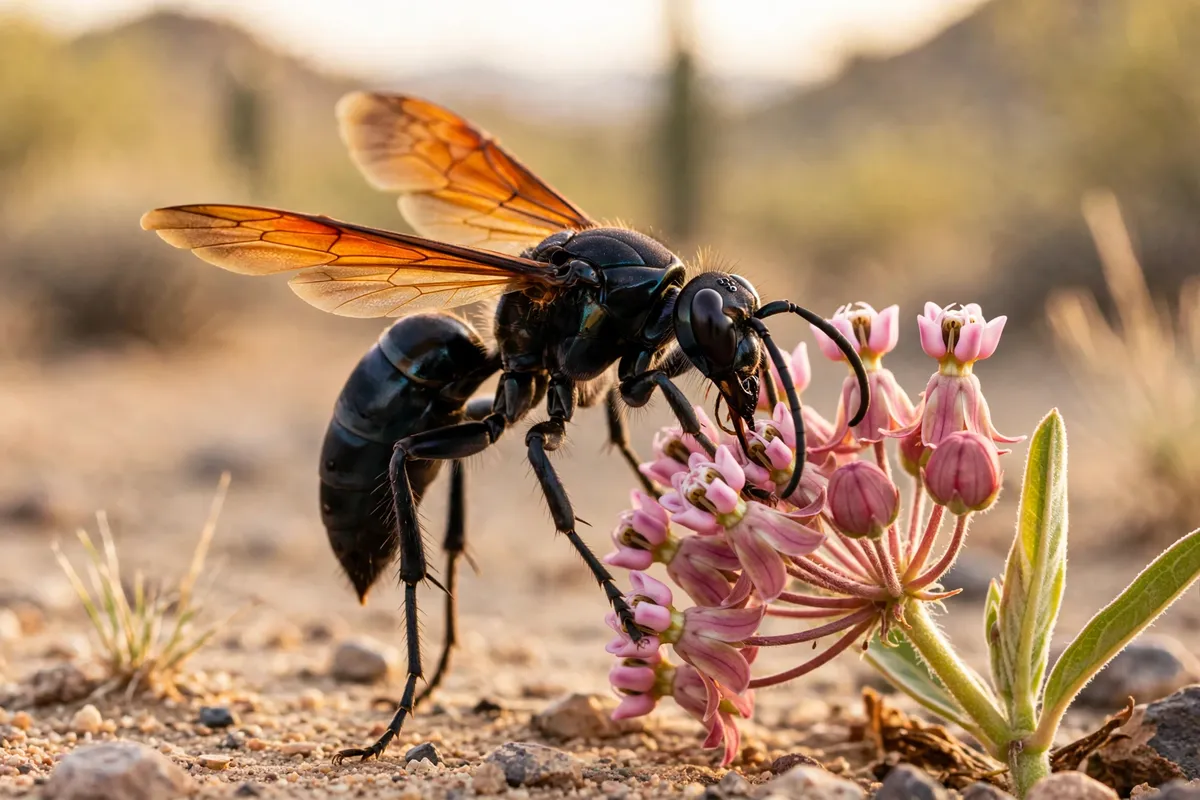

Picture a wasp the size of your thumb, with a body like polished blue-black metal and wings the colour of a desert sunset. Now imagine that its sting is rated the second most painful of any insect on Earth. That is the tarantula hawk wasp, and if you live in or visit the American Southwest, there is a good chance you will meet one.
Here is the part most people miss: it does not want to sting you. The tarantula hawk wasp is a shy, solitary insect that spends its days drinking nectar from flowers. Its famous sting is a hunting tool, built for tarantulas, not people. This guide explains what a tarantula hawk wasp is, how it hunts, how bad the sting really is, and what to do if you cross paths with one.
What Is a Tarantula Hawk Wasp?
A tarantula hawk wasp is a type of spider wasp, a member of the genera Pepsis and Hemipepsis in the family Pompilidae. There are 133 known species, all of them solitary. The largest, Pepsis heros of South America, can reach 11 centimetres long — about the length of your hand from wrist to fingertip.
The name comes from what the females do for a living: they hunt tarantulas, spiders that are often bigger than they are, and use them as living food for their young. It sounds like a horror story. In practice, it is one of the desert’s most ordinary sights.
How to recognise one
You will rarely need a field guide. A tarantula hawk wasp is hard to mistake for anything else:
- Size: about 1.5 to 2 inches long (38 to 50 mm), among the largest wasps in North America.
- Colour: a metallic blue-black body with bright orange or amber wings. The colours are a warning sign — biologists call this aposematic colouration — and most animals take the hint.
- Legs: long, spiny legs that dangle in flight, built for grappling with spiders.
- Flight: a loud, heavy buzz, low over the ground, often in a slow, searching pattern.
If it looks like a wasp wearing a Halloween costume, you have found one.
Male or female? The difference that matters
This is the detail most guides bury, and it changes everything about how worried you should be. Only female tarantula hawk wasps can sting. Males have no stinger at all.
You can tell them apart if you get a close look: males have straight antennae, while females have curled antennae and are slightly larger. In practice, the wasps that dart around you on a summer afternoon — the ones that swoop at anything moving, including people — are almost always males on mating patrol. They look alarming and cannot hurt you. The females are the quiet ones, flying low over the ground, hunting spiders. Give both of them space and you will be fine.
Where Do Tarantula Hawk Wasps Live?
Tarantula hawk wasps are desert insects. In the United States they are most common in the Southwest — Arizona, New Mexico, Nevada, California, Texas, Colorado and Utah — in dry, scrubby country where tarantulas live. Their range runs through Central America and into South America.
They are not only a southwestern story, though. Scattered sightings turn up in Florida and the Carolinas, with occasional reports in the Midwest and the Pacific Northwest. If you are spending a day outdoors in Florida, our Winter Haven, Florida guide is a good starting point for planning a trip in the kind of warm, open country these wasps like.
When you will see one
Tarantula hawk wasps are daytime insects, most active in the hot months. The peak season runs from late summer into fall — roughly July through October in California, and August through October for the males’ showy mating flights, when they gather on hilltops and dart at anything that passes.
The best place to spot one is a patch of milkweed in bloom. Adults feed on nectar, and milkweed is a favourite. Stand a few steps back from a flowering milkweed plant on a hot afternoon and watch for a big blue-black wasp with orange wings working the flowers. That is also where the males do their intercepting, so do not be surprised if one buzzes past your head. It is checking whether you are a mate, not picking a fight.
The Hunt: How It Takes Down a Tarantula
The hunt is the reason this wasp is famous, and it is stranger than most people expect. The wasp does not kill the tarantula. It needs the spider alive.
1. The stalk
The female flies low, searching the ground for a tarantula, often near the spider’s own burrow. When she finds one, she lands nearby and circles it, getting closer a little at a time. The tarantula’s eyesight is poor, and the circling confuses it.
2. The sting
When she is close enough, the wasp flips underneath the spider and drives her sting — up to a quarter of an inch long — into the soft spot between a leg joint and the belly plate. The venom works in seconds. The tarantula goes limp, paralysed but alive. The Natural History Museum puts it plainly: the wasps always win, and no one has ever seen a tarantula kill the wasp.
3. The drag
The wasp drags the helpless spider — often heavier than she is — back to a burrow. Sometimes she digs her own; often she simply uses the tarantula’s burrow. It is a long, awkward haul across open ground, and it is the moment you are most likely to see one in the wild.
4. The egg
Once the spider is tucked away, the wasp lays a single egg on its abdomen and seals the burrow. One tarantula, one egg, one larva. A female can repeat this hunt many times in her short adult life.
5. The larva’s slow meal
The egg hatches in three to four days. The larva bores into the still-living tarantula and feeds on it from the inside, starting with the spider’s blood-like fluid and the less vital organs, so the host stays alive as long as possible. It is grim, and it is exactly why the venom paralyses instead of killing.
6. The new wasp
Once the spider is eaten, the larva spins a cocoon and pupates into an adult wasp in two to three weeks. The adult female lives only 40 to 50 days, and the whole cycle starts again. If the egg fails to hatch, the tarantula can sometimes recover from the venom after several months — but that is rare.
| Life-cycle stage | How long it takes |
|---|---|
| Egg hatches | 3 to 4 days after laying |
| Larva feeds on the tarantula | Several weeks |
| Pupa in the cocoon | 2 to 3 weeks |
| Adult female lifespan | 40 to 50 days |
How Painful Is the Sting, Really?
Entomologist Justin Schmidt spent years letting insects sting him so he could rank the pain. His Schmidt Pain Index runs from 1 to 4, and the tarantula hawk wasp scores a 4 — the top of the scale, second only to the bullet ant of South America. Schmidt described the sting as “blinding, fierce, shockingly electric” and once advised that the only sensible response is to “lay down and scream.”
The good news is how short it is. The pain from a tarantula hawk sting usually fades in about five minutes. A bullet ant sting, by comparison, can burn for up to 24 hours. The venom is built to switch off a spider’s nervous system, not to damage human tissue, so for most people the sting leaves no lasting harm — just a story.
| Insect | Schmidt rating (1 to 4) | How long the pain lasts |
|---|---|---|
| Bullet ant | 4.0 | Up to 24 hours |
| Tarantula hawk wasp | 4.0 | About 5 minutes |
| Honeybee | 2.0 | Minutes |
A few facts help keep the fear in proportion. Only females sting, and they sting only if handled, swatted at, or stepped on. The stinger is not left behind in your skin the way a honeybee’s is, and a female can sting more than once if she feels trapped — another reason to leave her alone rather than swat.
What to Do If You Get Stung
There is no way to make a tarantula hawk sting painless. What you can do is ride out the few worst minutes safely and look after the sting afterwards.
1. Get somewhere safe and sit down
Move away from the wasp first, then sit or lie down. The pain can be so intense that it knocks your coordination for a minute, and the last thing you need is to stumble or fall. This is the step Schmidt himself recommended: lie down and wait it out.
2. Wash the sting
Once the worst pain starts to ease, wash the sting site with soap and clean water. There is no stinger to pull out — tarantula hawks keep theirs — so do not dig at the skin. If you are wearing a ring, watch or bracelet near the sting, slip it off before any swelling starts.
3. Apply a cold compress
Hold a cold compress or an ice pack wrapped in a cloth against the sting for 10 to 15 minutes at a time. It will not stop the pain, but it takes the edge off and keeps the swelling down.
4. Take pain relief if you need it
Once the peak has passed, an over-the-counter pain reliever such as ibuprofen or acetaminophen can help with the soreness that lingers. Most people feel back to normal within an hour, with only a tender spot left behind.
5. Know the warning signs
Most tarantula hawk stings need no medical care. Get help straight away if you notice any of these:
- Trouble breathing or swallowing, or swelling of the face, lips or throat
- Widespread hives or a rash
- Dizziness, fainting or a racing heartbeat once the pain has faded
- Nausea or vomiting
- Swelling that keeps growing after 24 hours, or red streaks spreading from the sting
These can be signs of an allergic reaction, which is uncommon but serious. If you know you are allergic to insect stings, use your epinephrine auto-injector if you carry one and call for emergency help.
Are Tarantula Hawk Wasps Dangerous to Pets?
Dogs are the usual victims — a curious dog that snaps at a big buzzing insect is exactly how most pet stings happen. The venom is not considered lethal to dogs or cats, but a sting still causes severe pain and distress, and a sting on the face, inside the mouth or on the throat can cause swelling that makes breathing hard.
If your pet is stung, move it away from the wasp, keep it calm, and call your veterinarian right away — do not wait to see whether it gets worse. Never give a pet human pain relievers unless your vet tells you to; many are toxic to animals. The vet can judge the swelling and decide whether the animal needs treatment.
What If There Is a Burrow Near Your Home?
A tarantula hawk burrow is a hole about one to two inches wide in sandy or dry soil, sometimes with a small mound of dug-out earth beside it. The wasp may have dug it herself, or she may be using a tarantula’s old burrow. Either way, it belongs to one wasp, not a colony — these insects do not nest in groups, and there is no hive to defend.
University extension advice is clear: there are no recommended control measures for tarantula hawk wasps, and they are not usually a pest problem. The best response is to leave the burrow alone, keep children and pets away from that patch of ground, and let the wasp finish her work. She will move on.
Two things do help. First, keep the yard clear of the clutter tarantulas like to hide under — wood piles, stacked pots, fallen debris — and clearing clutter from the yard makes the whole area less inviting to spiders, and to the wasps that follow them. Second, if wasp activity is right beside a door, a patio or a children’s play area, and you are worried, call a pest professional for an inspection. That is the exception, not the rule.
Tarantula Hawk or Something Else?
A few other insects get mistaken for tarantula hawks. Here is how to tell them apart at a glance:
| Insect | What to look for | How it differs |
|---|---|---|
| Tarantula hawk wasp | Metallic blue-black body, bright orange wings, 1.5 to 2 inches | The real thing — solitary, hunts tarantulas |
| Velvet ant | Red and black fuzzy body, no wings, walks on the ground | Actually a wingless female wasp, not an ant; also has a very painful sting |
| Mud dauber wasp | Thin, thread-like waist, black or metallic blue, builds mud tubes | Much smaller and slimmer; builds mud nests on walls |
| Paper wasp | Brown or black with yellow marks, long legs, papery grey nests | Lives in colonies; the nest is the giveaway |
The rule of thumb is simple: if it is two inches long, blue-black, orange-winged and alone, it is a tarantula hawk. If it is near a nest with dozens of others, it is something else.
Why They Matter More Than Their Sting
It is easy to remember the tarantula hawk wasp for its sting and forget the rest of the job it does. Adults are important pollinators of milkweed, one of the desert’s key wildflowers, and they visit mesquite and soapberry trees too. By hunting tarantulas, they keep spider numbers in check. And because almost nothing eats them — their venom, their smell and their hard shell put predators off — they sit near the top of the desert’s small food web. (Roadrunners are the rare exception: they have been seen smashing wasps on the ground to break the stinger before eating them.)
They are, in short, a desert specialist doing desert work. The sting is a warning label, not a weapon aimed at us.
New Mexico’s State Insect — Picked by Schoolkids
The tarantula hawk wasp is the official state insect of New Mexico, and the story of how it got the job is worth telling — New Mexico Magazine tells it in full. In 1988, Ruth Bradford, an elementary school teacher in Edgewood, set her class a project: New Mexico had a state flower, a state tree and a state fish, but no state insect. The children picked three candidates and mailed ballots to schools across the state. Nearly 10,000 fourth, fifth and sixth graders voted, and the tarantula hawk won by a landslide.
On April 3, 1989, Governor Garrey Carruthers signed House Bill 468, making it official. The law still lists the wasp under its older scientific name, Pepsis formosa, which scientists have since folded into Pepsis grossa. It remains the only state insect in America chosen by a vote of schoolchildren — and the only one famous for its sting.
So if you see one, give it room, watch it from a few steps back, and enjoy the show. A tarantula hawk wasp is one of the desert’s great sights: a two-inch hunter in orange wings, doing a job no other insect can do, and far more interested in spiders and flowers than in you.
Are tarantula hawk wasps dangerous to humans?
No, not really. Tarantula hawk wasps are docile and sting only if they are handled, swatted at or stepped on. The sting is extremely painful, but for most people it causes no lasting harm — the pain usually fades in about five minutes. Anyone with an insect-sting allergy should get medical help straight away if stung.
How painful is a tarantula hawk wasp sting?
It scores 4 out of 4 on entomologist Justin Schmidt’s pain index — the top of the scale, second only to the bullet ant. Schmidt described it as “blinding, fierce, shockingly electric.” The saving grace is that the pain usually lasts only about five minutes, while a bullet ant sting can burn for up to 24 hours.
Can a male tarantula hawk wasp sting?
No. Only females can sting. Males have straight antennae and no stinger at all, while females have curled antennae and are slightly larger. The wasps that dart around people on summer afternoons are usually males on mating patrol — they look alarming but cannot sting.
What should I do if a tarantula hawk wasp stings me?
Move away from the wasp, then sit or lie down — the pain can knock your coordination for a minute. Wash the sting with soap and water, hold a cold compress on it for 10 to 15 minutes, and take an over-the-counter pain reliever once the peak passes. Get medical help straight away for trouble breathing, face or throat swelling, hives, dizziness or fainting.
Do I need pest control for tarantula hawk wasps?
Usually not. They are solitary wasps with no colony to defend, and university extension advice is that no control measures are recommended. Leave the burrow alone and keep children and pets away from that patch of ground. Call a pest professional only if the wasps are active right beside a door, patio or play area.
