
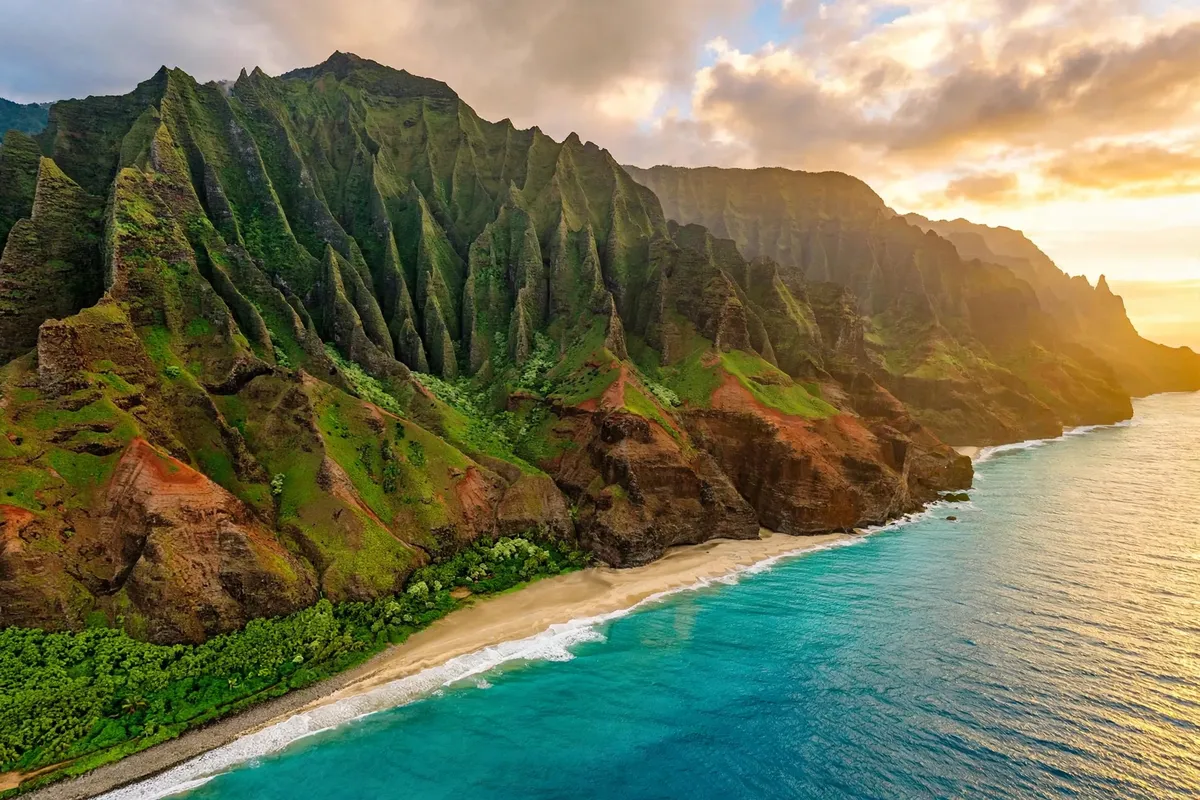

Ask someone to picture Hawaii and they will picture one place. A beach, a volcano, a sunset. The surprise is that there is no single Hawaii to picture. The Hawaiian islands are eight very different places that happen to share one state, one ocean and one long chain of volcanoes. Pick the wrong island and the trip you dreamed about turns into a trip you did not want.
This guide walks through all eight of the main Hawaiian islands — what each one is actually like, who it suits, and the practical facts that decide a trip: how big each island is, how old it is, what it costs to get into its famous places, and how to move between islands without wasting days in airports.
How Many Hawaiian Islands Are There, Really?
The honest answer is 137. That is the count of every island, islet and atoll in the Hawaiian archipelago, a chain that stretches about 1,500 miles across the central Pacific. Most of those 137 are specks of rock and reef that no one lives on and no traveller will ever see.
What people mean by “the Hawaiian islands” is the eight main islands. They are, from northwest to southeast: Niihau, Kauai, Oahu, Molokai, Lanai, Kahoolawe, Maui and Hawaii — the last one usually called the Big Island, so nobody confuses it with the state itself.
Seven of the eight are inhabited. The odd one out is Kahoolawe, which has no permanent residents and is closed to visitors. That leaves six islands you can actually visit: Kauai, Oahu, Molokai, Lanai, Maui and the Big Island. Niihau is inhabited but privately owned, and general tourism does not go there. So when a guide says “six islands”, it means the six you can plan a trip around. When it says “eight”, it means the whole main chain. Both numbers are right. They just answer different questions.
Hawaii is also the most isolated island chain on Earth, about 2,400 miles from the nearest continent. That distance shaped everything: the wildlife here evolved nowhere else, and the islands were built one by one as the Pacific plate drifted over a volcanic hotspot. The oldest sit in the northwest. The youngest, the Big Island, still sits over the hotspot and is still growing.
The 8 Hawaiian Islands at a Glance
Before the detail, here is the whole chain on one page. Sizes and ages come from the Hawaiian Archipelago reference data, and the visitor islands are the six the Hawaii Tourism Authority lists on its own islands page.
| Island | Nickname | Size | Highest point | Age | Can you visit? |
|---|---|---|---|---|---|
| Hawaii (Big Island) | The Big Island | 4,028 sq mi | Mauna Kea, 13,803 ft | About 400,000 years | Yes |
| Maui | The Valley Isle | 727 sq mi | Haleakala, 10,023 ft | About 1 million years | Yes |
| Oahu | The Gathering Place | 597 sq mi | Mount Kaala, 4,003 ft | About 3 million years | Yes |
| Kauai | The Garden Isle | 552 sq mi | Kawaikini, 5,243 ft | About 5 million years | Yes |
| Molokai | The Friendly Isle | 260 sq mi | Kamakou, 4,961 ft | About 1.9 million years | Yes |
| Lanai | The Pineapple Isle | 140 sq mi | Lanaihale, 3,366 ft | About 1.3 million years | Yes |
| Niihau | The Forbidden Isle | 69.5 sq mi | Mount Paniau, 1,250 ft | About 4.9 million years | No — private island |
| Kahoolawe | The Target Isle | 44.6 sq mi | Puʻuomoaʻula Nui, 1,483 ft | About 1 million years | No — closed to visitors |
Two things in that table surprise most people. The first is the scale: the Big Island alone is bigger than all the other seven main islands put together. The second is the age gap. Kauai, the oldest main island at roughly five million years, has had the longest time for rain and wind to carve it — which is exactly why it looks the way it does.
The Hawaiian Islands, One by One
Oahu — The Gathering Place
Oahu is the island most first-timers should start with, and the one most likely to be misunderstood. Yes, it has Honolulu, high-rises and traffic — about 70% of the state’s people live on its 600 square miles. But Oahu packs more variety into a small space than any other island: Waikiki Beach and Diamond Head in the morning, Pearl Harbor by midday, and the North Shore’s big winter surf in the afternoon.
Diamond Head is the classic first hike — a 1.6-mile round trip up an extinct tuff cone to a World War I fire-control station, with Waikiki spread out below. Non-residents now need a timed reservation booked up to 30 days ahead, and entry costs $5 a person with $10 for parking. Hanauma Bay, the flooded crater turned snorkelling reef, works the same way: $25 for non-residents aged 13 and over, reservations released two days ahead at 7 a.m. Hawaii time, and the bay is closed every Monday and Tuesday so the reef gets two days of rest.
Oahu suits first trips, families and anyone who wants a lot of Hawaii without a lot of driving. It also has the widest range of hotels at every price point, the best bus system in the state, and the most direct flights from the mainland. Skip it only if quiet is the whole point of the trip.
Maui — The Valley Isle
If Hawaii has a default postcard, it is Maui. The Road to Hana winds 620 curves and 59 one-lane bridges through rainforest to black-sand beaches. Haleakala, the 10,023-foot volcano that makes up three-quarters of the island, puts you above the clouds at sunrise. Molokini, a half-sunk crater off the south coast, is one of the clearest snorkelling spots in the state.
Maui is the island to plan hardest for. The Haleakala sunrise needs a $1 vehicle reservation from Recreation.gov, released 60 days and again two days ahead at 7 a.m. Hawaii time, and it sells out fast — on top of the $30 park entry fee, which covers three days. Bring warm layers: the summit often sits near freezing before dawn, even when the beach below is 80 degrees.
Lahaina, the old whaling town on the west side, is still rebuilding after the 2023 wildfire. Front Street reopened to traffic in August 2026, and businesses are gradually returning, but check current conditions before building a day around it. Maui suits couples, honeymoons and travellers who want resorts, beaches and scenery in roughly equal parts. It is often the most expensive island, and its popular areas can feel resort-heavy.
Hawaii (Big Island) — The Big Island
The Big Island is the odd one out in the best way. At 4,028 square miles it is larger than all the other main islands combined, and at around 500,000 years old it is the youngest — still sitting over the hotspot that built the chain, and still growing as lava reaches the sea. It is the only island where you can watch the Earth being made.
Hawaii Volcanoes National Park is the centrepiece. Kilauea, one of the world’s most active volcanoes, has erupted on and off since 1983, and since December 2024 it has put on regular summit lava-fountain episodes inside Halemaumau crater. Entry is $30 per vehicle for seven days, paid by card at the gate, and the park is open 24 hours a day — but check the USGS volcano update the morning you go, because viewing points and trail closures change with the activity.
The same island also holds Mauna Kea, at 13,803 feet the highest point in Hawaii. Measured from its base on the ocean floor it rises more than 33,000 feet, taller than Mount Everest from base to peak, and its summit is one of the best stargazing sites on Earth. You can drive from a black-sand beach to snow on Mauna Kea in a single day. The Big Island suits road-trippers, volcano watchers and anyone who wants the most variety per mile. It needs the most driving, though — the island is huge, and the two main towns, Kona and Hilo, sit on opposite sides.
Kauai — The Garden Isle
Kauai is the oldest main island, about five million years old, and it shows. Rain and time have carved it into the greenest, steepest landscape in Hawaii: the Na Pali Coast’s fluted cliffs, Waimea Canyon’s red walls, and Hanalei Bay’s perfect crescent of sand. It is the island people mean when they say Hawaii looks like a film set — much of it literally was.
Kauai is for travellers who want Hawaii to feel like nature, not entertainment. There are no high-rises, and the pace is slower. The trade-off is that the weather is wetter, especially on the north shore, and the famous Kalalau Trail along the Na Pali Coast needs a permit and real fitness. The island rewards hikers, photographers and anyone happy to trade nightlife for waterfalls.
One practical note: Kauai’s north shore is reached by a single road, and its most popular beach park, Haena State Park, now needs an advance reservation like the other famous spots. Book before you go, not when you arrive.
Molokai — The Friendly Isle
Molokai is the least commercially developed of the main islands, and it likes it that way. There are no mega-resorts, no traffic lights to speak of, and no crowds. What there is: the tallest sea cliffs in the world on the north shore, long empty beaches, and a way of life that has changed less than anywhere else in Hawaii.
The island is also home to Kalaupapa, the remote peninsula that was once a settlement for people with Hansen’s disease (leprosy) and is now a national historical park. It is a place of real history, not a tourist stop — access is limited and respectful behaviour is expected. Molokai suits travellers who want the old Hawaii and are comfortable with very little infrastructure. It does not suit anyone who needs nightlife, shopping or a resort pool. Come for a day trip from Maui, or come for a few quiet days and leave the schedule at home.
Lanai — The Pineapple Isle
Lanai is the smallest island you can actually visit, at 140 square miles, with about 3,000 residents and roughly 30 miles of paved road. It was once the world’s largest pineapple plantation. Today it is two things at once: a quiet, rugged island of red-dirt roads and empty beaches, and home to two polished luxury resorts that most visitors never leave.
Most of the island is owned by Oracle founder Larry Ellison, who bought the great majority of it in 2012. The resorts are the draw for most visitors, but the island’s real character is outside them — Shipwreck Beach, the Garden of the Gods rock formations, and the ferry ride over from Maui, which is itself half the experience. Lanai suits a splurge, a honeymoon add-on, or a day trip for travellers who want to say they have been somewhere almost nobody goes.
Niihau — The Forbidden Isle
Niihau is the island you cannot visit. Privately owned by the Robinson family since 1864, it is home to a small community that still speaks Hawaiian as its first language, and it has no hotels, no public roads and no tourism industry. The family bought it from the Hawaiian kingdom with a commitment to preserve Hawaiian culture and way of life, and that commitment still holds.
The only way most people ever see Niihau is from a helicopter tour that circles it without landing. It stays in this guide because every “which island” list that skips it leaves readers wondering. The answer is simple: it is beautiful, it is private, and it is not a travel option.
Kahoolawe — The Target Isle
Kahoolawe is the eighth main island and the one almost nobody mentions. At 44.6 square miles it is the smallest of the eight, with no permanent residents, and it is closed to the public. The US military used it as a bombing range from 1941 to 1990 — the origin of its grim nickname, the Target Isle. It was returned to the state in 1994 and is now a cultural and environmental reserve, restored by Native Hawaiian volunteers.
You cannot visit Kahoolawe, and you should not try. It is here for completeness: when someone asks how many Hawaiian islands there are, this is the eighth one, and the reason the count of “islands you can visit” stops at six.
Which Hawaiian Island Should You Visit?
There is no single best Hawaiian island — only a best island for the trip you want to take.
| If you want… | Go to | Know this first |
|---|---|---|
| A bit of everything, first trip | Oahu | Busiest island, but the easiest logistics |
| Resorts, beaches and romance | Maui | Often the priciest; book the sunrise early |
| Volcanoes and road trips | Big Island | Huge distances — base in Kona or Hilo, not both |
| Hiking and wild scenery | Kauai | Wettest island; north shore needs reservations |
| Quiet and the old Hawaii | Molokai | Almost no tourist infrastructure |
| A splurge or a day trip | Lanai | Small, pricey, reached by ferry or small plane |
First-timers do best on Oahu. It gives you the widest range of experiences with the least friction: the most flights, the most hotels, the most famous sights within an hour of each other. Maui is the runner-up if the trip is really about beaches and a polished resort stay. Families with young children usually land on Oahu too, for the same reason — calm, lifeguarded beaches like Waikiki and easy days with no long drives. Hawaii’s beaches are mostly unguarded once you leave the resort strips, so choose swimming spots the way you would choose a managed beach park. Our Al Mamzar Beach Park guide is a useful checklist for what makes a beach day work with kids.
Hikers belong on Kauai. Volcano and stargazing fans belong on the Big Island, and only there — no other island has an active volcano. Honeymooners who want scenery without a city usually pick Maui. And if the whole point of the trip is to disappear, Molokai or Lanai will do it better than any resort on the big four.
Planning the Trip Between the Islands
How many days do you need on each island?
Five to seven days is the right length for one island. Oahu works in four or five, because everything is close together. The Big Island needs at least five, and seven is better — Kona to the volcano park is about two hours each way. Maui and Kauai sit in the middle at five to seven days each. Molokai and Lanai work as day trips from Maui, or two quiet days on their own.
How many islands should you visit in one trip?
One island is ideal for a five-to-seven-day trip. Two islands work for eight to eleven days, with one early interisland flight between them. Three islands in a week is the mistake people make exactly once: every hop costs half a day once you add the airport, the rental-car return and the new check-in. Think of each island as its own small destination — the same one-base approach we used in our Winter Haven, Florida guide — and give each one the days it deserves.
Getting between the islands
There are no bridges and no regular car ferries between the main islands. Interisland flights are the way to move, and they are short — usually 25 to 50 minutes in the air — but budget half a day door to door. Hawaiian Airlines and Southwest both fly between the main airports. Southwest’s interisland routes are worth knowing about if you already fly with them, and the bag rules are the same as their mainland ones — our Southwest Airlines baggage limits guide covers what counts as a free bag.
Two exceptions: Lanai and Molokai can be reached by ferry from Maui, and by small plane from Honolulu or Maui. The ferry is slower, but it is also a trip in itself, and it is how many locals travel.
The reservations and fees to book first
Hawaii’s most famous places now run on timed-entry reservations, and they sell out. Book these before you book dinner. Fees and windows change, so confirm them on the official page for your date — but this is what they looked like in late 2026.
| Place | Cost (non-resident) | How to book |
|---|---|---|
| Diamond Head, Oahu | $5 entry, $10 parking | gostateparks.hawaii.gov, up to 30 days ahead |
| Hanauma Bay, Oahu | $25 (ages 13+), $3 parking cash | pros.hnl.info, 2 days ahead at 7 a.m. HST |
| Haleakala sunrise, Maui | $1 reservation + $30 park entry (3 days) | Recreation.gov, 60 days and 2 days ahead at 7 a.m. HST |
| Hawaii Volcanoes National Park, Big Island | $30 per vehicle, 7 days | Pay at the gate, card only — no reservation needed |
Hawaii residents enter free at the state parks and Hanauma Bay with a Hawaii ID. Children 3 and under are free at Diamond Head, and children 12 and under are free at Hanauma Bay. And one rule that catches people out: Hawaii bans the sale of sunscreens containing oxybenzone and octinoxate, so buy reef-safe sunscreen before you fly or at a local shop.
When to go
There is no bad month, only different trade-offs. Highs sit in the low 80s all year; what changes is rain and surf. Winter, December through March, brings the biggest north-shore surf and the humpback whales, in Hawaiian waters roughly from December to April. Summer is drier and calmer on most beaches, but hotter and busier.
The sweet spot is the shoulder months — late April into early June, and September into early November — when the crowds thin and the rates drop. Whenever you go, pack for two climates: a beach day and a mountain morning are often the same day in Hawaii, and the top of Haleakala or Mauna Kea can be 40 degrees colder than the coast.
How many Hawaiian islands are there?
There are 137 islands, islets and atolls in the Hawaiian archipelago, but only eight main islands. Seven of those are inhabited, and six are open to visitors: Kauai, Oahu, Molokai, Lanai, Maui and the Big Island. Niihau is privately owned and Kahoolawe is closed to the public.
Which Hawaiian island is best for a first trip?
Oahu, for most people. It has the widest range of experiences with the least friction — the most flights, the most hotels, and the most famous sights within an hour of each other. Maui is the runner-up if the trip is really about beaches and a polished resort stay.
Which Hawaiian island is the biggest?
Hawaii, the Big Island, at 4,028 square miles — bigger than all the other main islands put together. It is also the youngest island, at around 500,000 years old, and it is still growing as lava reaches the sea.
Can you visit all the Hawaiian islands?
No. Kahoolawe is closed to the public and managed as a cultural and environmental reserve, and Niihau is privately owned by the Robinson family with no general tourism. Six islands are open to visitors.
Do you need reservations for Hawaii’s parks and beaches?
Yes, for the famous ones. Diamond Head and Hanauma Bay on Oahu, the Haleakala sunrise on Maui and Haena State Park on Kauai all need advance reservations, and they sell out — book them before anything else on your trip.
