
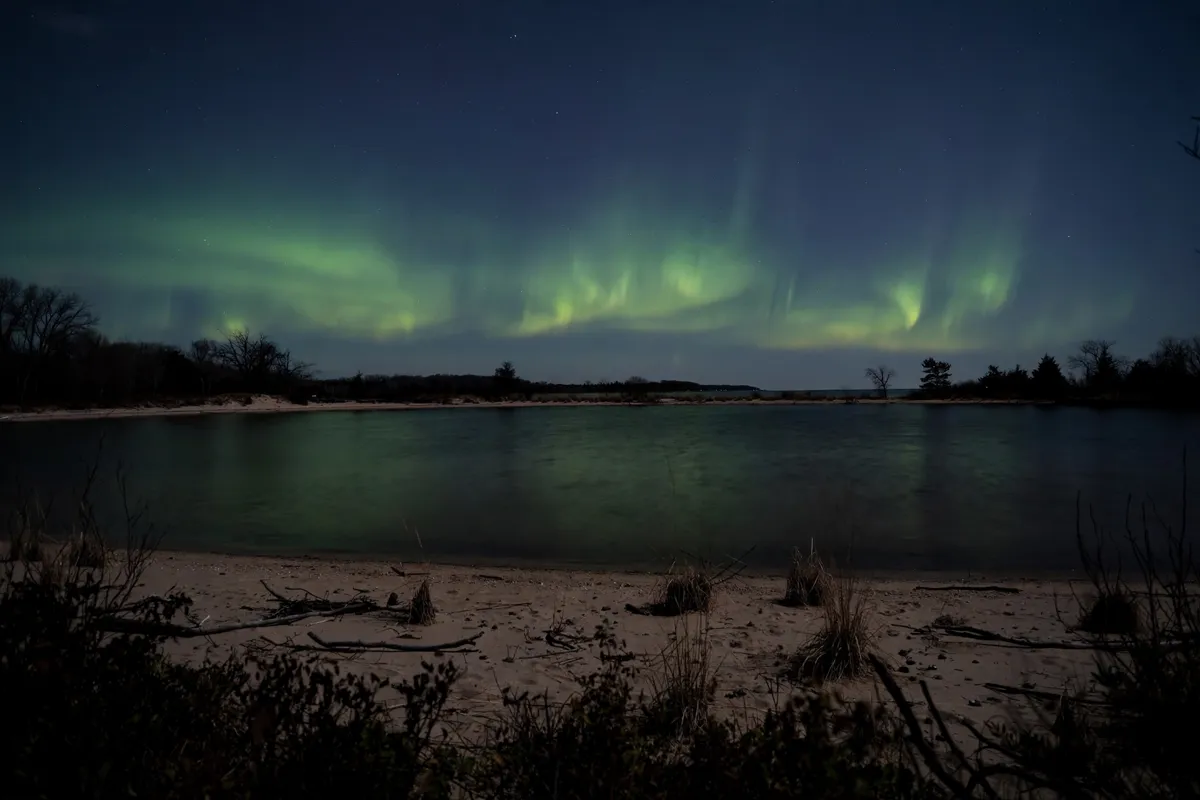

Yes, you can see the northern lights in Ohio — just not often, and never on an ordinary night. Ohio sits well south of the auroral oval, the ring around the North Pole where the lights live most nights. For the glow to reach this far south, the sun has to throw a strong geomagnetic storm at Earth, the kind that only comes along a few times a year, even now near the peak of the solar cycle.
That rarity is why the question gets searched so much. When a storm is coming, social media fills up with green skies over Lake Erie, and everyone in Cleveland, Columbus, and Cincinnati wants to know one thing: is tonight the night? Here is the straight answer, the number to watch, the places that work, and a simple plan for the night.
Can You See the Northern Lights in Ohio?
Yes — during strong geomagnetic storms. Ohio stretches from about 39° north latitude in Cincinnati to about 42° in Toledo, which puts the whole state in what scientists call the mid-latitude aurora zone. On a normal night the aurora stays hundreds of miles to the north. But when a big storm hits, the oval swells south, and the lights can show up low on Ohio’s northern horizon.
The proof is recent. During the May 2024 geomagnetic storm — the first G5, or extreme, storm since 2003 — people reported aurora across all of Ohio, from Cleveland and Columbus to Dayton and even Cincinnati, with vivid green and purple curtains overhead. It was the strongest storm in more than 20 years, which is the point: Ohio’s great aurora nights are rare, but they are real, and they are worth being ready for.
Why Ohio Gets the Aurora So Rarely
The northern lights happen when charged particles from the sun collide with oxygen and nitrogen high in Earth’s atmosphere, giving off light — green from oxygen, red and purple from higher up. Earth’s magnetic field funnels those particles toward the poles, which is why the lights normally hang over Alaska, northern Canada, and Scandinavia.
For the lights to reach Ohio, the sun has to be active — a coronal mass ejection aimed at Earth, or a fast stream of solar wind — and that wind has to disturb Earth’s magnetic field hard enough to push the oval hundreds of miles south. Only the strongest storms do that; a mild one might light up Michigan’s Upper Peninsula and leave Ohio dark. One twist matters here: magnetic latitude is not map latitude. The magnetic pole sits in northern Canada, so Ohio’s magnetic latitude is roughly 48 to 51 degrees — further north than the map suggests. That is the number forecast tools use, and why the same storm can be visible from Toledo and invisible from Cincinnati.
What Kp Index Do You Need in Ohio?
The Kp index is the number that decides your night. It runs from 0 to 9 and measures how disturbed Earth’s magnetic field has been over the last three hours. NOAA assigns a storm rating to it: Kp 5 is G1 minor, Kp 6 is G2 moderate, Kp 7 is G3 strong, Kp 8 is G4 severe, and Kp 9 is G5 extreme. Read NOAA’s own plain-language advice on how to read the Kp index and view the aurora.
Here is where most guides confuse people. Some say Ohio needs Kp 7; others say Kp 8. Both are right — they answer different questions. A Kp 7 storm can put a glow low on the northern horizon from the darkest spots in northern Ohio. A Kp 8 storm puts that glow on the horizon as far south as Columbus and Cincinnati, and can push the lights overhead in the north. The number you need depends on where you stand and what you hope to see.
How much Kp each part of Ohio needs
| Where you are | Glow low on the northern horizon | Lights overhead |
|---|---|---|
| Toledo and Cleveland (Lake Erie shore) | Kp 7 (G3 storm) | Kp 8 (G4 storm) |
| Columbus | Kp 8 (G4 storm) | Kp 9 (G5 storm) |
| Cincinnati and Dayton | Kp 8 (G4 storm) | Kp 9 (G5 storm) |
Those numbers come from NOAA’s rule of thumb: at Kp 0 the oval’s edge sits at about 66 degrees magnetic latitude, moving about 2 degrees toward the equator with each step of Kp. NOAA is clear the relationship is approximate — treat the table as odds, not a promise. At the threshold Kp, expect a faint glow hugging the horizon, not curtains overhead; the big shows need a storm a step stronger than the minimum.
When Are the Northern Lights Most Likely in Ohio?
Three things decide the calendar: the time of night, the time of year, and where we are in the sun’s 11-year cycle.
The best hours are 10 PM to 2 AM
NOAA’s advice is simple: the best aurora usually shows up within an hour or two of midnight, between about 10 PM and 2 AM local time. That is when your part of Earth has rotated under the densest part of the oval. On a strong storm night the window stretches earlier into the evening and later toward morning, but midnight is the heart of it. Plan to be in position by 10 PM and be ready to wait.
Spring and fall are the best seasons
The weeks around the spring and fall equinoxes — March and April, September and October — statistically produce the most geomagnetic activity, so big storms cluster there. Long winter nights help too. The practical season for Ohio runs from late August to mid-April; summer nights are short and the sky often never gets properly dark.
We are still near the peak of Solar Cycle 25
The sun runs on a roughly 11-year cycle, and NASA and NOAA announced in October 2024 that the sun had entered the maximum phase of Solar Cycle 25 — the same period that produced the May 2024 G5 storm and another strong G4 storm that October. Maximum is a period, not a single day, and high activity has continued through 2025 and into 2026. The next year or two still holds Ohio’s best odds in a decade: a realistic shot a few times a year near the peak, versus several years with nothing at all when the cycle is quiet.
How to Check the Northern Lights Forecast for Ohio Tonight
Do not trust a single screenshot on social media. Check it yourself, in this order — it takes about five minutes.
Step 1: Check the 3-day Kp forecast
Start with NOAA’s 3-day Kp forecast, which shows the highest Kp expected over the next three days in three-hour blocks. For Ohio, you want a forecast peak of Kp 7 or higher. Kp 5 or 6 means the lights stay north of the border, no matter how excited the posts on your feed look.
Step 2: Check the 30-minute aurora map
NOAA’s aurora 30-minute forecast uses the OVATION model to show where the aurora should be in the next 30 to 90 minutes, turning from green to red where a stronger display is expected. If the red edge dips below the Canadian border and over the Great Lakes, Ohio has a real chance. Watch this one once you are outside — it updates far faster than the Kp index.
Step 3: Check the clouds
Aurora hunting is a clear-sky hobby, and this is where Ohio trips people up. Lake-effect clouds can sit over the Lake Erie shoreline — exactly where you need to look — while the rest of the state is clear. Check the cloud forecast for your exact spot, not just your city, and look at the sky to the north specifically. A thin high haze dims the lights; a solid deck of low cloud ends the night.
Step 4: Check the moon
A bright moon washes out faint aurora — NOAA notes a full moon dims the apparent brightness of the lights, even though the aurora itself is just as strong. A Kp 7 display on a moonless night can look better than a Kp 8 display under a full moon, so the best nights pair a strong storm with a new or crescent moon, or a moon that has set by midnight.
One last step: sign up for NOAA’s free space-weather alerts, so a storm watch reaches you the same time it reaches the forecasters — not hours later, from someone else’s photos.
Best Places to See the Northern Lights in Ohio
Two things make a good aurora spot in Ohio: a dark sky and a clear view to the north. That points straight at the Lake Erie shoreline — a flat, dark horizon in exactly the right direction, with no town lights and no hills in the way. The further north and the further from city glow you get, the better your odds.
Headlands Beach State Park, near Mentor
The classic Ohio aurora spot, named by nearly every guide. Headlands Beach sits on the Lake Erie shore east of Cleveland, with a long stretch of sand facing straight north over open water, pairing the region’s darkest shoreline skies with an unobstructed northern horizon. Get there early on storm nights, and check the park’s hours before you go.
Maumee Bay State Park, near Toledo
The northwestern option, on the western end of Lake Erie close to Toledo, with a beach and boardwalk facing north over the lake. It is the handiest dark shoreline for the Toledo area, and on a Kp 7 night one of the first places in the state where the glow can appear.
Lake Erie Bluffs, Perry
A quieter alternative east of Cleveland, in Perry. The bluffs give an elevated view over the lake, which helps when the aurora sits very low on the horizon. Fewer people, same northern sky.
Observatory Park, Geauga County
Ohio’s first and best-known dark-sky park. Observatory Park in Montville Township is a 1,100-acre Silver Tier International Dark Sky Park — the first in Ohio — with an observatory, a planetarium, and red walkway lighting that protects your night vision. It sits inland, so it lacks the lake’s flat horizon, but its open fields give a reasonable view north. See the Geauga Park District page for Observatory Park for details — and note one trap: the park closes at 11 PM from Labor Day to Memorial Day (6 AM to 1 AM in summer), right in the middle of the 10 PM to 2 AM viewing window. A locked gate at 11 PM is a miserable way to miss a storm.
Hocking Hills State Park
Southeastern Ohio’s Hocking Hills has some of the darkest skies in the state — the best bet if you are based in Columbus or further south and cannot make the drive to the lake. The catch is the trees: use the open fields around the park’s edges rather than the trails, and save it for the strongest storms, when the lights climb high enough to clear the treeline.
If you live in Columbus, Cincinnati, or Dayton, the honest advice is this: on a Kp 7 night, drive north. Two hours toward the lake on a G3 night beats standing in your backyard hoping. Save the backyard for Kp 8 and 9 nights, when the lights can reach the whole state.
What the Northern Lights Actually Look Like in Ohio
This is the part most guides skip, and it decides whether you go home happy or disappointed. In Ohio, the aurora almost never looks like the photos from Iceland. What you will usually see is a faint green-grey glow sitting low on the northern horizon, like the last light of sunset that never quite fades. It may slowly brighten, shift, and throw up faint vertical rays. Your eyes need 15 to 20 minutes in real darkness to see it at all — every glance at your phone screen resets that clock.
During a G4 or G5 storm, the show changes completely: the glow climbs higher, curtains and pillars appear, and greens give way to purples and reds overhead. That is the May 2024 experience, and it is what everyone is chasing. Go in expecting the quiet version and you will enjoy the night whatever happens — and remember the camera sees more than you do, which is why photos from a Kp 7 night can look far more dramatic than the night felt.
How to Photograph the Northern Lights With Your Phone
You do not need a fancy camera — a phone, a small tripod, and a little patience will get you a photo worth keeping.
Step 1: Put the phone on a tripod
A long exposure and a hand-held phone do not mix. A cheap phone tripod, or even the phone propped against a bag on a fence post, is enough. If your phone has a self-timer, set it to 3 seconds so your tap does not shake the shot.
Step 2: Turn on Night mode and let it run long
On an iPhone, Night mode appears automatically in the dark — tap the moon icon and drag the exposure slider to the longest setting, up to 10 seconds hand-held and 30 on a tripod. On Android, open Night Sight and hold still for the full countdown. The longer the exposure, the more colour the sensor collects.
Step 3: Turn the flash off and focus on the sky
Flash is useless against the sky and ruins your night vision. Tap the brightest star on screen to lock focus, and if your phone has a manual or Pro mode, set focus to infinity and white balance to daylight so the greens stay true.
Your Aurora Night Checklist
Aurora watching is a waiting game in the cold, usually after midnight, often a long drive from home. Dress warmer than you think you need — layers, a windproof jacket, hat, gloves, and warm boots. Bring a red flashlight, a power bank (cold drains phone batteries fast, and your phone is your forecast, camera, and map), water, and a snack. Before dark, check the park’s closing time, fill the tank, tell someone where you are going, and download an offline map — some of the best spots have patchy signal. Arrive 30 minutes before the expected peak, let your eyes adapt, and stay at least an hour: displays come in waves, and the people who see the best of it are the ones who stayed.
The Short Version
Northern lights in Ohio are real, rare, and worth the effort — but only on the right nights. Wait for a forecast of Kp 7 or higher, and Kp 8 if you are in central or southern Ohio. Check the 3-day Kp forecast, then the 30-minute aurora map, then the clouds and the moon. Drive to a dark spot with a clear northern horizon, ideally on the Lake Erie shore, get there by 10 PM, dress warm, and stay past midnight. Most nights the answer will be no. But on the few nights a year when the storm is strong enough, you will be standing in the right place, looking north, when the sky turns green. And if you enjoy planning trips around what nature is doing, our guide to things to do in Winter Haven, Florida is the same kind of planning-first travel read — while our Toronto to New York by train guide covers another practical US trip worth planning properly.
Can you see the northern lights in Ohio tonight?
Only during a strong geomagnetic storm. Check NOAA’s 3-day Kp forecast: Ohio needs a forecast peak of Kp 7 or higher in the north, and Kp 8 or higher further south. If the forecast peaks at Kp 5 or 6, the lights will stay north of the border.
What Kp index is needed for northern lights in Ohio?
Kp 7 (a G3 strong storm) can put a glow low on the northern horizon from the darkest spots in northern Ohio, around Toledo and Cleveland. Kp 8 (G4 severe) puts that glow on the horizon as far south as Columbus and Cincinnati, and can push the lights overhead in the north. Overhead displays in central and southern Ohio need Kp 9 (G5 extreme).
Where is the best place to see the northern lights in Ohio?
Headlands Beach State Park near Mentor, on the Lake Erie shore east of Cleveland — a long stretch of sand facing straight north over open water, with dark skies and an unobstructed northern horizon. Maumee Bay State Park near Toledo, Lake Erie Bluffs in Perry, and Observatory Park in Geauga County are the other proven spots.
What time of night is best to see the aurora in Ohio?
Between 10 PM and 2 AM local time, centred on midnight — that is when your part of Earth has rotated under the densest part of the auroral oval. The best seasons are the weeks around the spring and fall equinoxes, in March–April and September–October.
How often does Ohio get the northern lights?
A few times a year near the peak of the solar cycle — we are still in the maximum phase of Solar Cycle 25, announced by NASA and NOAA in October 2024. In quiet years, Ohio can go several years without a visible display.
