
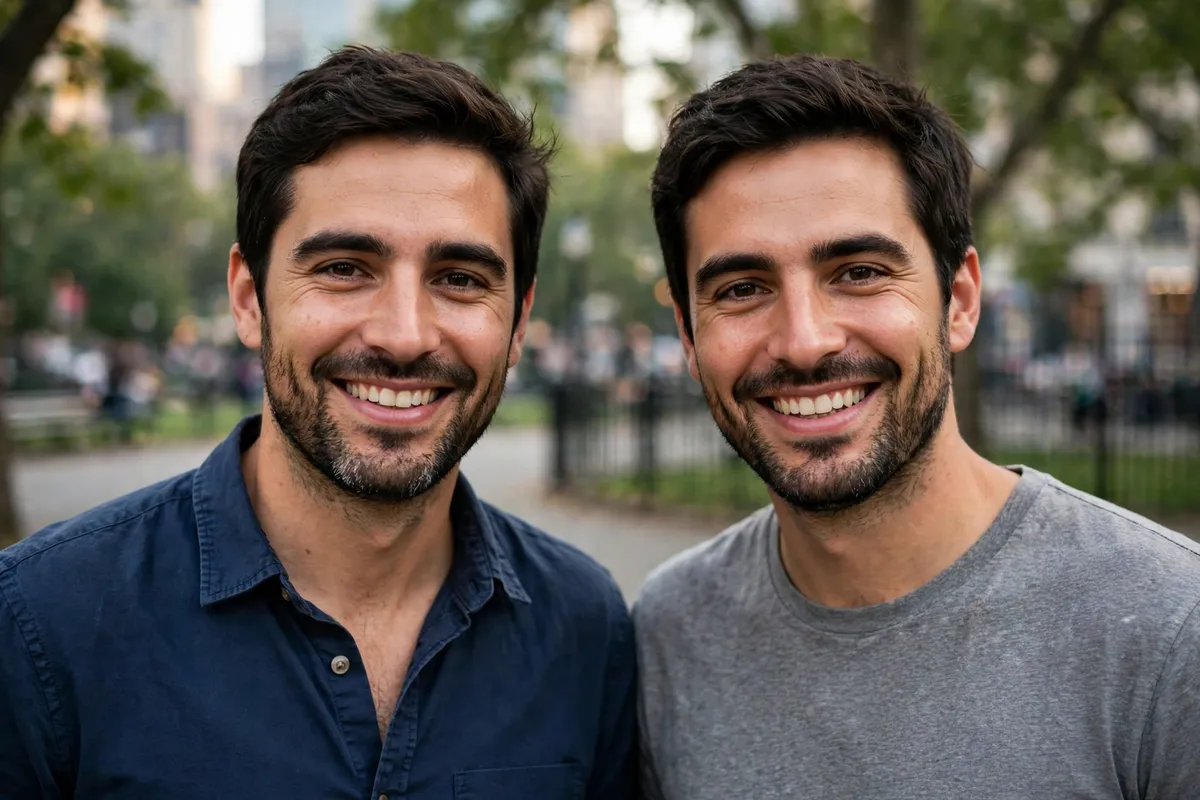

Somewhere in the world, there may be a person who looks almost exactly like you. Same eyes. Same smile. Same face shape. You have never met them, you share no family, and yet a stranger could mistake one of you for the other. That person is your doppelganger.
For centuries, meeting your double was treated as a terrible omen. Today, most people use the word for something far more cheerful — a lookalike spotted in a café or in a photo online. Both meanings are real, and both come from the same German word.
What Does Doppelganger Mean?
In plain words, a doppelganger is a person who looks strikingly like another person but is not related to them. If someone stops you because you look just like their friend, that friend is your doppelganger.
It carries two meanings:
- The everyday meaning: an unrelated lookalike — a stranger with your face. This is how the word is used most of the time today, also called a “twin stranger.”
- The old meaning: a ghostly double of a living person. In folklore, seeing one was a warning of bad luck or death.
Say it like this: DOP-uhl-gang-er, with the strongest beat on the first part. You will see it spelled two ways — doppelgänger, with two dots over the “a,” and doppelganger, without them. Both are accepted.
Where Does the Word Doppelganger Come From?
The word is German, built from two plain pieces: doppel, meaning “double,” and gänger, meaning “walker” or “goer.” Put together, a doppelganger is a “double-walker” — someone who walks the world as your second self.
The idea is far older than the word. People had told stories about spirit doubles for thousands of years before the German writer Jean Paul coined the name in his 1796 novel Siebenkäs, explaining it in a footnote.
Here is the twist most dictionary pages leave out. Jean Paul actually invented two words that day. He used Doppeltgänger for the lookalike — and Doppelgänger for a meal in which two courses were served at the same time. The two words soon swapped jobs, and Doppelgänger became the one we still use for a double.
English already had its own word for the same idea: the fetch, an apparition of a living person, listed in Francis Grose’s Provincial Glossary in 1787. But it was Catherine Crowe’s bestselling ghost book, The Night-Side of Nature (1848), that made the German word familiar to English readers. Like prejudice, a word whose everyday sense narrowed from its older meaning, doppelganger started as something ghostly and ended up as something you might laugh about with friends.
Doppelganger vs Lookalike vs Twin: What Is the Difference?
People use these words as if they mean the same thing. They do not:
| Word | What it means |
|---|---|
| Twin | Two people born from the same pregnancy. Identical twins share the same genes. |
| Lookalike | Anyone who resembles someone else. A loose word — a lookalike can be a vague resemblance. |
| Doppelganger | An unrelated person who looks so much like you that people could mistake one for the other. Stronger than a lookalike, and with no family link. |
| Evil twin | A fictional double who looks like the hero but acts in the opposite, darker way. A story device, not a real person. |
| Alter ego | A second self or hidden side of someone’s personality. It is about character, not looks. |
Every doppelganger is a lookalike, but not every lookalike is a doppelganger — the doppelganger is the uncanny one, the person who makes you do a double-take.
The Old Belief: Seeing Your Double Was Bad Luck
Long before the word existed, the idea of the double was already old. In ancient Egypt, the ka was a spirit double with the same memories and feelings as its person. In Norse myth, the vardøger was a ghostly double seen doing your actions before you arrived. In English and Irish tradition, the fetch played the same role, and in many Muslim countries the qareen is a spirit double sharing your temperament. The warning was much the same everywhere: seeing your own double — especially three times — could mean death would soon follow.
Abraham Lincoln’s doubled reflection
Soon after his election in 1860, Abraham Lincoln reportedly saw his reflection doubled in a mirror, one face beside the other, with a ghostly pallor. The second face appeared twice more when his wife was not there. Mary Todd Lincoln first took it as a sign he would serve two terms — then, more darkly, that he would die before the second one ended.
Percy Shelley meets himself on the terrace
The poet Percy Bysshe Shelley claimed to have met his own doppelganger in the summer of 1822. His wife Mary Shelley wrote about it in a letter that August, weeks after Percy drowned on 8 July 1822. He had told her he had seen a figure of himself on the terrace, which asked him, “How long do you mean to be content?”
Doppelgangers in Books and Films
Writers loved the double because it let them split a character in two — the doppelganger could carry the hero’s dark side, or act as a conscience that would not stay quiet.
Edgar Allan Poe’s “William Wilson” (1839)
A schoolboy meets another boy with the same name, looks, and birthday. The double follows him through life, ruining his schemes — until Wilson kills him and realises he has killed his own better self.
Fyodor Dostoyevsky’s “The Double” (1846)
A mild, awkward clerk meets a bold double who looks just like him and starts taking over his life, while the clerk slides toward madness.
Hans Christian Andersen’s “The Shadow” (1847)
A man’s shadow separates from him, grows into a walking double with the opposite morals, and eventually replaces him entirely. The same fear in fairytale form: what if the copy is better at being you than you are?
The double has been a staple of Gothic fiction ever since.
What Science Says: Do Doppelgangers Share DNA?
In 2022, a team led by the geneticist Manel Esteller published a study in the journal Cell Reports that gave the question a real answer. They started with the photographs of François Brunelle, a Canadian photographer who has spent years — since 1999 — taking portraits of unrelated strangers who look almost identical, for a project called “I’m Not a Look-Alike!” They invited 32 pairs of Brunelle’s lookalikes to answer questions about their lives and give DNA samples. Facial-recognition software scored how similar each pair’s faces were, and 16 of the 32 pairs scored as similar to identical twins. Then came the DNA: of those 16 strongest pairs, 9 shared many of the same genetic variations — single-letter differences in DNA known as SNPs — in the parts of the genome that shape bone structure, skin pigmentation, and how the face holds water. In plain words, the people who looked most alike shared the genes that build a face.
What they did not share is just as interesting. Their epigenomes — the chemical marks that switch genes on and off — were different, and so were their microbiomes. As Esteller put it, “Genetics put them together, and epigenetics and microbiome pulls them apart.” His summary is simple: “There are only so many ways to put a human face together.” With around 7.9 billion people alive today, “these look-alike repetitions are increasingly likely to occur.” A doppelganger is not magic — it is the same set of common genetic variants landing twice, by chance, in a very large crowd.
Does Everyone Have a Doppelganger?
That is the question everyone asks next, and the honest answer is: it depends what you mean by “doppelganger.”
In 2015, the forensic anthropologist Teghan Lucas and her colleague Maciej Henneberg at the University of Adelaide tested the odds with hard numbers. They measured eight facial features on nearly 4,000 people, to the nearest millimetre, and found no two faces that matched on seven traits. Their maths put the chance of two people matching on all eight traits at less than one in a trillion. In other words, there is only about a one-in-135 chance that even a single pair of exact, measurement-perfect doppelgangers exists anywhere on Earth.
But read that carefully. Lucas and Henneberg were measuring faces to the millimetre, and a human eye is far more forgiving than a ruler. Your double’s ears might be a millimetre longer than yours — and nobody in a café would ever notice. As one statistician put it, it depends whether you mean a look-alike to a human, or a look-alike to facial-recognition software. An exact copy, down to the last millimetre, is almost certainly not out there. A near lookalike is far more likely.
There is also a down-to-earth explanation for some “I saw myself” stories. Psychologists have identified a neurological condition called heautoscopy, in which a person hallucinates their own image at a distance — often during illness or exhaustion, which fits the old pattern of doubles appearing when someone was sick or half asleep. The basics of psychology explain why a quick glance at a face can fool you so completely.
The Charlie Chaplin Story: True or Just a Good Tale?
No doppelganger article is complete without the Charlie Chaplin story — and no honest one can tell it as settled fact. The tale goes like this: at the height of his fame, Chaplin secretly entered a Charlie Chaplin lookalike contest and lost. In one version, set in a San Francisco theatre, he failed even to make the finals. In another, told by his son, the contest was at Grauman’s Chinese Theatre in Hollywood — and Chaplin came third.
The problem is that the versions do not agree, and Chaplin himself denied the story in a 1966 interview, saying it had no basis in fact. Most likely, it grew from a real craze — lookalike contests were everywhere in the 1910s and 1920s — and attached itself to the man himself. It survives because it is a perfect little joke: the one person who could not win at being Charlie Chaplin was Charlie Chaplin. Enjoy it as a legend, not as history.

How to Find Your Own Doppelganger
If you want to meet your double, the internet has made it far easier than it used to be. Twin Strangers is the best-known lookalike-matching site: you upload a clear, front-facing photo, and its system compares your face against millions of other registered users. You get five free searches per account — the catch is that your double has to be registered there too. A reverse image search on Google Lens is worth a try as well.
One warning before you upload your face anywhere: read the site’s privacy terms first. A photo of your face is personal data — use a site that lets you delete your account and photos, and never upload anyone else’s photo without their permission.
And if you do meet yours, take the photo first — everyone will want to see it. Then compare notes: the science says lookalikes often share more than a face. Do not expect a mystical bond, though. Your doppelganger shares some of your genes, not your life. That is what makes the meeting fun rather than frightening: two strangers, built from the same handful of genetic parts, who turned out to be entirely different people. An exact copy of your face almost certainly does not exist. But a person who could pass for you at a glance? With eight billion people on the planet, the odds are better than you might think.
What is a doppelganger in simple words?
A doppelganger is a person who looks strikingly like you but is not related to you — an unrelated lookalike, sometimes called a twin stranger. In older folklore, the word meant a ghostly double of a living person.
What does doppelganger mean in German?
It comes from the German words “doppel” (double) and “gänger” (walker or goer), so it literally means “double-walker” — someone who walks the world as your second self.
Is it bad luck to see your doppelganger?
In English and German folklore, seeing your own double — especially three times — was believed to mean death would soon follow. Today most people treat meeting a lookalike as a fun coincidence, not an omen.
Does everyone have a doppelganger?
Probably not an exact one. A 2015 study measuring eight facial features to the nearest millimetre put the chance of an exact match at less than one in a trillion. But a near lookalike — someone who makes strangers do a double-take — is far more likely.
Do doppelgangers share the same DNA?
Partly. A 2022 study in Cell Reports found that the strongest lookalike pairs shared many of the same genetic variations in the parts of the genome that shape the face — but their epigenomes and microbiomes were different, so shared genes, not shared lives, explain the resemblance.
