
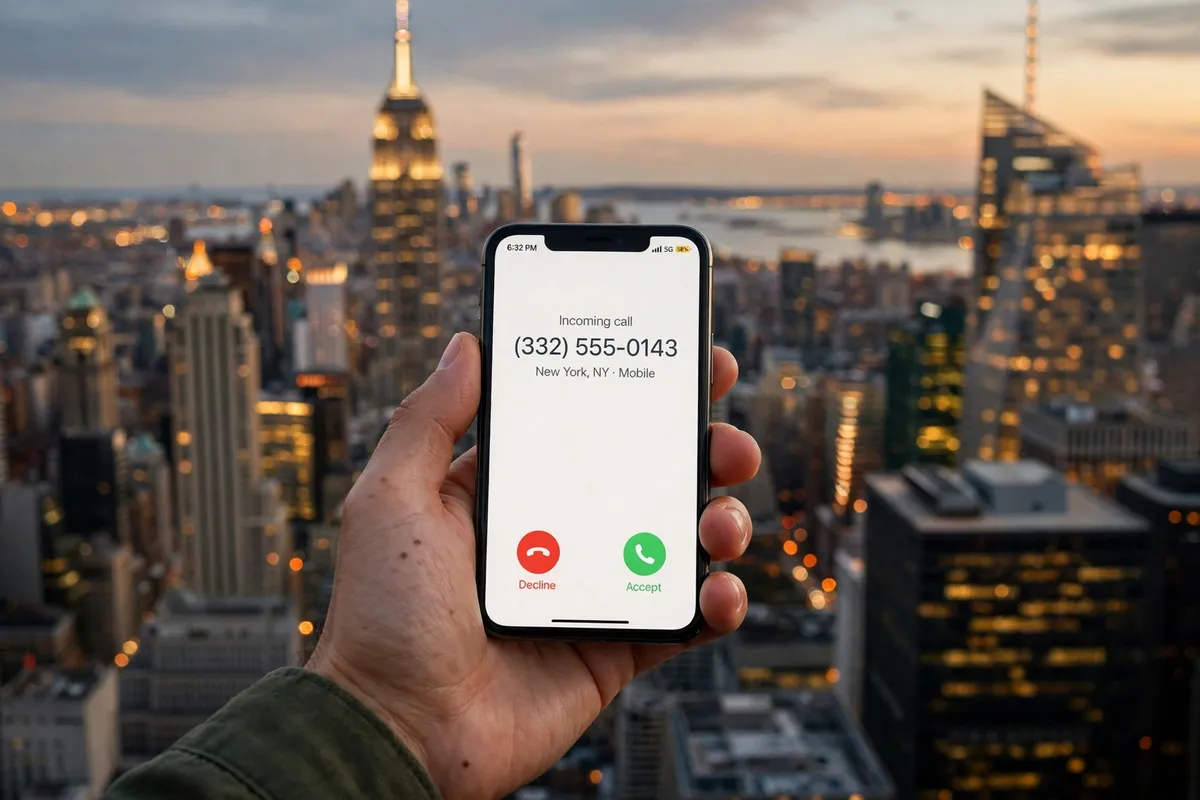

If a number starting with 332 just flashed up on your phone, here is the short answer: it is a Manhattan number. Area code 332 covers the borough of Manhattan in New York City, and nothing else. It has been in service since June 10, 2017, added as an overlay on the famous 212 code because Manhattan was running out of numbers.
The details around it are worth knowing, though. Some lookup sites list Brooklyn and Queens under 332, which is wrong. Plenty of people assume a 332 number is somehow less “real” than a 212. And scammers love borrowing a Manhattan code to look local. This guide sorts out where 332 applies, how it differs from 212, 646 and 917, how to dial it, and how to tell a genuine 332 call from a spoofed one.
Where Is Area Code 332?
Area code 332 serves Manhattan — New York County, New York — from the Battery at the southern tip to Inwood at the northern end: Midtown, the Upper East and Upper West Sides, Harlem, Washington Heights, Chelsea, Greenwich Village, SoHo, Tribeca and the Financial District.
Two edge cases catch people out: Marble Hill counts as part of Manhattan even though it sits on the mainland, north of the Harlem River, and Roosevelt Island, in the East River, is covered too. Both sit inside the 332 footprint and share the same dialing rules as the rest of the borough.
What 332 does not cover matters just as much. The other four boroughs — Brooklyn, Queens, the Bronx and Staten Island — use 718, 347 and 929. So if a lookup site tells you a 332 number belongs to Brooklyn, Queens, Astoria or Sunnyside, that site is wrong: those places sit in 718 territory, and no 332 number is assigned there. The confusion comes from data aggregators that lump whole metro areas together, and it is one of the most common mistakes on the web about this code.
332 sits in the Eastern Time Zone (UTC-5, UTC-4 in daylight saving).
What Is an Overlay Area Code, Anyway?
An overlay adds numbers without redrawing the map. When an area code starts running low, the numbering administrator layers a second code over the exact same territory. Old numbers keep their code, new numbers get the new one, and two neighbours on the same street can end up with different area codes. Nobody has to change their number.
The alternative is a split, where a region is cut in two and half the numbers change — the norm for decades, and a headache for everyone involved. Overlays replaced splits because they are far less disruptive, at one cost: everyone in the area must dial all ten digits, even for a call across the street. Manhattan has done that since 1999, so by the time 332 arrived in 2017, nobody noticed.
Manhattan is not the only place this happened: Phoenix got the 480 area code when its original 602 code ran short, and Arizona’s West Valley later got 623 for the same reason. A city grows, numbers run out, and a new code is laid over the old one.
332 vs 212 vs 646 vs 917: How Manhattan’s Codes Compare
Four codes point at the same island. Side by side, the picture clears up:
| Area code | Since | What it is | Where it applies |
|---|---|---|---|
| 212 | 1947 | The original Manhattan code | Manhattan only |
| 917 | 1992 | First overlay in North America; originally for mobiles and pagers | All five boroughs |
| 646 | 1999 | First all-services overlay on 212 | Manhattan only |
| 332 | 2017 | Second all-services overlay on 212 | Manhattan only |
212, 646 and 332 cover exactly the same ground, with the same dialing rules. 917 is the odd one out — it reaches all five boroughs, built for mobile phones rather than for one place.
How Manhattan Got Four Area Codes
| Year | What happened |
|---|---|
| 1947 | AT&T’s Bell System assigned 212 to New York City as one of the original 86 area codes. It covered all five boroughs. |
| 1984 | 718 was carved out of 212 for Brooklyn, Queens and Staten Island. The Bronx stayed in 212 for a few more years. |
| 1992 | 917 went into service as the first overlay in the North American Numbering Plan, taking mobile and pager numbers across all five boroughs. The Bronx moved to 718 the same year. |
| 1999 | 646 went into service as the first all-services overlay on 212 across Manhattan, and ten-digit dialing became mandatory for every local call. |
| 2017 | 332 was activated on June 10 as the second overlay on 212, after the 212 inventory was projected to run out in the third quarter of that year. |
Each new code arrived because the one before it was nearly full, not because the map changed. 332 was assigned by the North American Numbering Plan Administrator (NANPA) in November 2015, and carriers began preparing for it in early 2017 before the June activation.
How to Dial a 332 Number
Because 332 is an overlay, the area code is never optional: you dial all ten digits for every call, even to the flat next door.
| Calling from | Dial |
|---|---|
| Inside Manhattan (local call) | 332 + seven-digit number |
| Elsewhere in the US | 1 + 332 + seven-digit number |
| Outside the US | +1 332 + seven-digit number |
That first row surprises people: in most of the country a local call needs only seven digits, but in Manhattan seven digits alone will not connect you anywhere — a rule in place since 646 arrived in 1999, and applying to 332 from its first day in 2017.
Is Area Code 332 Still Available?
Yes. 332 is where most new Manhattan numbers come from: it is the youngest of the borough’s codes and holds the deepest inventory left. NANPA’s file lists 163 assigned codes inside 332, and 16 were assigned in the twelve months to November 2026 — carriers are still drawing fresh blocks, including several AT&T codes assigned in October 2026. The three digits after 332 are the central office code: the carrier’s block, not a neighbourhood or a person.
Manhattan is in no danger of running out soon. NANPA’s October 2025 exhaust analysis projects the combined 212, 332, 646 and 917 inventory will last until the first quarter of 2057, and no relief planning for a fourth Manhattan code is under way. Number pooling — carriers sharing blocks of a thousand numbers instead of taking whole exchanges — has eased the crunch that forced 332 into existence, so a new Manhattan line is most likely to start with 332.
Does a 332 Number Mean the Same Thing as a 212?
Yes, in every way that matters: a 332 number is assigned to the same borough, the same rate centre and the same dialing rules as a 212 number, and carries no technical difference at all. The only thing separating them is age — 212 has been around since 1947, and 332 since 2017.
So why does 212 feel special? Because it is scarce. New Yorkers have treated 212 as a status symbol for decades — a signal that you or your business were in Manhattan before the numbers ran out. New lines cannot get a 212 number any more; the inventory is exhausted. That scarcity is the whole story. A new restaurant, law firm or resident will almost certainly get 332 or 646, and that number is every bit as much a Manhattan number as the 212 on a firm that has been there since the seventies.
Can You Keep Your 332 Number If You Move?
Usually, yes — with one catch. US number-portability rules let you keep your number when you switch carriers, and a mobile number generally travels with its owner. The catch is the rate centre: every 332 number is tied to a single one, New York City Zone 01. Move somewhere served by a different rate centre and you may need a new number; move within the New York area and there is normally no problem at all.
The same rule cuts the other way: a 332 number on a mobile phone does not prove its owner is in Manhattan right now — people move, numbers move with them, and a number can be ported between carriers while keeping its code.
Is 332 a Toll-Free Number?
No. 332 is an ordinary geographic area code, and calls to it are billed like any other call inside the United States. Toll-free numbers start with 800, 888, 877, 866, 855, 844 or 833. If someone promises a call to a 332 number is free, check before you dial.
Got a Call From a 332 Number? How to Tell If It Is Real
Here is the part the other guides mostly skip: a 332 number on your caller ID proves nothing about who is calling. Scammers can fake any number they like, a trick called spoofing, and a Manhattan code is a handy disguise because it looks local and trustworthy. The FCC’s own guidance puts it plainly: spoofing is when a caller deliberately falsifies the information sent to your caller ID display, often using “neighbor spoofing” so the call appears to come from a local number, or faking the number of a company or agency you already trust.
So a 332 call could be your bank, your doctor’s office, a restaurant confirming a booking — or a scammer in another country. The number alone cannot tell you which. What you do next is what matters:
Do not answer numbers you do not recognise
If you do pick up and something feels off, hang up straight away — the FCC’s advice is not to answer unknown numbers at all.
Never press buttons or answer yes-or-no questions
If a recording asks you to press a button to stop the calls, just hang up: scammers use that trick to mark your number as live. Do not answer questions that can be answered with a yes or a no, either — a recorded “yes” can be reused.
Never hand over personal details on an incoming call
Account numbers, Social Security numbers, passwords and codes are never things a legitimate caller asks for out of the blue. The FTC’s phone-scam guidance makes the same point: scammers can make any name or number show up on your caller ID, so even a call that looks like a government agency can be a fake.
Verify through a number you trust
If the caller claims to be your bank, phone company or a government agency, hang up and call the number on your statement, your card or the organisation’s official website. A real institution will almost always have written to you first before calling about a payment.
Report it
If you think you have been targeted by a spoofing scam, file a complaint with the FCC through its Consumer Complaint Center. The FTC also takes reports at ReportFraud.ftc.gov, and passes the numbers it receives to carriers and call-blocking services every business day. It takes a minute, and it is the main way these numbers get flagged for everyone else.
None of this means every 332 call is a scam — most are ordinary calls from ordinary Manhattan numbers. It means the area code is not evidence either way, so treat an unexpected 332 call like an unexpected call from any code you do not know.
The Bottom Line
Area code 332 is Manhattan’s newest code: an overlay on 212, in service since June 10, 2017, covering the whole borough from the Battery to Inwood. It shares its territory exactly with 212 and 646, needs ten-digit dialing like every other Manhattan code, and is where most new Manhattan numbers come from — with enough inventory to last into 2057 by NANPA’s projections. It is every bit as much a Manhattan number as a 212. Just remember the code tells you where the number was issued, not who is on the other end of the line.
What city is area code 332?
Manhattan, New York City. Area code 332 covers the whole borough of Manhattan (New York County), from the Battery to Inwood, and has been in service since June 10, 2017.
Is 332 the same as 212?
They cover the same area, but they are different codes. 212 is the original Manhattan code from 1947, while 332 is the newer overlay added in 2017. A 332 number is a real Manhattan number.
Do I need to dial 1 before a 332 number?
For local calls inside Manhattan, dial all 10 digits (332 plus the seven-digit number). From elsewhere in the US, dial 1 + 332 + the number. From abroad, dial +1 332 + the number.
Can a call from a 332 number be a scam?
Yes. Scammers can fake any caller ID, so a 332 number on your screen does not prove the caller is in Manhattan. Do not trust the number alone — hang up and verify through a number you trust.
Is area code 332 toll-free?
No. 332 is an ordinary geographic area code for Manhattan, and calls to it are billed like any other call inside the United States. Toll-free numbers start with 800, 888, 877, 866, 855, 844 or 833.
