
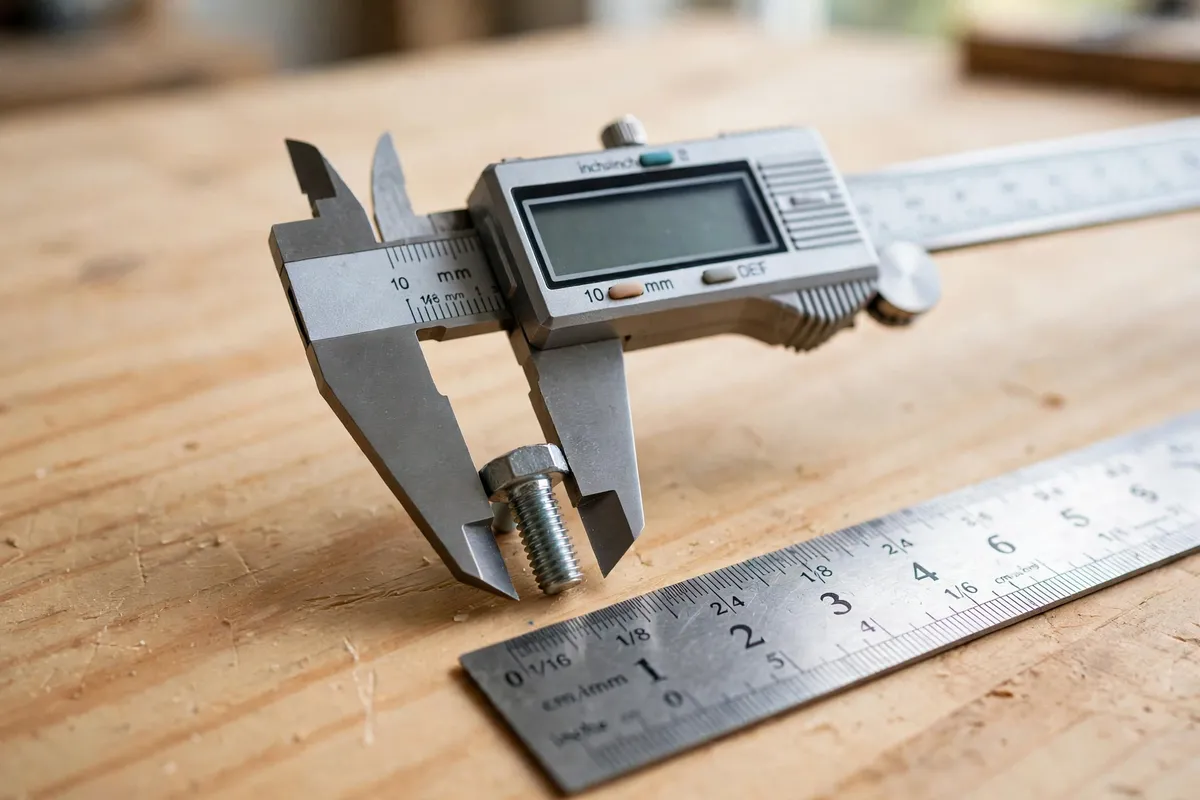

10 millimetres is 0.3937 inches. That is the whole answer, and if you only came for the number, you have it. On a ruler it sits just under the 3/8-inch mark, and it is exactly one centimetre.
The catch is that 0.3937 is not a number you can mark on a tape measure. Tape measures speak in fractions, and 10 mm falls between two of them. That gap is where most of the confusion lives — and where a 10 mm bolt meets a 3/8-inch socket that almost, but does not quite, fits. This guide gives you the exact figure, the formula, a full 1–50 mm chart with fractions, and the real-world places where 10 mm shows up.
How to Convert Millimetres to Inches
There is one rule, and it never changes: divide the millimetres by 25.4. One inch is defined as exactly 25.4 millimetres, so the division is exact. The only rounding happens when you decide how many decimal places to write down.
For 10 mm, the sum looks like this:
10 ÷ 25.4 = 0.3937 inches
Four decimal places is enough for almost everything. If you are working to a finer tolerance, keep more digits: 10 mm is 0.393701 inches, and the decimal goes on from there. To go the other way, multiply inches by 25.4. Half an inch, for example, is 0.5 × 25.4 = 12.7 mm.
One millimetre on its own is 0.03937 inches — a little under 1/25 of an inch, and only about two-thirds of the smallest 1/16-inch mark on most imperial rulers.
If you need a rough answer in your head, multiply the millimetres by 0.04. For 10 mm that gives 0.4 inches, which is close enough to eyeball a cut or pick a drill bit. Just do not use the shortcut where the fit matters. It overshoots by 0.0063 inches on 10 mm, and that error grows with the size — on 100 mm it is already 0.063 inches, more than a sixteenth.
10mm to Inches Conversion Chart
Every whole millimetre from 1 to 50, with the exact decimal and the two fractions you will actually use on a ruler. The 1/16 column is what a standard tape measure reads. The 1/32 column is the finer reading for woodworking and general machining. You can cross-check any value with a converter, but the table below has the common ones covered.
| Millimetres (mm) | Decimal inches | Nearest 1/16″ | Nearest 1/32″ |
|---|---|---|---|
| 1 | 0.0394 | 1/16″ | 1/32″ |
| 2 | 0.0787 | 1/16″ | 3/32″ |
| 3 | 0.1181 | 1/8″ | 1/8″ |
| 4 | 0.1575 | 3/16″ | 5/32″ |
| 5 | 0.1969 | 3/16″ | 3/16″ |
| 6 | 0.2362 | 1/4″ | 1/4″ |
| 7 | 0.2756 | 1/4″ | 9/32″ |
| 8 | 0.3150 | 5/16″ | 5/16″ |
| 9 | 0.3543 | 3/8″ | 11/32″ |
| 10 | 0.3937 | 3/8″ | 13/32″ |
| 11 | 0.4331 | 7/16″ | 7/16″ |
| 12 | 0.4724 | 1/2″ | 15/32″ |
| 13 | 0.5118 | 1/2″ | 1/2″ |
| 14 | 0.5512 | 9/16″ | 9/16″ |
| 15 | 0.5906 | 9/16″ | 19/32″ |
| 16 | 0.6299 | 5/8″ | 5/8″ |
| 17 | 0.6693 | 11/16″ | 21/32″ |
| 18 | 0.7087 | 11/16″ | 23/32″ |
| 19 | 0.7480 | 3/4″ | 3/4″ |
| 20 | 0.7874 | 13/16″ | 25/32″ |
| 21 | 0.8268 | 13/16″ | 13/16″ |
| 22 | 0.8661 | 7/8″ | 7/8″ |
| 23 | 0.9055 |
