
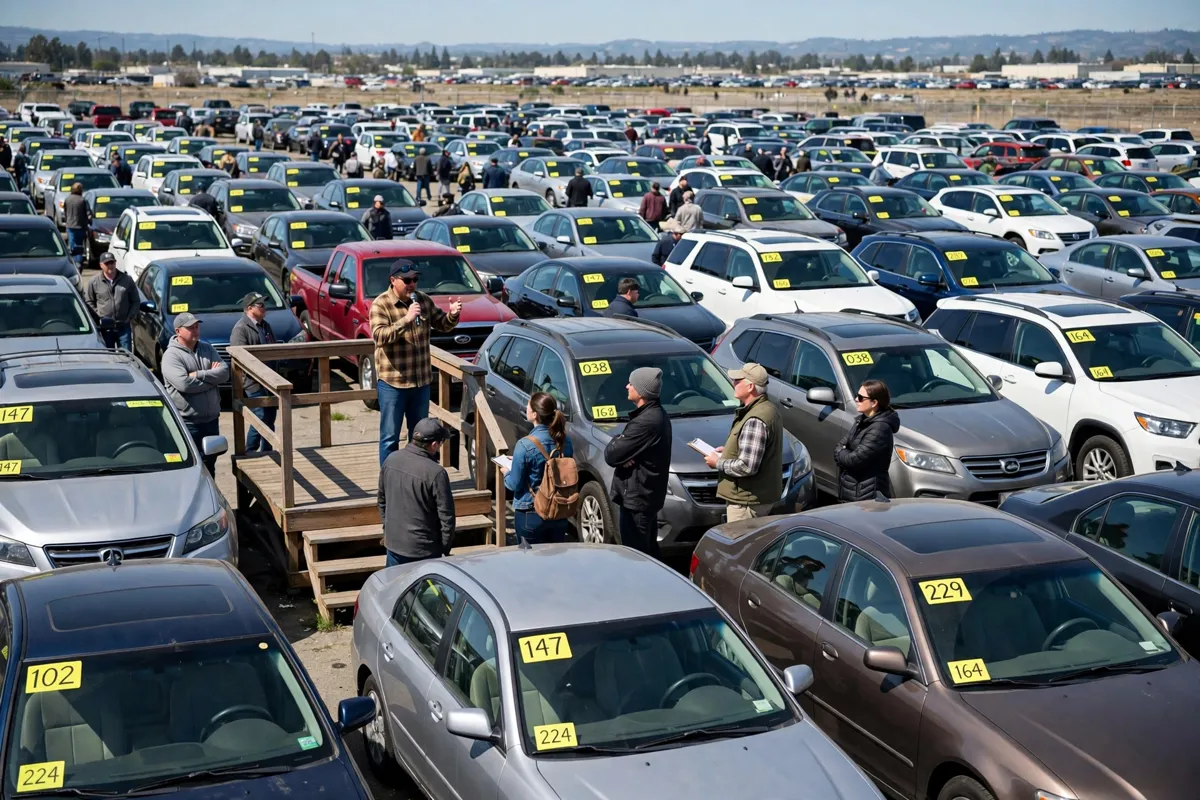

Buying cars at auction sounds like a shortcut to a bargain, and sometimes it is. A car that would cost $8,000 at a dealership can hammer down for $5,000 in front of a fast-talking auctioneer. But that $5,000 is not the price. Fees, transport, repairs and paperwork stack up after the gavel falls, and the car is yours as-is, with no warranty and no cooling-off period. This guide walks you through how auctions really work, what a winning bid actually costs, and the simple formula that keeps you from overpaying on your first car.
What Buying Cars at Auction Actually Means
A car auction is a sale where vehicles go to the highest bidder, one lot at a time. The seller might be an insurance company offloading a written-off car, a bank selling a repossessed one, a government agency retiring fleet vehicles, or a dealer clearing old stock. The auction house runs the sale and takes a fee from the buyer. You do not haggle. You bid against the room, or against thousands of people online, and the highest number wins.
Not every auction is open to you. There are five kinds worth knowing, and they decide who can bid and what condition the cars are in.
| Auction type | Who can bid | What you will find |
|---|---|---|
| Public auctions | Anyone 18 or older | Repossessions, trade-ins, lease returns, impounded cars |
| Dealer-only wholesale (Manheim, ADESA) | Licensed dealers only | Trade-ins and off-lease cars dealers buy to resell |
| Salvage auctions (Copart, IAA) | Public buyers in many states, dealers everywhere | Insurance total-loss cars, from lightly damaged to wrecked |
| Government and fleet (GSA Auctions) | Anyone 18 or older | Retired federal fleet cars with clean titles |
| Enthusiast platforms (Bring a Trailer, Cars & Bids) | Anyone registered | Collector and specialty cars, usually at premium prices |
For a first-time buyer, the realistic starting points are public auctions, the salvage giants Copart and IAA, and government fleet sales. Dealer-only wholesale auctions are closed to you unless you hire a licensed dealer to bid on your behalf, which adds a broker fee of roughly $200 to $500 to every purchase.
Can Anyone Buy a Car at Auction?
Yes, with two conditions. First, you must be 18 or older and register with the auction house, which means a government photo ID and, at most places, a refundable deposit. Second, your state has to allow it. Public access to salvage auctions is set by state law, not by the auction company, and it varies a lot.
At Copart, a private individual can bid directly on both clean-title and salvage cars in 15 states, and on neither in 25. At IAA, the numbers are similar: direct public bidding on clear and salvage titles in 16 states, and neither in 24. In the rest, you either bid through a licensed broker or stick to the lots your state does allow. Always check the auction’s state eligibility page before you fall in love with a car, because the rules follow where the car sits, not where you live.
Registration itself is straightforward. Copart offers a Basic membership at $99 a year for occasional buyers and a Premier membership at $249 a year, which comes with a $400 refundable deposit and higher bidding limits. A Basic member can bid up to $2,000 with no deposit and puts down 10% of anything above that. IAA charges public buyers a $225 annual membership fee, paid by card when you register. Both sites let you browse for free as a guest before you pay anything, so look around first.
How Buying a Car at Auction Works, Step by Step
Step 1: Register and pick your auction
Start with the kind of car you need, not the auction. A daily driver with a clean title points you toward public auctions and GSA fleet sales. A project car you plan to repair points you toward Copart or IAA salvage lanes. Register on one platform, learn its fee schedule and its state rules, and watch a few sales end before you bid on anything. Watching costs nothing and teaches you the pace: a lot can sell in under a minute.
Step 2: Shortlist cars and check the VIN
Every listing carries a VIN, the car’s 17-digit fingerprint. Run it through the National Motor Vehicle Title Information System at vehiclehistory.gov before you bid. It is the federal database that shows title brands, total-loss records and odometer readings reported by insurers, salvage yards and state motor vehicle departments. A paid report from Carfax or AutoCheck adds service history and accident detail, but the NMVTIS check is the one that tells you whether the title is clean, salvage or branded in another state. Skip any car whose VIN story does not match the listing.
Step 3: Inspect the car in person
Almost no auction lets you test drive. At most, you can start the engine, listen for knocks, check for smoke, and walk around the car. That is your whole inspection, so make it count. Bring a flashlight and a friend who knows cars, or pay a local mechanic to meet you at the yard. Check the oil and coolant, look under the car for leaks, check that the frame rails are straight, and look for mismatched paint and uneven panel gaps, which point to repaired crash damage. At Copart and IAA, many lots have photo galleries and short video walkarounds, but photos hide rust and smells. If you cannot inspect a car yourself, treat the listing photos as a guess, not a fact, and bid accordingly.
Step 4: Set your maximum bid before the sale starts
Write your ceiling down before the bidding starts, and do not move it when the auctioneer is shouting. Your ceiling is not the car’s value. It is the car’s value minus repairs, minus fees, minus transport. There is a formula for it further down this guide. Bidding without a ceiling is how a $4,000 bargain becomes a $6,500 mistake.
Step 5: Bid, and understand the reserve
At a live auction, the auctioneer opens the lot, calls for bids, and sells to the highest hand in the air. Online, you can place a pre-bid before the sale or bid live while it runs. Some cars carry a reserve price, a minimum the seller will accept. If bidding stops below the reserve, the car does not sell, though you can sometimes negotiate with the seller afterward. A winning bid is a binding contract. If you win and refuse to pay, you face penalties and a ban from future auctions.
Step 6: Pay and pick up the car
Winning is the start of the paperwork, not the end of it. Copart gives you three business days to pay in full; after that comes a $50 late fee, and a car left unpaid for eight days is relisted and you owe 10% of the price, with a $600 minimum. IAA is tighter: payment is due by 5 p.m. local branch time on the second business day after the award, with a late fee of $50 or 2% of the price, whichever is greater. Unpaid after seven days, the renege fee is $1,000 or 15% of the price. Pick up the car quickly, too. Copart includes three free storage days, then charges roughly $30 a day. Most auctions will not let you drive the car off the lot even if it runs, so budget for a tow or a trailer.
The Real Cost: What a Winning Bid Actually Costs
The hammer price is only the first line of the bill. Every auction layers fees on top of it, and on cheaper cars the fees can add 25% to 40% to what you pay. Here is what a $5,000 winning bid at Copart looks like for a public buyer paying by a secured method, using Copart’s published fee schedule.
| Charge | Amount |
|---|---|
| Winning bid | $5,000 |
| Buyer fee (tiered by bid) | $750 |
| Internet bid fee (online win) | $179 |
| Gate fee | $95 |
| Environmental fee | $15 |
| Title and documentation fee | $20 |
| Total before tax, transport and repairs | $6,059 |
That is $1,059, or about 21%, on top of the bid, before you have paid sales tax, towed the car home, or fixed anything. IAA works the same way. A $3,500 winning bid there costs a non-licensed buyer about $940 in fees: a $705 buyer fee, a $110 live online bid fee, a $105 service fee and a $20 title-handling fee. The exact numbers change with the bid size, the title type and how you pay. Paying by credit card instead of a wire or debit card raises Copart’s buyer fee, and a clean-title car carries a lower gate fee ($79) than a non-clean one ($95). Check the fee schedule on Copart’s member fees page or the lot page before you bid, and run the auction’s own fee calculator on the exact lot you want.
One route avoids the fee stack almost entirely. GSA Auctions sells retired federal fleet vehicles to the public, and GSA fleet sales carry no buyer premium and no registration fee. You still pay state sales tax, titling and transport, but the auction itself adds nothing to the bid. For a buyer who needs a drive-ready, insurable car rather than a project, that is often the cheapest door into auctions.
The Max-Bid Formula (So You Never Overpay)
Before you bid on any car, work out your ceiling with this formula, used by salvage buyers to keep a margin for the unknowns:
Maximum bid = (clean-title value x 0.70) – repair estimate – fees
The 0.70 is the rebuilt-title discount. A car with a salvage or rebuilt title is worth roughly 30% less than the same car with a clean title, because insurers charge more to cover it, banks are reluctant to finance it, and the next buyer will discount it too. The formula builds that discount in before you spend a dollar.
Here it is on a real example. Say a clean-title 2018 Honda Civic is worth $8,000, the auction car needs $1,000 of repairs, and fees will run about $900:
$8,000 x 0.70 = $5,600. Minus $1,000 for repairs = $4,600. Minus $900 for fees = $3,700. Your maximum bid is $3,700. If the bidding passes $3,700, let it go. There will be another Civic next week, and the auction is not going anywhere.
Title Types, Decoded
The title is the car’s legal identity, and the word on it decides whether you can register, insure and resell the car. Four labels cover almost everything you will see at auction.
Clean title. No insurance total-loss record, no flood or salvage brand. This is the normal title, and the easiest car to register, insure and finance.
Salvage title. An insurer declared the car a total loss, which usually means the repair estimate passed a percentage of the car’s value, not that the car is destroyed. Modern cars get totaled for surprisingly minor damage because sensors and calibration are so expensive. A salvage-title car can be repaired, inspected and re-titled as rebuilt in most states.
Rebuilt title. A former salvage car that has been repaired and passed a state inspection. It is legal to drive and insure, but it is worth 25% to 40% less than a clean-title car, and some insurers will only offer liability coverage on it.
Non-repairable, scrap or parts-only title. The car can never be registered for road use again, in any state. It is for parts or scrap only. Never bid on one expecting to drive it.
Watch for title washing. A salvage brand can be laundered by re-registering the car in a state with looser branding rules, so the new title comes back clean. That is why the NMVTIS check matters more than the piece of paper in front of you: it follows the VIN across states, and a brand that was washed off a title still shows up in the database.
After You Win: Payment, Pickup and Paperwork
The clock starts the moment the lot closes. Pay inside the window, collect the car before storage fees start, and get the title transferred in your name. A salvage-title car needs a rebuilt inspection first in most states, so check your DMV’s rules before you bid. Do not drive the car until it is registered and insured in your name.
Arrange transport before you bid. Most auctions ban drive-offs for liability reasons, even if the car runs perfectly. A local tow costs roughly $100 to $300 depending on distance, and a long-distance haul can cost far more. IAA lets you book a tow through its own transport service at checkout, which helps stop storage fees from adding up while you arrange a truck.
Transfer the title and register the car. The auction sends you the title, usually within a few weeks. Take it to your state motor vehicle department with proof of insurance and pay the sales tax and registration fees.
Insure it before it moves. Call your insurer with the VIN as soon as you win. A branded title can mean higher premiums or liability-only coverage, and you want to know that before the car is sitting in your driveway uninsured.
7 Beginner Mistakes That Cost Real Money
1. Bidding without checking the fees
The most common beginner error is treating the winning bid as the price. Fees add 25% to 40% on a cheap car. Run the auction’s fee calculator on the exact lot before you bid, and set your ceiling from the all-in number, not the hammer price.
2. Skipping the VIN and title check
A $25 NMVTIS report can save you from a flood car, an odometer rollback or a washed title. Check the VIN before you bid, not after you have paid.
3. Guessing the repair bill
Photos hide the expensive stuff. Get a repair estimate from a mechanic who has seen the car, or assume the worst and price it in. A car that needs a transmission is not a bargain at any bid.
4. Chasing a car past your ceiling
Auction fever is real, and the auctioneer is good at it. Write your maximum bid on paper before the sale, and stop when the bidding passes it. There is always another lot.
5. Ignoring the title type
A salvage title is a project. A non-repairable title is scrap. Bidding on either as if it were a clean-title daily driver is how beginners end up with a car they cannot legally drive.
6. Forgetting transport and storage
The tow home and the daily storage fee are part of the price. A car that sits at the yard for a week while you find a truck can cost hundreds more than the bid suggested.
7. Assuming you can drive it home
Most auctions do not allow drive-offs. If you have no trailer and no tow booked, you have bought a car you cannot move. Sort transport before you bid, not after you win.
Is Buying a Car at Auction Worth It?
For the right buyer, yes. If you can inspect cars yourself, pay cash, arrange your own transport, and live with a branded title, auctions are one of the cheapest ways to buy a car. Insurance salvage guides put the discount at roughly 20% to 40% below comparable clean-title prices, and government fleet sales can be cheaper still, with no buyer premium at all.
It is a poor fit if you need a car this week, you need financing, or you cannot tell a good engine from a bad one. A financed buyer cannot buy at most salvage auctions anyway, since lenders will not finance a branded-title car sight unseen. And if you are buying your first car and you have never turned a wrench, a dealer car with a warranty is a safer first purchase, even at a higher price. Just like timing any big purchase, the best deal at auction goes to the buyer who did the homework before the sale started. The same goes for choosing when to buy: the cheapest car is the one you researched, inspected, priced with fees included, and walked away from when the bidding passed your ceiling.
Go to one auction as a spectator first. Watch how fast the lots move, listen to how the fees are announced, and see what a $5,000 car actually looks like. Then register, set your budget, and bid on one car, not five. The bargain is real. So is the risk. The buyers who come out ahead are the ones who knew both before they raised a hand.
Can I buy a car at auction without a dealer license?
Yes. Public auctions, government fleet sales and the public tiers of Copart and IAA are open to anyone 18 or older. Dealer-only wholesale auctions like Manheim need a license, or a licensed broker bidding for you.
How much are the fees on top of the winning bid?
A lot. A $5,000 winning bid at Copart costs about $1,059 in fees (buyer fee $750, internet bid fee $179, gate fee $95, environmental fee $15, title fee $20), and a $3,500 win at IAA costs about $940. Budget 25% to 40% extra on cheaper cars, plus tax, transport and repairs.
What is a salvage title?
A title brand meaning an insurer declared the car a total loss, usually because the repair estimate passed a percentage of the car’s value. A salvage car can be repaired and re-titled as rebuilt in most states after inspection, but it is worth 25% to 40% less than a clean-title car.
Can I test drive a car before bidding at auction?
Almost never. At most auctions you can start the engine, listen for odd noises and walk around the car, but test drives are not allowed. Bring a mechanic or pay for an inspection instead.
How soon do I have to pay after winning a car at auction?
Copart gives you three business days to pay in full; IAA requires payment by 5 p.m. local branch time on the second business day. Both charge late fees, and an unpaid car can be relisted with a penalty of 10% (Copart) or $1,000 or 15% (IAA).
