
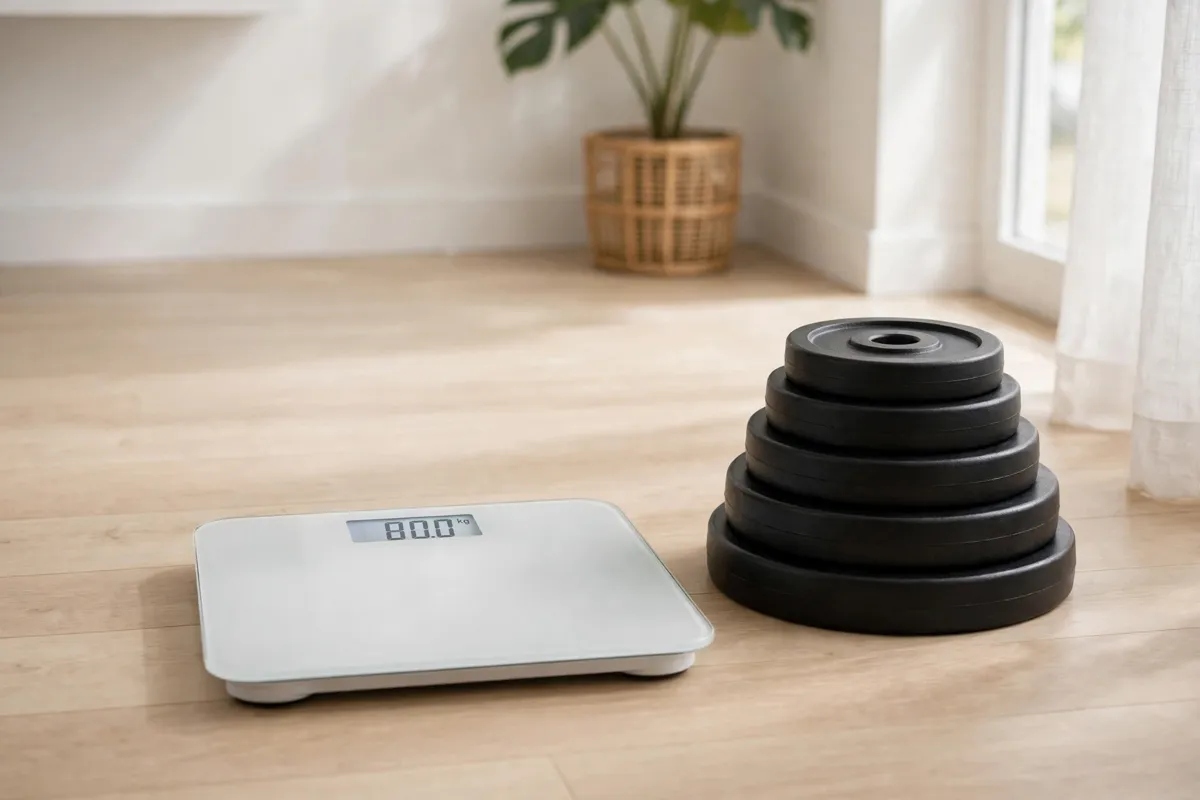

80 kg is 176.37 lb. 32 kg is 70.55 lb. 200 kg is 440.92 lb. Those are the three answers most people come here for, and they are all on this page in the first table below. If you only need one number, take it and go. If you want the method, the stone equivalents, or the full 1–100 kg chart, keep reading — everything here is worked from the same exact conversion, so the numbers agree with each other wherever you look.
The formula is short: multiply kilograms by 2.20462. One kilogram equals 2.20462 pounds, because the pound is defined as exactly 0.45359237 kilograms. That definition was fixed by international agreement in 1959, so this is not a measurement that might change — it is arithmetic, and every value on this page follows from it.
The Three Answers, Up Front
Here are the three searched weights in every form you are likely to need: decimal pounds, pounds and ounces, and stone and pounds for UK readers.
| Kilograms | Pounds (lb) | Pounds and ounces | Stone and pounds |
|---|---|---|---|
| 80 kg | 176.37 lb | 176 lb 5.9 oz | 12 st 8.4 lb |
| 32 kg | 70.55 lb | 70 lb 8.8 oz | 5 st 0.5 lb |
| 200 kg | 440.92 lb | 440 lb 14.8 oz | 31 st 6.9 lb |
A quick note on rounding: the exact figures are 176.3698 lb, 70.5479 lb and 440.9245 lb. Two decimal places is plenty for luggage, gym weights and everyday weighing. If you are totalling freight or working to a strict limit, carry more digits — the full chart below is rounded to two decimals, and the formula section shows how to get the exact value.
How to Convert Kilograms to Pounds
There is one formula, and it works in both directions.
Kilograms to pounds: multiply by 2.20462
Pounds = kilograms × 2.20462
Worked example, step by step:
80 kg × 2.20462 = 176.3696 lb, which rounds to 176.37 lb.
Try it with the other two weights. 32 × 2.20462 = 70.5478, so 32 kg = 70.55 lb. And 200 × 2.20462 = 440.924, so 200 kg = 440.92 lb. Same formula, same rounding, no surprises.
Pounds to kilograms: multiply by 0.45359237
Going the other way, multiply pounds by 0.45359237 — or divide by 2.20462, which is the same thing.
Kilograms = pounds × 0.45359237
Worked examples: 176 lb × 0.45359237 = 79.83 kg, so 176 lb is just under 80 kg. 70 lb × 0.45359237 = 31.75 kg. And 440 lb × 0.45359237 = 199.58 kg, a touch under 200 kg. That small gap is real, not a mistake: 176 lb is not quite 80 kg, it is 79.83 kg, because the exact 80 kg figure is 176.37 lb.
If you only remember one number, remember 2.20462. It is the only conversion factor you need for this pair of units.
The Quick Mental Shortcut — and How Far Off It Is
No calculator to hand? Double the kilograms and add 10% of the doubled number. For 80 kg that is 160 + 16 = 176 lb. It takes two seconds and lands within half a pound every time.
Here is how the three common shortcuts compare against the exact answers:
| Weight | Exact | Double + 10% (× 2.2) | Error | × 2.205 | Error |
|---|---|---|---|---|---|
| 32 kg | 70.55 lb | 70.40 lb | −0.15 lb | 70.56 lb | +0.01 lb |
| 80 kg | 176.37 lb | 176.00 lb | −0.37 lb | 176.40 lb | +0.03 lb |
| 200 kg | 440.92 lb | 440.00 lb | −0.92 lb | 441.00 lb | +0.08 lb |
Two things worth noticing. First, doubling and adding 10% is exactly the same as multiplying by 2.2, so the two shortcuts always give the same answer. Second, the error grows with the weight: a third of a pound off at 80 kg becomes nearly a full pound off at 200 kg. For a person stepping on a scale, that does not matter — bodyweight moves by more than that in a day. For freight, where charges are calculated per kilogram, use the full 2.20462.
The × 2.205 shortcut is the most accurate of the three and still easy to do in your head for round numbers: 80 × 2.205 = 176.4 lb, only 0.03 lb from exact. If you want a shortcut you can trust at any size, that is the one.
Kilograms to Pounds in Stone (for UK Readers)
Britain is the odd one out: nearly everything is weighed in kilograms except people, who are still weighed in stone and pounds. A stone is 14 pounds, and that is all you need to convert.
Take the pounds figure and divide by 14. The whole number is the stone; multiply the decimal part by 14 and you get the leftover pounds.
For 80 kg: 176.37 ÷ 14 = 12.598, so 12 whole stone, and 0.598 × 14 = 8.4 lb left over. 80 kg = 12 st 8.4 lb.
For 32 kg: 70.55 ÷ 14 = 5.039, so 5 stone and 0.039 × 14 = 0.5 lb. 32 kg = 5 st 0.5 lb — barely over five stone.
For 200 kg: 440.92 ÷ 14 = 31.495, so 31 stone and 0.495 × 14 = 6.9 lb. 200 kg = 31 st 6.9 lb.
Watch out for the classic trap: 12.6 stone is not 12 stone 6 lb. The decimal is in fourteenths, not tenths, so 0.6 of a stone is 0.6 × 14 = 8.4 lb, not 6 lb. If you ever see a weight written as “12 stone 6”, it is wrong — the correct figure is 12 stone 8 lb.
The Full Kilograms to Pounds Chart (1–100 kg)
Every whole kilogram from 1 to 100, with the stone equivalent alongside. Values are rounded to two decimal places.
| kg | lb | Stone | kg | lb | Stone |
|---|---|---|---|---|---|
| 1 | 2.20 | 0 st 2.2 lb | 51 | 112.44 | 8 st 0.4 lb |
| 2 | 4.41 | 0 st 4.4 lb | 52 | 114.64 | 8 st 2.6 lb |
| 3 | 6.61 | 0 st 6.6 lb | 53 | 116.84 | 8 st 4.8 lb |
| 4 | 8.82 | 0 st 8.8 lb | 54 | 119.05 | 8 st 7.0 lb |
| 5 | 11.02 | 0 st 11.0 lb | 55 | 121.25 | 8 st 9.3 lb |
| 6 | 13.23 | 0 st 13.2 lb | 56 | 123.46 | 8 st 11.5 lb |
| 7 | 15.43 | 1 st 1.4 lb | 57 | 125.66 | 8 st 13.7 lb |
| 8 | 17.64 | 1 st 3.6 lb | 58 | 127.87 | 9 st 1.9 lb |
| 9 | 19.84 | 1 st 5.8 lb | 59 | 130.07 | 9 st 4.1 lb |
| 10 | 22.05 | 1 st 8.0 lb | 60 | 132.28 | 9 st 6.3 lb |
| 11 | 24.25 | 1 st 10.3 lb | 61 | 134.48 | 9 st 8.5 lb |
| 12 | 26.46 | 1 st 12.5 lb | 62 | 136.69 | 9 st 10.7 lb |
| 13 | 28.66 | 2 st 0.7 lb | 63 | 138.89 | 9 st 12.9 lb |
| 14 | 30.86 | 2 st 2.9 lb | 64 | 141.10 | 10 st 1.1 lb |
| 15 | 33.07 | 2 st 5.1 lb | 65 | 143.30 | 10 st 3.3 lb |
| 16 | 35.27 | 2 st 7.3 lb | 66 | 145.51 | 10 st 5.5 lb |
| 17 | 37.48 | 2 st 9.5 lb | 67 | 147.71 | 10 st 7.7 lb |
| 18 | 39.68 | 2 st 11.7 lb | 68 | 149.91 | 10 st 9.9 lb |
| 19 | 41.89 | 2 st 13.9 lb | 69 | 152.12 | 10 st 12.1 lb |
| 20 | 44.09 | 3 st 2.1 lb | 70 | 154.32 | 11 st 0.3 lb |
| 21 | 46.30 | 3 st 4.3 lb | 71 | 156.53 | 11 st 2.5 lb |
| 22 | 48.50 | 3 st 6.5 lb | 72 | 158.73 | 11 st 4.7 lb |
| 23 | 50.71 | 3 st 8.7 lb | 73 | 160.94 | 11 st 6.9 lb |
| 24 | 52.91 | 3 st 10.9 lb | 74 | 163.14 | 11 st 9.1 lb |
| 25 | 55.12 | 3 st 13.1 lb | 75 | 165.35 | 11 st 11.3 lb |
| 26 | 57.32 | 4 st 1.3 lb | 76 | 167.55 | 11 st 13.6 lb |
| 27 | 59.52 | 4 st 3.5 lb | 77 | 169.76 | 12 st 1.8 lb |
| 28 | 61.73 | 4 st 5.7 lb | 78 | 171.96 | 12 st 4.0 lb |
| 29 | 63.93 | 4 st 7.9 lb | 79 | 174.17 | 12 st 6.2 lb |
| 30 | 66.14 | 4 st 10.1 lb | 80 | 176.37 | 12 st 8.4 lb |
| 31 | 68.34 | 4 st 12.3 lb | 81 | 178.57 | 12 st 10.6 lb |
| 32 | 70.55 | 5 st 0.5 lb | 82 | 180.78 | 12 st 12.8 lb |
| 33 | 72.75 | 5 st 2.8 lb | 83 | 182.98 | 13 st 1.0 lb |
| 34 | 74.96 | 5 st 5.0 lb | 84 | 185.19 | 13 st 3.2 lb |
| 35 | 77.16 | 5 st 7.2 lb | 85 | 187.39 | 13 st 5.4 lb |
| 36 | 79.37 | 5 st 9.4 lb | 86 | 189.60 | 13 st 7.6 lb |
| 37 | 81.57 | 5 st 11.6 lb | 87 | 191.80 | 13 st 9.8 lb |
| 38 | 83.78 | 5 st 13.8 lb | 88 | 194.01 | 13 st 12.0 lb |
| 39 | 85.98 | 6 st 2.0 lb | 89 | 196.21 | 14 st 0.2 lb |
| 40 | 88.18 | 6 st 4.2 lb | 90 | 198.42 | 14 st 2.4 lb |
| 41 | 90.39 | 6 st 6.4 lb | 91 | 200.62 | 14 st 4.6 lb |
| 42 | 92.59 | 6 st 8.6 lb | 92 | 202.83 | 14 st 6.8 lb |
| 43 | 94.80 | 6 st 10.8 lb | 93 | 205.03 | 14 st 9.0 lb |
| 44 | 97.00 | 6 st 13.0 lb | 94 | 207.23 | 14 st 11.2 lb |
| 45 | 99.21 | 7 st 1.2 lb | 95 | 209.44 | 14 st 13.4 lb |
| 46 | 101.41 | 7 st 3.4 lb | 96 | 211.64 | 15 st 1.6 lb |
| 47 | 103.62 | 7 st 5.6 lb | 97 | 213.85 | 15 st 3.8 lb |
| 48 | 105.82 | 7 st 7.8 lb | 98 | 216.05 | 15 st 6.1 lb |
| 49 | 108.03 | 7 st 10.0 lb | 99 | 218.26 | 15 st 8.3 lb |
| 50 | 110.23 | 7 st 12.2 lb | 100 | 220.46 | 15 st 10.5 lb |
Heavier weights: 105–300 kg
For freight, gym equipment and larger items, here are the heavier values in steps of five kilograms.
| kg | lb | kg | lb | kg | lb |
|---|---|---|---|---|---|
| 105 | 231.5 | 155 | 341.7 | 205 | 451.9 |
| 110 | 242.5 | 160 | 352.7 | 210 | 463.0 |
| 115 | 253.5 | 165 | 363.8 | 215 | 474.0 |
| 120 | 264.6 | 170 | 374.8 | 220 | 485.0 |
| 125 | 275.6 | 175 | 385.8 | 225 | 496.0 |
| 130 | 286.6 | 180 | 396.8 | 230 | 507.1 |
| 135 | 297.6 | 185 | 407.9 | 235 | 518.1 |
| 140 | 308.6 | 190 | 418.9 | 240 | 529.1 |
| 145 | 319.7 | 195 | 429.9 | 245 | 540.1 |
| 150 | 330.7 | 200 | 440.9 | 250 | 551.2 |

Where These Three Weights Actually Come Up
These are not random numbers. Each of the three weights shows up in a different part of everyday life, which is why they are searched so often.
32 kg: the suitcase limit
Thirty-two kilograms is the per-piece weight limit many airlines set for business-class checked bags — 70.55 lb, usually rounded to 70 lb on the airline’s own pages. If your bag weighs 32 kg at check-in, it is right on the line, so weigh it at home first. The same figure turns up in shipping, where 32 kg is a common maximum for a single parcel under courier rules.
80 kg: a person’s weight
Eighty kilograms is almost always a bodyweight figure. On its own it says very little — the same 80 kg reads very differently depending on height. Paired with height it becomes a body mass index: weight in kilograms divided by height in metres squared. At 1.80 m tall, 80 kg gives a BMI of 24.7 (80 ÷ 1.8²). BMI is a rough screening number, not a diagnosis: it takes no account of muscle mass or build, so treat it as one data point among several, and talk to your clinician if you want a real assessment of your weight.
200 kg: heavy things
Two hundred kilograms is 440.92 lb — roughly the weight of a large motorcycle or a grand piano. It is the sort of figure you meet when moving furniture, hiring a van, or reading a weight limit on equipment. At this size the rounding matters more: using the rough × 2.2 shortcut gives 440 lb, nearly a full pound short of the true 440.92 lb, so use the full factor when the number decides a price or a safety limit.
Common Mistakes to Avoid
Most conversion errors come from the same few slips. They are all easy to avoid once you know them.
Converting in the wrong direction
The commonest mistake is multiplying when you should divide. Kilograms are the smaller number: 80 kg is 176 lb, not 36 lb. If your answer comes out smaller than the number you started with, you have gone the wrong way — pounds are always the bigger figure.
Mixing up pounds and fluid ounces
Pounds measure weight; fluid ounces measure volume. A fluid ounce of water weighs about an ounce, but that is a coincidence of water’s density, not a rule — a fluid ounce of honey weighs considerably more. If you are converting liquid volumes, our guide to how many ounces are in a gallon covers that side of it.
Reading stone decimals as pounds
As shown above, 12.6 stone is 12 stone 8.4 lb, not 12 stone 6 lb. The decimal part of a stone figure is a fraction of 14 pounds, so always multiply it by 14.
Rounding too early
Rounding 2.20462 down to 2.2 and then multiplying a big number compounds the error — at 200 kg it costs you almost a pound. Round only at the end, never in the middle of the calculation.
Why the Number Is 2.20462
The conversion factor is not a measurement. It comes from a definition: since 1 July 1959, the international pound has been defined as exactly 0.45359237 kilograms, under an agreement between the United States, the United Kingdom, Canada, Australia, New Zealand and South Africa. One kilogram is therefore 1 ÷ 0.45359237 pounds, which works out to 2.2046226218… — a number that never terminates, which is why we round it to 2.20462 for everyday use.
The definition is published in the NIST Guide for the Use of the International System of Units (SP 811), and the history of the pound records the 1959 agreement and the earlier definitions it replaced. Because the factor is exact by definition, converting back and forth loses nothing except the digits you choose to drop when rounding.
That is the whole story: three answers, one formula, and a chart for everything in between. Bookmark the chart if you convert often — and if you work with other units, our guide to converting milliliters to
milligrams and our Celsius to Fahrenheit chart follow the same pattern: the answer first, the method second, and no invented numbers anywhere.
How many pounds is 80 kg?
80 kg is 176.37 pounds. Multiply 80 by 2.20462 to get 176.3698, which rounds to 176.37 lb. In stone that is 12 stone 8.4 lb.
How many pounds is 32 kg?
32 kg is 70.55 pounds. Multiply 32 by 2.20462 to get 70.5479, which rounds to 70.55 lb — just over 5 stone (5 st 0.5 lb).
How many pounds is 200 kg?
200 kg is 440.92 pounds. Multiply 200 by 2.20462 to get 440.9245, which rounds to 440.92 lb. In stone that is 31 stone 6.9 lb.
How do I convert kilograms to pounds?
Multiply the kilograms by 2.20462. For example, 80 kg × 2.20462 = 176.37 lb. To go the other way, multiply pounds by 0.45359237 — so 176 lb is 79.83 kg.
What is 80 kg in stone?
80 kg is 12 stone 8.4 lb. Divide 176.37 lb by 14 to get 12.598 stone, so 12 whole stone with 0.598 × 14 = 8.4 lb left over.
