

Ask most people outside Mexico when the country celebrates its independence, and you will hear the wrong date. May 5 gets the parties and the beer commercials in the United States. But Mexico’s real Independence Day is September 16.
It marks the morning in 1810 when a parish priest rang a church bell in a small town and called his neighbours to rise against Spanish rule. That call — the Grito de Dolores — started an eleven-year war, and every year since, Mexicans have gathered on the night of September 15 to hear it called again.
Here is the full story: what happened that morning, why the date is September 16, how the two days unfold, and how to stop mixing it up with Cinco de Mayo.
When Is Mexican Independence Day?
Mexican Independence Day falls on September 16 every year, whatever day of the week that happens to be. In 2026, it lands on a Wednesday.
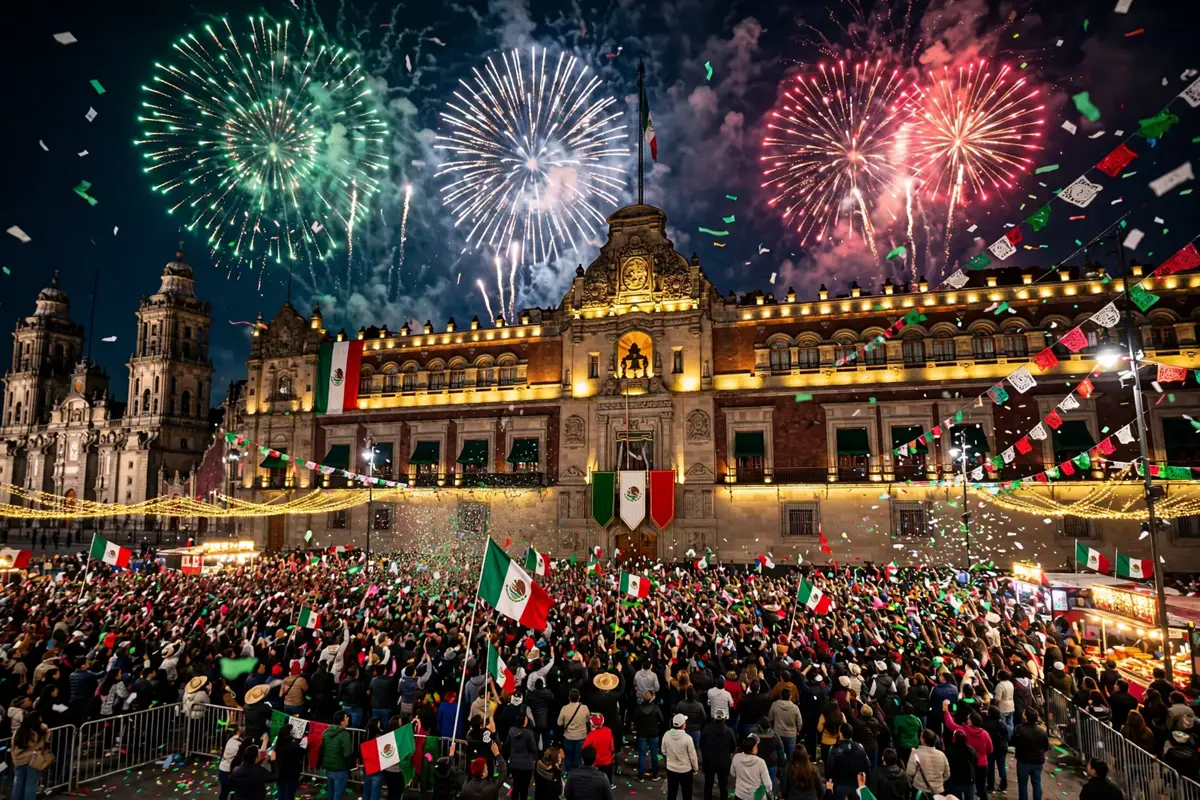
The main event happens on the evening of September 15, when the president re-enacts the Grito from the balcony of the National Palace in Mexico City. The celebration rolls through the night into September 16, a national holiday — banks, government offices, and most schools close.
September is known in Mexico as el Mes de la Patria, the Month of the Homeland, and flags go up on houses everywhere. Like other national days with confusing dates, the trick is knowing which day is the real one — and here, there is no doubt.
What Happened on September 16, 1810?
It starts two years earlier, when France invaded Spain in 1808 and put Napoleon’s brother on the throne. Suddenly nobody in New Spain — the colony that is now Mexico — knew who was really in charge, and some Mexicans began plotting an uprising.
One of the plotters was Miguel Hidalgo y Costilla, a Roman Catholic priest in the small town of Dolores, in what is now Guanajuato. The revolt was planned for a later date, but when the Spanish authorities discovered the conspiracy, Hidalgo and his fellow plotters decided they could wait no longer.
Before dawn on Sunday, September 16, 1810, Hidalgo rang the bell of his parish church to summon the townspeople, then called on them to take up arms against Spanish rule. That call became known as the Grito de Dolores — the Cry of Dolores. Britannica’s account of that morning puts it simply: the priest’s appeal was not immediately successful, but it is the moment Mexicans still remember.
Nobody knows his exact words — the speech was never written down. Historians agree on the message: an end to Spanish rule, and a demand for social and racial equality. Carrying a banner of Our Lady of Guadalupe, thousands joined the rebellion within days.
Hidalgo did not live to see the end of it. His army won early battles, then lost badly, and he was captured and executed on July 30, 1811, less than a year after the bell rang.
The Long Road from the Cry to a Country
The Grito started the war; it did not finish it. The fight dragged on for eleven years, and the men who kept it going paid for it with their lives.
1808 — The spark
France invades Spain and puts Napoleon’s brother on the throne. Across New Spain, people start asking who they owe loyalty to — and some begin planning a break.
1810 — The Grito
On September 16, Hidalgo rings the church bell in Dolores and calls the town to revolt. The uprising spreads fast, but the rebel army is defeated within months.
1811 — Hidalgo executed
Hidalgo is captured and executed on July 30, 1811. The rebellion loses its leader, not its momentum.
1813 — Morelos declares independence
Another priest, José María Morelos y Pavón, takes up the cause and formally declares independence at the Congress of Chilpancingo in 1813. He too is captured and killed two years later.
1821 — Independence won
The end comes from an unlikely direction: commander Agustín de Iturbide allies with guerrilla leader Vicente Guerrero under the Plan de Iguala, which declares Mexico a sovereign state. On September 27, 1821, the Army of the Three Guarantees marches into Mexico City; the next day the Act of Independence is signed, and a treaty with Spain makes it official. History.com’s account of the struggle traces the same arc: a cry in 1810, a war, and a negotiated end eleven years later.
1825 — The first national celebration
September 16 is first celebrated nationally in 1825. Two centuries on, it is still the biggest date on Mexico’s calendar.
Why September 16, Not the Day Mexico Won?
If Mexico did not actually become independent until 1821, why celebrate 1810?
September 16 honours the beginning, not the end. Hidalgo’s cry was the moment ordinary Mexicans first stood up and said they would govern themselves. Mexicans chose to remember the day the movement was born, not the day the paperwork was signed.
It is the same instinct behind celebrating a birthday instead of a graduation. The struggle lasted eleven years and cost its first leaders their lives — the date of the first cry carries the meaning, and the dates of the victory are for the history books.
How Mexico Celebrates: The Two Days, Hour by Hour
The celebration runs two days, and the schedule barely changes from year to year.
September 15, around 11 p.m. — El Grito
The heart of the holiday happens the night before the date itself. At around 11 p.m. on September 15, the president steps onto the balcony of the National Palace in Mexico City and rings the same bell Hidalgo rang in Dolores in 1810 — it was moved to the palace long ago. Then the president recites the Grito, naming the heroes of the independence movement, and ends with a threefold shout of ¡Viva México!
Below the balcony, as many as half a million people fill the Zócalo, Mexico City’s great main square, answering every line with their own ¡Viva! Then the bell rings again, the president waves the Mexican flag, the national anthem plays, and fireworks light up the square.
The same ceremony plays out in every town and city, led by the local governor or mayor, and at Mexican embassies and consulates around the world. In 2025, President Claudia Sheinbaum became the first woman to lead the Grito.
The words of the Grito
The modern Grito follows the same shape every year, though presidents sometimes add a line of their own:
¡Mexicanos!
¡Vivan los héroes que nos dieron patria!
¡Viva Hidalgo!
¡Viva Morelos!
¡Viva Josefa Ortiz de Domínguez!
¡Viva Allende!
¡Vivan Aldama y Matamoros!
¡Viva la independencia nacional!
¡Viva México! ¡Viva México! ¡Viva México!
In English: “Mexicans! Long live the heroes who gave us our homeland! Long live Hidalgo! Long live Morelos! Long live Josefa Ortiz de Domínguez! Long live Allende! Long live Aldama and Matamoros! Long live national independence! Long live Mexico! Long live Mexico! Long live Mexico!” The full text is recorded in Wikipedia’s account of the ceremony.
The bell Hidalgo rang
The bell is the most concrete link to 1810 in the whole ceremony: the president does not ring a replica. The bell on the National Palace balcony is the one Hidalgo rang to summon the people of Dolores, and two centuries later it still opens the celebration.
September 16 — The parade and the day off
On the morning of September 16, the national military parade sets off from the Zócalo and marches down the Paseo de la Reforma, Mexico City’s main boulevard, past the Ángel de la Independencia column. Around the country, the day brings parades, concerts, and school programmes — and since it is a public holiday, most Mexicans spend the rest of the day resting, or recovering from the night before.
What people eat and drink

No Mexican holiday is complete without the food, and Independence Day has its own star dish: chiles en nogada. A roasted poblano chilli is stuffed with picadillo — seasoned ground meat mixed with dried fruit — covered in a creamy walnut sauce, and scattered with pomegranate seeds and parsley. The green, white, and red match the Mexican flag, which is half the point. Making it takes most of a day, so it is a dish for a real occasion.
Alongside it, you will find pozole — slow-cooked hominy soup with pork or chicken and fresh vegetables — plus tamales, enchiladas, and guacamole. To drink, there is tequila — and a flag-coloured favourite called the Bandera: three small glasses, lime juice for green, tequila for white, and sangrita for red, sipped in that order. Big holiday meals follow the same logic everywhere — our Thanksgiving dinner planning guide works from the same idea.
Mexican Independence Day vs Cinco de Mayo
Here it is plainly: Cinco de Mayo is not Mexican Independence Day. The two dates mark two different events, 52 years apart, against two different empires.
| Mexican Independence Day | Cinco de Mayo | |
|---|---|---|
| Date | September 16 | May 5 |
| Year | 1810 | 1862 |
| Event | The Grito de Dolores starts the war of independence | The Battle of Puebla, one victory over the French |
| Against | Spain | France |
| Marks | A nation’s independence movement beginning | A single battle won |
| Bigger in | Mexico | The United States |
Cinco de Mayo celebrates May 5, 1862, when a smaller Mexican army beat invading French forces at Puebla. It was a real victory — it delayed the French advance on Mexico City by nearly a year — but it was one battle in a longer war. In Mexico itself, Cinco de Mayo is a minor holiday, mainly observed in the state of Puebla. It grew big in the United States instead, where Mexican-American communities first celebrated it in California in 1863, and where beer companies turned it into a national party day in the 1980s.
One more date people mix in: November 20, Mexican Revolution Day, which marks the start of the Mexican Revolution in 1910. Three autumn dates, three different stories — and September 16 is the one that founded the country.
Celebrating Outside Mexico
You do not have to be in Mexico to mark the day. Mexican embassies and consulates hold their own Grito ceremonies on September 15 or 16, and cities with large Mexican-heritage communities hold festivals, parades, and concerts of their own.
If you are joining one, the etiquette is simple: learn the words of the Grito, answer each ¡Viva! with your own, and know what you are shouting for. It is the anniversary of the morning a priest rang a bell and a country began.
September 16 is Mexico’s birthday. May 5 is a battle anniversary. Now you know which is which — and why the bell still rings.
Is Mexican Independence Day September 15 or 16?
September 16 is the date, but the main celebration — the re-enactment of El Grito — happens on the evening of September 15, around 11 p.m. September 16 itself is the national holiday in Mexico.
What does “Grito de Dolores” mean?
“The Cry of Dolores.” It is the name given to the call to arms Miguel Hidalgo made in the town of Dolores on September 16, 1810, when he rang his parish church bell and urged the townspeople to rise against Spanish rule.
Who was Miguel Hidalgo?
A Roman Catholic priest in Dolores, Guanajuato, who launched Mexico’s war of independence with the Grito de Dolores in 1810. He was executed on July 30, 1811, and is remembered as the face of the independence movement.
When did Mexico actually become independent?
The war ended in 1821: the Army of the Three Guarantees entered Mexico City on September 27, and the Act of Independence was signed on September 28. September 16 celebrates the start of the struggle in 1810, not its end.
Is Cinco de Mayo Mexican Independence Day?
No. Cinco de Mayo (May 5) marks the Battle of Puebla in 1862, a single victory over French forces. Mexican Independence Day is September 16, marking the start of the war of independence from Spain in 1810.
