
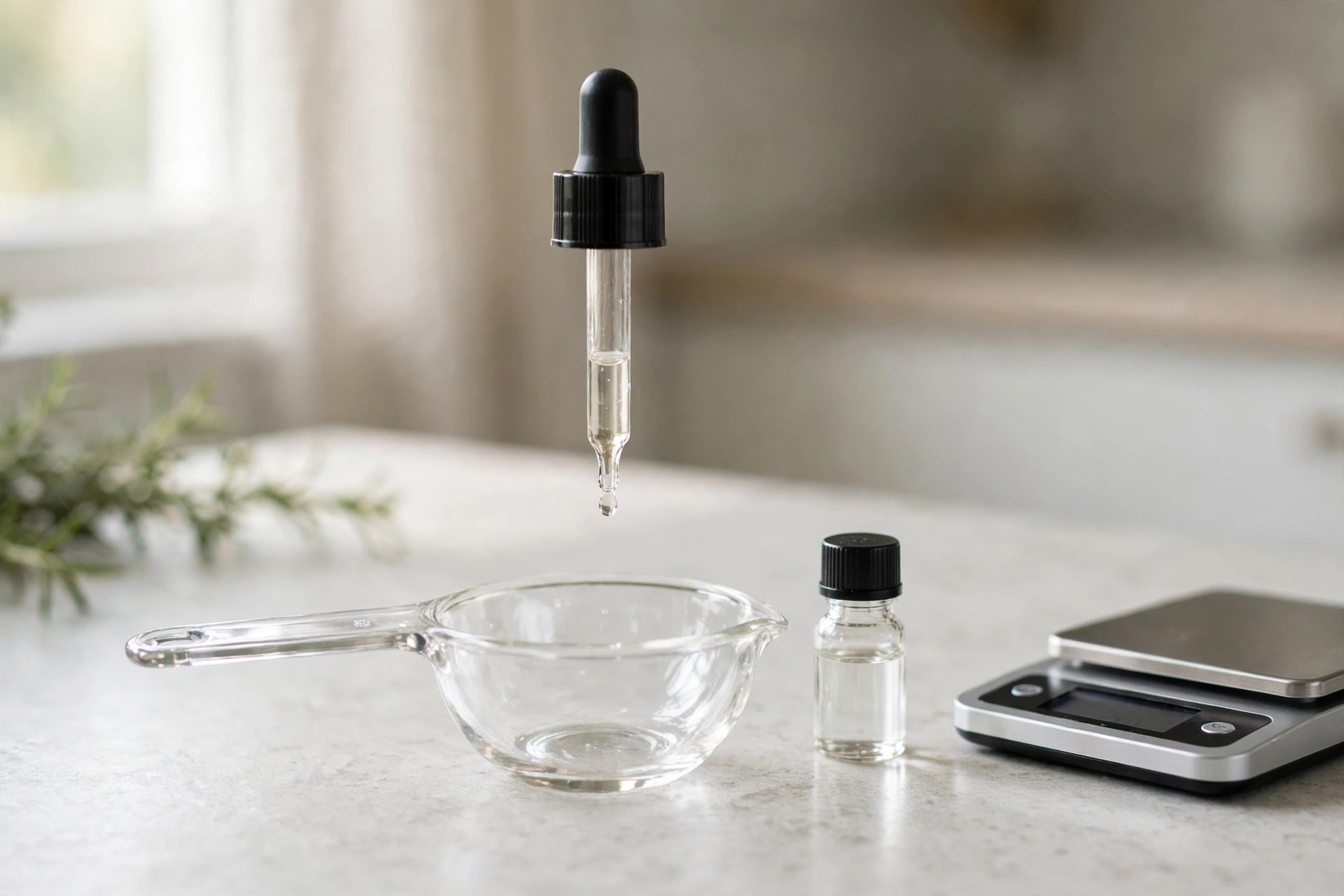

Short answer first: there is no one fixed number of milligrams in a millilitre, because the two units measure different things. For water, 1 ml weighs about 1,000 mg. For anything else, the answer depends on that liquid’s density — or, for a medicine, on the concentration printed on its label. And for the second half of the question: 1 ml of a water-like liquid is about 20 drops from a standard dropper, but that is an approximation, not a rule of nature.
Why There Is No Single Answer to “How Many mg in a ml?”
The confusion starts with the units themselves. They sound similar, and in everyday kitchen and pharmacy talk they get swapped constantly, but they belong to two different kinds of measurement.
Milligrams Measure Mass
A milligram (mg) is a unit of mass — how much stuff there is. There are 1,000 milligrams in one gram, and 1,000 grams in one kilogram. When a label says a tablet contains 500 mg of something, it is telling you the mass of that ingredient, not how much space it takes up.
Millilitres Measure Volume
A millilitre (ml) is a unit of volume — how much space a liquid occupies. One millilitre is the same as one cubic centimetre. A teaspoon holds 5 ml and a tablespoon holds 15 ml, which is why those spoon conversions work for volume but say nothing about weight.
Density Is the Missing Piece
Density is mass divided by volume: how much mass is packed into each unit of space. Britannica defines density as the mass of a unit volume of a substance, and gives water’s density as 1 gram per cubic centimetre — which is the same as 1 gram per millilitre. That single fact is what connects the two units. Without a density (for a pure liquid) or a concentration (for a solution), a millilitre cannot be turned into milligrams at all. A millilitre of a light liquid weighs less than a millilitre of a heavy one, even though both occupy exactly the same space.
How Many mg in 1 ml? The Formula and the Water Answer
The formula is simple once you have the density:
Mass in mg = volume in ml × density in mg per ml
Since density is often given in grams per millilitre, multiply by 1,000 to get milligrams per millilitre. So a liquid with a density of 0.9 g/ml carries 900 mg in each millilitre, and a liquid with a density of 1.2 g/ml carries 1,200 mg in each millilitre. Those are arithmetic examples, not claims about any particular product — always use the density or concentration of the actual liquid in front of you.
Water: 1 ml = 1,000 mg
Water is the reference case, and the reason the 1,000 mg figure is so widely quoted. Pure water reaches a density of about 1 g/ml (1,000 mg/ml) at 4°C, and stays very close to that at ordinary room temperature — about 0.998 g/ml at 20°C. So for practical purposes:
- 1 ml of water ≈ 1,000 mg
- 5 ml of water ≈ 5,000 mg (5 grams)
- 10 ml of water ≈ 10,000 mg (10 grams)
- 100 ml of water ≈ 100,000 mg (100 grams)
Water-based liquids such as saline come out close to the same figure. But a thicker, sweeter, oilier or saltier liquid has a different density, and so does its milligram figure — never carry the water number over to a different liquid.
Medicines: Read the Concentration, Not the Volume
For a liquid medicine, the number that matters is the concentration on the label: how many milligrams of active ingredient are in each millilitre. That is a property of that specific product, and two products with the same name can have different concentrations.
Here is how the arithmetic works, using a made-up label purely as an example: if a label states 100 mg per 5 ml, divide 100 by 5 and you get 20 mg in each 1 ml. If a label states 250 mg per 5 ml, the same division gives 50 mg per 1 ml. The volume alone never tells you this — only the label does. This guide gives no dosing instructions: if you are unsure about a medicine, use the measuring device that came with it and ask your pharmacist or clinician. MedlinePlus advises against using flatware spoons for medicine, noting that a flatware teaspoon can range from 2.5 ml to 10 ml, and points out that oral syringes are accurate measuring devices.
The Reverse Direction
Going the other way uses the same relationship in reverse: volume in ml = mass in mg ÷ density in mg per ml. Our companion guide covers that direction in full.
How Many Drops in 1 ml?
A drop is not a standard unit in the way a millilitre is. It is whatever volume comes out of a particular dropper tip in one squeeze, so the honest answer always comes with a qualifier: about 20 drops, with a standard dropper and a water-like liquid.
The Standard Figure: 20 Drops per ml
The standard pharmaceutical convention treats one drop as 0.05 ml. Divide 1 ml by 0.05 ml and you get exactly 20 drops. RMIT University’s nursing teaching material uses the same figure as its drop factor for standard (macro) drops: 1 ml equals 20 drops, 2 ml equals 40 drops, and 5 ml equals 100 drops. For everyday estimating with water-like liquids, 20 drops per ml is the figure to use — and to label as approximate whenever you use it.
Why the Number Moves
Three things change drop size: viscosity (thicker liquids form larger drops, so fewer fit in a millilitre), the dropper tip (a fine tip makes smaller drops than a wide opening), and technique (angle and squeeze change the drop that forms). That is why drop counts are never good enough where an exact amount matters.
Different Droppers, Different Counts
Not every dropper follows the 20-per-ml convention. RMIT’s material notes the contrast in clinical infusion sets: standard macro drops run at 20 per ml, while much smaller micro drops run at 60 per ml. Household droppers vary too, and one product’s dropper should never be assumed to match another’s. If the amount matters, count in millilitres with a marked device, not in drops.
Drops in Common Bottle Sizes
Using the standard 20 drops per ml, the bottle arithmetic is straightforward:
- 5 ml bottle ≈ 100 drops
- 10 ml bottle ≈ 200 drops
- 15 ml bottle ≈ 300 drops
- 30 ml bottle ≈ 600 drops
These are estimates for water-like liquids from a standard dropper — a rough guide for planning, never a measuring method.
Converting Drops to ml and Back
With the standard figure, the conversions are one division or one multiplication away:
- Drops to ml: divide the drop count by 20. So 40 drops ÷ 20 = 2 ml, and 100 drops ÷ 20 = 5 ml.
- ml to drops: multiply the millilitres by 20. So 2 ml × 20 = 40 drops, and 0.5 ml × 20 = 10 drops.
- One drop in ml: 1 ÷ 20 = 0.05 ml per drop, under the standard convention.
Worked example: 3 ml of a water-like liquid is about 60 drops (3 × 20), and 60 drops divided by 20 gives 3 ml again. The round trip only works because both directions assume the same drop size — change the dropper, and it breaks.
Common Mistakes Worth Avoiding
Assuming 1 ml = 1 mg
This is the most common error, and it comes from mixing up the units. One millilitre equals one milligram only for a liquid whose density is 1 mg per ml — an extremely thin, unusual case. For water, 1 ml is 1,000 mg, a thousand times larger. Whenever a conversion looks suspiciously neat, check whether mass and volume have been swapped.
Counting Drops for a Medicine Dose
Drops are fine for a rough sense of how long a bottle might last. They are not a dosing method: drop size varies with the liquid, the dropper and the squeeze, so counting drops can easily under- or over-deliver. Use the device supplied with the medicine and follow the product’s own instructions; if anything is unclear, ask a pharmacist.
Treating a Dropperful as a Fixed Amount
A “dropperful” is not a unit either. It is however much liquid one squeeze of one particular dropper picks up, and it varies between droppers and products. Some droppers are marked in millilitres, and those markings are the reliable part; the squeeze itself is not. If a direction gives an amount in millilitres, measure in millilitres.
Copying the Water Figure to Every Liquid
Water’s 1,000 mg per ml is a reference point, not a universal constant: oil, syrup, saline and alcohol-based liquids all sit at different densities. The formula stays the same; only the density changes. If you cannot find the density or concentration, you cannot do the conversion accurately.
Quick Reference
| Question | Short answer | Caveat |
|---|---|---|
| How many mg in 1 ml of water? | About 1,000 mg | Water’s density is about 1 g/ml |
| How many mg in 1 ml of any liquid? | Volume × density | You must know the density or concentration |
| How many drops in 1 ml? | About 20 drops | Standard dropper, water-like liquid only |
| How many ml is 1 drop? | About 0.05 ml | Standard convention, not a fixed unit |
| How many drops in 5 ml? | About 100 drops | At 20 drops per ml |
| How many mg in 1 ml of medicine? | Check the label | Concentration varies by product; ask a pharmacist |
So the two questions in this article’s title have different kinds of answers. “How many mg in a ml” is answered by a formula plus one missing fact — density or concentration — and water gives the cleanest example at 1,000 mg. “How many drops in 1 ml” is answered by a convention — about 20 — that is useful for estimating and unsafe for measuring. Keep those two ideas apart, and both conversions stop being confusing. This article is general information only, not medical advice: for any question about a medicine you or someone in your care takes, talk to your pharmacist or clinician.
For the reverse conversion, see our guide to converting milliliters to milligrams, and for another everyday conversion family, see our Celsius to Fahrenheit chart. Density itself is defined by Britannica, the 20-drops-per-ml drop factor is taught in RMIT University’s drop-factor material, and safe liquid-medicine measuring is covered by MedlinePlus.
How many mg are in 1 ml of water?
About 1,000 mg, because water’s density is about 1 g/ml (1,000 mg/ml).
How do I convert ml to mg for any liquid?
Multiply the volume in ml by the density in mg per ml. Without a density or a label concentration, the conversion cannot be done accurately.
How many drops are in 1 ml?
About 20 drops from a standard dropper for a water-like liquid, since one standard drop is 0.05 ml. The count varies with the liquid and dropper.
How many ml is one drop?
About 0.05 ml under the standard dropper convention.
Can I measure medicine in drops?
No. Drop size varies, so use the measuring device supplied with the medicine and ask your pharmacist or clinician if unsure. This article is general information only, not medical advice.
