
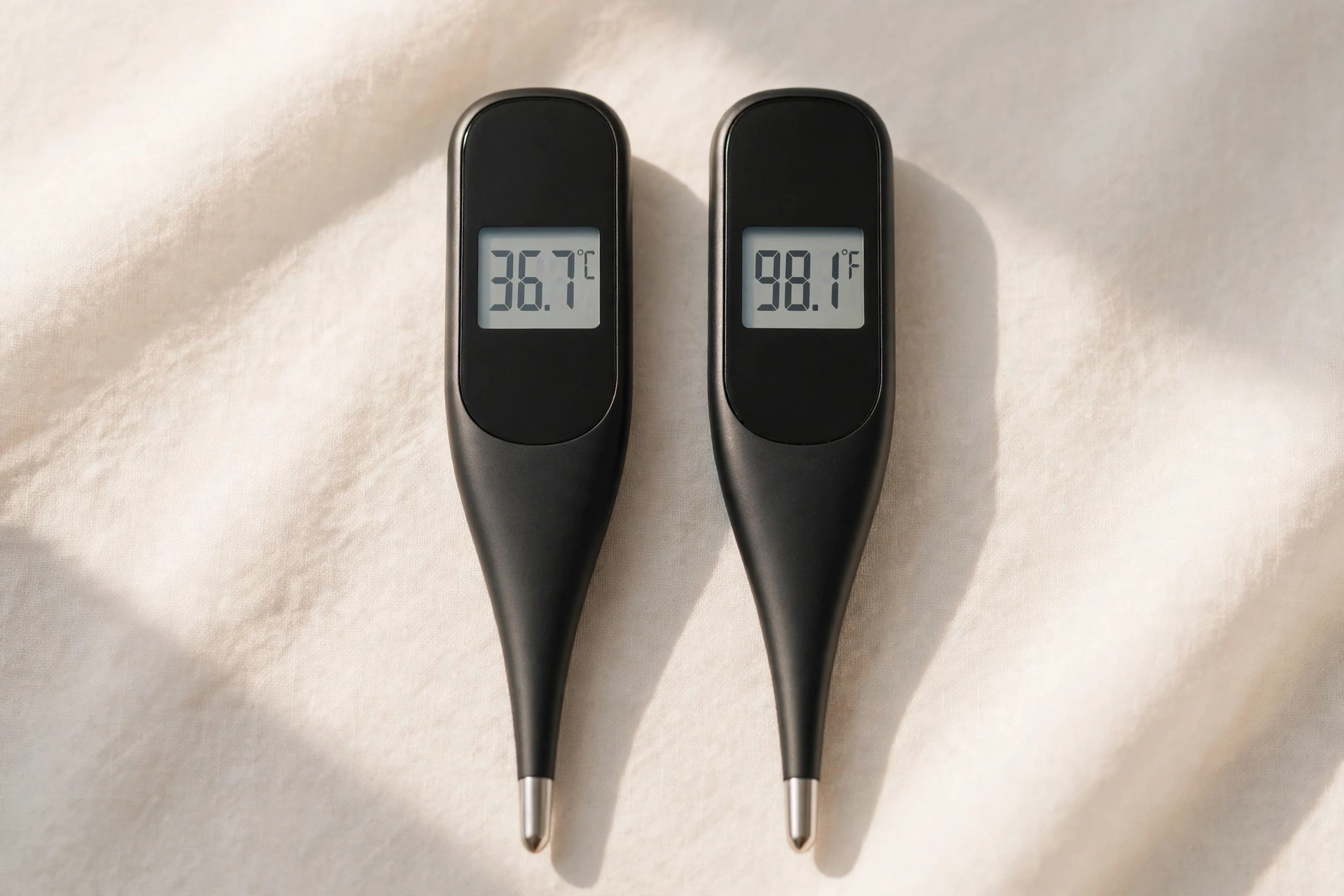

36.7 degrees Celsius converts to 98.1 degrees Fahrenheit. The exact figure is 98.06°F, which rounds to 98.1°F on a one-decimal thermometer display. If you have just seen 36.7°C on a thermometer and you think in Fahrenheit, that is the number you are looking for — and it sits comfortably inside the normal body-temperature range, not anywhere near a fever.
This guide gives you the conversion, the working, what 36.7°C actually means for body temperature, and how far it sits from the fever threshold — so you can read the number once and stop second-guessing it.
36.7°C to Fahrenheit: The Answer
36.7°C = 98.1°F (98.06°F before rounding).
That puts 36.7°C just below the long-used average of 37°C (98.6°F). It is an ordinary, everyday reading for a healthy adult — the kind of number you might see first thing in the morning, when body temperature tends to run at its lowest.
How to Convert 36.7°C to Fahrenheit
The formula is the same for every Celsius-to-Fahrenheit conversion:
°F = (°C × 9/5) + 32
Step 1: Multiply by 9/5
Multiply 36.7 by 9, then divide by 5 — or simply multiply by 1.8, which is the same thing. Either way you get 66.06.
Step 2: Add 32
Add 32 to 66.06 and you get 98.06. Rounded to one decimal place, that is 98.1°F.
Step 3: Check it in reverse
To go back the other way, subtract 32 and multiply by 5/9: (98.1 − 32) × 5/9 = 36.7°C. The round trip lands back where it started, which is a quick way to confirm you have not slipped a digit.
If you want the full chart rather than a single temperature, our Celsius to Fahrenheit conversion chart covers the weather and fever ranges in one place.
What 36.7°C Means for Body Temperature
A single temperature reading only makes sense against the normal range, and that range is wider than the famous 98.6°F figure suggests.
A touch below the familiar 37°C average
MedlinePlus, the U.S. National Library of Medicine’s consumer health service, gives the average normal body temperature as 98.6°F (37°C) — and a normal range stretching from 97°F (36.1°C) to 99°F (37.2°C). At 36.7°C (98.1°F), you are 0.3°C below the average and well inside that range. Nothing about the number itself is unusual.
Inside the normal range, not near a fever
The NHS describes a high temperature in adults as usually 38°C or above. MedlinePlus likewise says a temperature over 100.4°F (38°C) most often means a fever. A reading of 36.7°C is 1.3°C — about 2.3°F — below that threshold. It is not a low-grade fever, and it is not borderline. There is a whole degree and more of headroom between 36.7°C and the point where clinicians start talking about fever.
Your normal may differ from someone else’s
Normal body temperature varies by person, by age, by activity, and by time of day — that is MedlinePlus’s own list of factors, and the NHS makes the same point: normal body temperature is different for everyone and changes during the day. Some healthy adults habitually run a little cooler than 37°C; others run a little warmer. What matters most is how a reading compares with your own usual temperature, not whether it matches 98.6°F exactly.
How Far Is 36.7°C From a Fever?
Here is the gap in plain numbers:
36.7°C is 1.3°C below the 38°C fever threshold. In Fahrenheit, 98.1°F is 2.3°F below 100.4°F. To reach fever territory from 36.7°C, a temperature would have to climb by more than a full degree Celsius — roughly the difference between a cool morning reading and a genuinely raised one.
That distance is worth keeping in mind because 36.7°C sometimes worries people who expect to see exactly 37°C. A reading a few tenths below the average is not a sign of anything on its own. Bodies are not thermostats set to a single number; they drift up and down through the day, and a morning reading of 36.7°C followed by an evening reading nearer 37°C is an ordinary pattern.
One NHS nuance is worth knowing: you can feel hot, cold, or shivery and have a high temperature even when the thermometer reads below 38°C. The number and how you feel belong together — a thermometer reading alone never tells the whole story. If you feel unwell, that matters more than whether a single reading looks tidy.
Nearby Temperatures at a Glance
These conversions, all worked from the same formula, show where 36.7°C sits among the readings people most often look up:
| Celsius | Fahrenheit | Where it sits |
|---|---|---|
| 36.0°C | 96.8°F | Low end of the normal range |
| 36.5°C | 97.7°F | Normal |
| 36.7°C | 98.1°F | Normal — just below the 37°C average |
| 37.0°C | 98.6°F | The classic average |
| 37.5°C | 99.5°F | Top end of the normal range |
| 38.0°C | 100.4°F | Fever threshold |
Read across the table and the picture is clear: 36.7°C is grouped with the normal readings, with 37.5°C and the fever line both visibly above it.
Why Your Reading May Not Be Exactly 36.7°C Next Time
Take the same person’s temperature three times in a day and you may well get three slightly different numbers. That is normal, and it has a few straightforward causes.
Time of day
Body temperature is normally lowest in the early morning and highest in the evening, according to MedlinePlus. A 36.7°C reading taken on waking can quite naturally become 37.1°C or 37.2°C by late afternoon without anything being wrong.
Where and how you measure
Mouth, armpit, ear, and forehead readings do not always agree with each other, and technique matters — the NHS’s guidance on taking a temperature stresses placing the thermometer correctly and following its instructions. A reading taken under the arm, for instance, typically runs a little lower than one taken under the tongue. If a number surprises you, re-taking it carefully with the same thermometer in the same spot is more useful than comparing it with a different device.
What you were doing just before
Physical activity, a hot drink, heavy clothing, and a warm room can all nudge a reading upward for a short while. MedlinePlus lists activity among the factors that shift body temperature. Waiting a few minutes, resting, and re-measuring gives a steadier number than one grabbed mid-activity.
Quick Check: Reading Your Own Result
Use this short run-through when a thermometer shows 36.7°C:
Convert it
36.7°C is 98.1°F. Write it down if you are tracking readings over a day or two.
Compare it with the range, not just the average
The normal range runs roughly 36.1°C to 37.2°C (97°F to 99°F). A reading of 36.7°C falls inside it, below the 37°C average.
Check the distance to fever
Fever is usually counted from 38°C (100.4°F). At 36.7°C you are 1.3°C below that line.
Notice how you feel
A number in the normal range plus feeling well is a reassuring combination. Feeling unwell, shivery, or hot despite a normal-looking number is a reason to pay attention to symptoms rather than the digit alone — and to talk to your clinician if you are concerned.
Common Mix-Ups With 36.7°C
Mixing up 36.7°C with 37.6°C or 37.7°C
Those higher readings convert to around 99.7°F and 99.9°F — still below the 100.4°F fever line, but noticeably closer to it than 36.7°C. A single misread digit changes the picture, so it is worth double-checking the display, especially on a small thermometer screen.
Assuming 98.6°F is the only healthy number
The 37°C (98.6°F) average dates back to 19th-century measurements and has stuck around as a shorthand. Modern guidance describes a range, not a single point. Landing on 36.7°C instead of 37.0°C is a variation within that range, not a miss.
Converting the wrong way round
The classic slip is subtracting 32 first when converting Celsius to Fahrenheit, or forgetting to add it. The order matters: multiply first, then add 32. If your answer for 36.7°C comes out below 90°F or above 110°F, the working has gone wrong somewhere — redo it step by step.
For other everyday conversions done the same careful way, see our guide to converting milliliters to milligrams, which follows the same rule: one formula, worked examples, no guesswork.
The Bottom Line
36.7°C to Fahrenheit is 98.1°F — a normal body temperature, a touch below the 37°C average, and a full 1.3°C below the usual 38°C fever threshold. If that is the number on your thermometer, the conversion itself gives you no cause for concern.
This article is general information only, not medical advice for any individual situation. If you feel unwell, if a temperature stays raised, or if you are ever unsure what a reading means for you or a child in your care, talk to your clinician or pharmacist — they can judge the number alongside your symptoms and history, which no conversion chart can do.
Sources: NHS guidance on high temperature (fever) in adults; MedlinePlus Medical Encyclopedia on body temperature norms and on fever. Links to both are included above.
What is 36.7°C in Fahrenheit?
36.7°C is 98.1°F. The exact conversion is 98.06°F, which rounds to 98.1°F on a one-decimal display. Work it out as (36.7 × 9/5) + 32 = 98.06.
Is 36.7°C a normal body temperature?
Yes. MedlinePlus gives the normal range as roughly 97°F to 99°F (36.1°C to 37.2°C), with 98.6°F (37°C) as the average. At 98.1°F, 36.7°C sits just below that average and well inside the normal range.
Is 36.7°C a fever?
No. A fever is usually counted from 38°C (100.4°F) — the threshold used by the NHS and MedlinePlus. At 36.7°C you are 1.3°C below that line, so it is a normal reading, not a fever.
Why is my temperature 36.7°C in the morning and higher later in the day?
Body temperature is normally lowest in the early morning and highest in the evening, and it also varies with activity and how you measure it. A morning reading of 36.7°C rising nearer 37°C later in the day is an ordinary daily pattern.
How do I convert Celsius to Fahrenheit quickly?
Use °F = (°C × 9/5) + 32. For a mental shortcut, double the Celsius number, subtract 10% of that doubled figure, then add 32: for 36.7, that is 73.4 − 7.34 + 32 = 98.06, or 98.1°F.
