
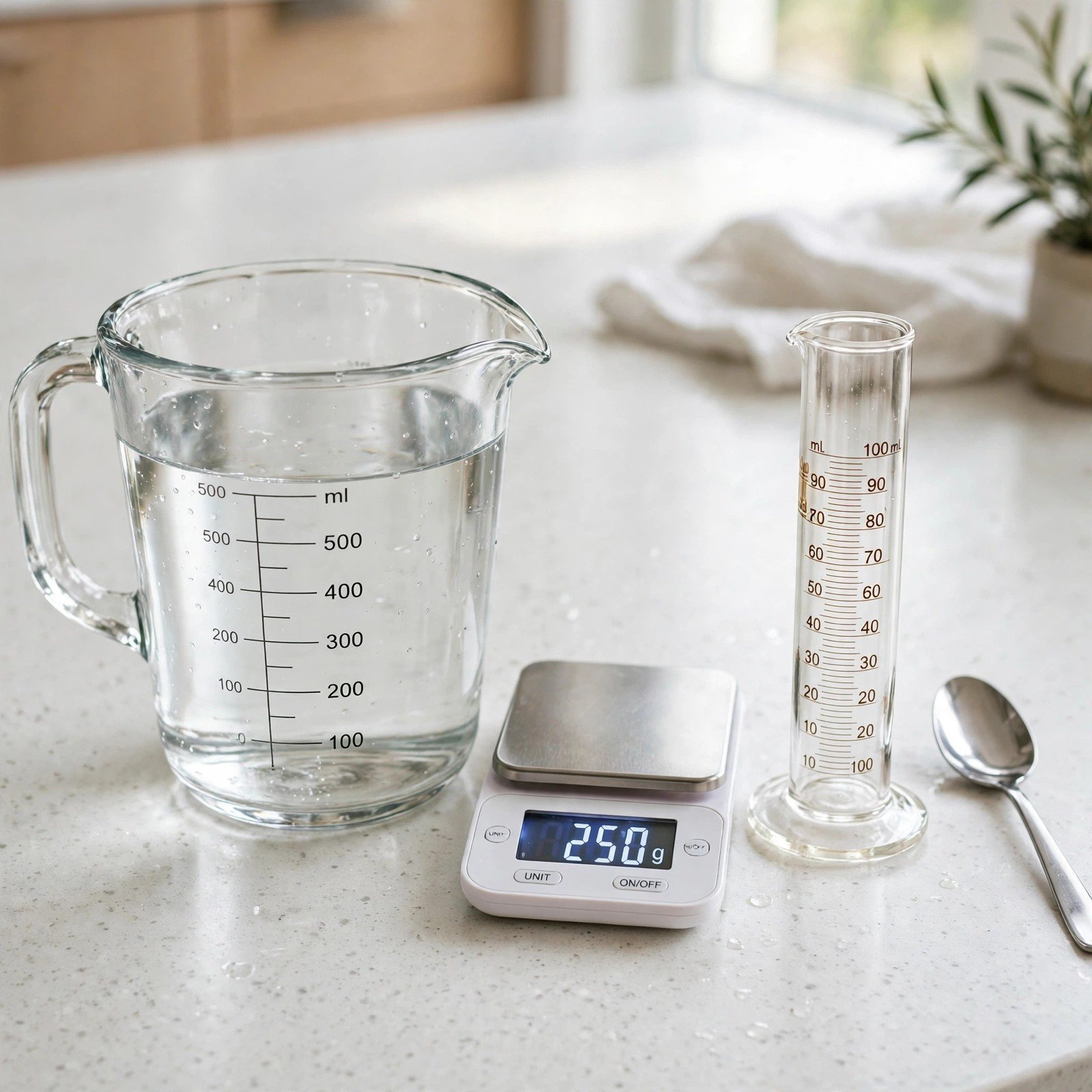

If you have ever stared at a recipe, a lab sheet, or a supplement label and wondered how to turn milliliters into milligrams, you are not alone. The two units look alike, they share the same “milli” prefix, and they show up side by side in kitchens and clinics. But they measure different things, and that is exactly why the conversion trips people up.
A milliliter milligram conversion is not a fixed exchange rate. There is no single number that works for every liquid, because a milliliter measures space and a milligram measures mass. The bridge between them is density: how much mass is packed into each unit of volume. Once you know a liquid’s density, the conversion is simple arithmetic. This guide walks through the formula, the easy water case, and worked examples for a few everyday liquids, so you can convert with confidence instead of guessing.
Milliliters vs Milligrams: Why There Is No Single Answer
What a milliliter measures
A milliliter (mL) is a unit of volume. It tells you how much space a liquid takes up. One milliliter equals one cubic centimeter, and 1,000 milliliters make a liter. When a measuring jug says 250 mL, it is describing the size of the space the liquid fills, not how heavy it is.
What a milligram measures
A milligram (mg) is a unit of mass. It tells you how much matter is there. One milligram is one-thousandth of a gram, so 1,000 milligrams make a gram. A kitchen scale reading in grams is really reporting mass, even though we casually call it weight in everyday speech.
Why the same volume weighs differently
Pour 1 mL of water and 1 mL of honey into two identical tiny cups and they will not balance on a scale. The honey is heavier because its molecules are packed more tightly: it has a higher density. Density is defined as mass divided by volume, and it is different for every substance. That single fact explains the whole conversion problem. Without density, a milliliter-to-milligram question has no answer; with it, the answer is one multiplication away.
The Milliliter to Milligram Formula
The formula, step by step
The formula is:
milligrams = milliliters × density (in g/mL) × 1,000
Work through it in three steps. First, find the liquid’s density in grams per milliliter. Second, multiply your volume in milliliters by that density to get grams. Third, multiply by 1,000 to turn grams into milligrams. That is all there is to it, and every example below follows the same three steps.
Working with density in g/mL vs mg/mL
Densities are usually published in grams per milliliter, but some references give milligrams per milliliter instead. The two are easy to move between: multiply a g/mL figure by 1,000 to get mg/mL. Water at 1.00 g/mL is 1,000 mg/mL. If your density is already in mg/mL, skip the final × 1,000 step and just multiply milliliters by mg/mL directly.
The reverse conversion: mg to mL
Going the other way uses division instead of multiplication:
milliliters = milligrams ÷ density (in mg/mL)
So 500 mg of water becomes 500 ÷ 1,000 = 0.5 mL, and 680 mg of corn syrup (density 1,360 mg/mL) becomes 680 ÷ 1,360 = 0.5 mL as well. Same volume, different mass — density doing its quiet work in both directions.
Water Conversions: The Easy Case
Water is the one liquid where the conversion feels effortless, and there is a good reason for that. At room temperature, water’s density sits very close to 1 gram per milliliter: chemistry references list it as 1.000 g/mL at 4°C and 0.998 g/mL at 20°C. For everyday purposes, 1 mL of water weighs 1 gram, which is 1,000 milligrams. That is why so many quick answers online simply say 1 mL = 1,000 mg — they are talking about water, even when they forget to say so.
Water conversion table (mL to mg, rounded)
Using water’s everyday density of 1 g/mL:
- 1 mL of water = 1,000 mg
- 5 mL of water (one teaspoon) = 5,000 mg
- 10 mL of water = 10,000 mg
- 50 mL of water = 50,000 mg
- 100 mL of water = 100,000 mg
- 250 mL of water = 250,000 mg
- 500 mL of water = 500,000 mg
- 1,000 mL of water = 1,000,000 mg
Why water’s number is so round
The roundness is not a coincidence. The metric system was built around water: a liter of water was originally defined to weigh a kilogram, which forces a milliliter to weigh a gram. The modern definitions have moved on, but the near-perfect 1-to-1 relationship survives, and it is why water is the reference liquid for density itself. A substance denser than water sinks in it; a lighter one floats.
Converting Other Liquids: Worked Examples
Water is the exception, not the rule. Here are three everyday liquids worked through the formula, using densities from standard chemistry references: corn oil at 0.922 g/mL, honey at 1.42 g/mL, and ethanol at 0.79 g/mL.
Example 1: 250 mL of corn oil
Corn oil is lighter than water, so expect a smaller number than water’s 250,000 mg. Multiply 250 mL by 0.922 g/mL to get 230.5 grams, then multiply by 1,000: 230,500 mg. The same cup that holds 250,000 mg of water holds about 230,500 mg of corn oil.
Example 2: 50 mL of honey
Honey is much denser than water, so expect a bigger number. Multiply 50 mL by 1.42 g/mL to get 71 grams, then multiply by 1,000: 71,000 mg. A small 50 mL pour of honey weighs 71 grams — noticeably more than the same volume of water, which would be 50 grams.
Example 3: 100 mL of ethanol
Ethanol, the alcohol in spirits and hand sanitizer, is lighter than water at 0.79 g/mL. Multiply 100 mL by 0.79 g/mL to get 79 grams, then multiply by 1,000: 79,000 mg. This is also why a bottle of spirits feels lighter than a same-sized bottle of water.
Common Mistakes to Avoid
Mistake 1: Assuming 1 mL = 1 mg
This is the most common error, and it is off by a factor of a thousand even for water. One milliliter of water is 1,000 mg, not 1 mg. The confusion comes from the shared “milli” prefix, but milli only means one-thousandth of the base unit — a thousandth of a liter is not the same thing as a thousandth of a gram.
Mistake 2: Using water’s density for everything
Water’s 1,000 mg per mL is a handy shortcut that only works for water and liquids very close to it. Apply it to oil and you will overstate the mass; apply it to honey and you will understate it by nearly a third. If the liquid is not water, look up its density first.
Mistake 3: Mixing up grams and milligrams
The × 1,000 step at the end of the formula is where answers most often go wrong by exactly three zeros. After multiplying milliliters by a g/mL density, you have grams. Only the final multiplication gives milligrams. If your answer looks a thousand times too small, this step is almost certainly the one that got skipped.
Mistake 4: Converting medicine doses without the label concentration
Liquid medicines are a special case. A prescribed dose in milligrams cannot be turned into milliliters from density alone, because what matters is the concentration printed on the bottle — for example, a syrup labelled 100 mg per 5 mL. Never guess a medicine conversion: read the concentration on the label, and if anything is unclear, ask your pharmacist or clinician before measuring a dose. This guide covers general unit conversion only and gives no dosing advice.
Quick-Reference Density Table
Keep this table handy. Densities are at around room temperature (20–25°C) from standard chemistry references, and small differences between brands and temperatures will shift the last digits slightly.
- Water: 1.00 g/mL — 1 mL = 1,000 mg
- Corn oil: 0.922 g/mL — 1 mL = 922 mg
- Ethanol: 0.79 g/mL — 1 mL = 790 mg
- Corn syrup: 1.36 g/mL — 1 mL = 1,360 mg
- Honey: 1.42 g/mL — 1 mL = 1,420 mg
One practical habit ties all of this together. When a recipe, a school assignment, or a product label gives you milliliters and asks for milligrams, pause and ask one question first: what liquid is this? Find its density, run the three-step formula, and check that the result makes sense — denser than water means more milligrams per milliliter, lighter means fewer. That single check catches nearly every conversion error before it happens.
If you do a lot of kitchen measuring, you will run into the same volume-versus-mass question in recipes: our meal prep guide for beginners shows how measuring by weight instead of volume makes weekly cooking more consistent, and our Thanksgiving dinner planning guide works through the quantities a big holiday meal actually needs. The metric prefixes behind all of this are set out by the National Institute of Standards and Technology, density itself is defined in Chemistry LibreTexts’ density chapter, and the metric equivalents used in healthcare measuring are summarised in Medicine LibreTexts’ metric system tables.
How many milligrams are in 1 milliliter of water?
About 1,000 mg. Water’s density is 1.00 g/mL at room temperature (1.000 g/mL at 4°C and 0.998 g/mL at 20°C), so 1 mL of water weighs about 1 gram, which is 1,000 milligrams.
Is 1 mL equal to 1 mg?
No. A milliliter measures volume and a milligram measures mass. Only a liquid with a density of 1 mg/mL would make them equal, and no common liquid works that way — even water is 1,000 mg per mL.
How do I convert mL to mg without knowing the density?
You cannot do it accurately. The formula needs density: milligrams = milliliters × density (g/mL) × 1,000. Without density, any answer is a guess.
How do I convert milligrams back to milliliters?
Divide by density: milliliters = milligrams ÷ density (mg/mL). For water, divide by 1,000; for corn syrup, divide by 1,360.
Does temperature change a milliliter to milligram conversion?
Slightly. Density falls as temperature rises, so warm water weighs a little less per milliliter than cold water — 0.998 g/mL at 20°C versus 1.000 g/mL at 4°C. For everyday cooking the difference is negligible; for lab work, use the density at your working temperature.
