
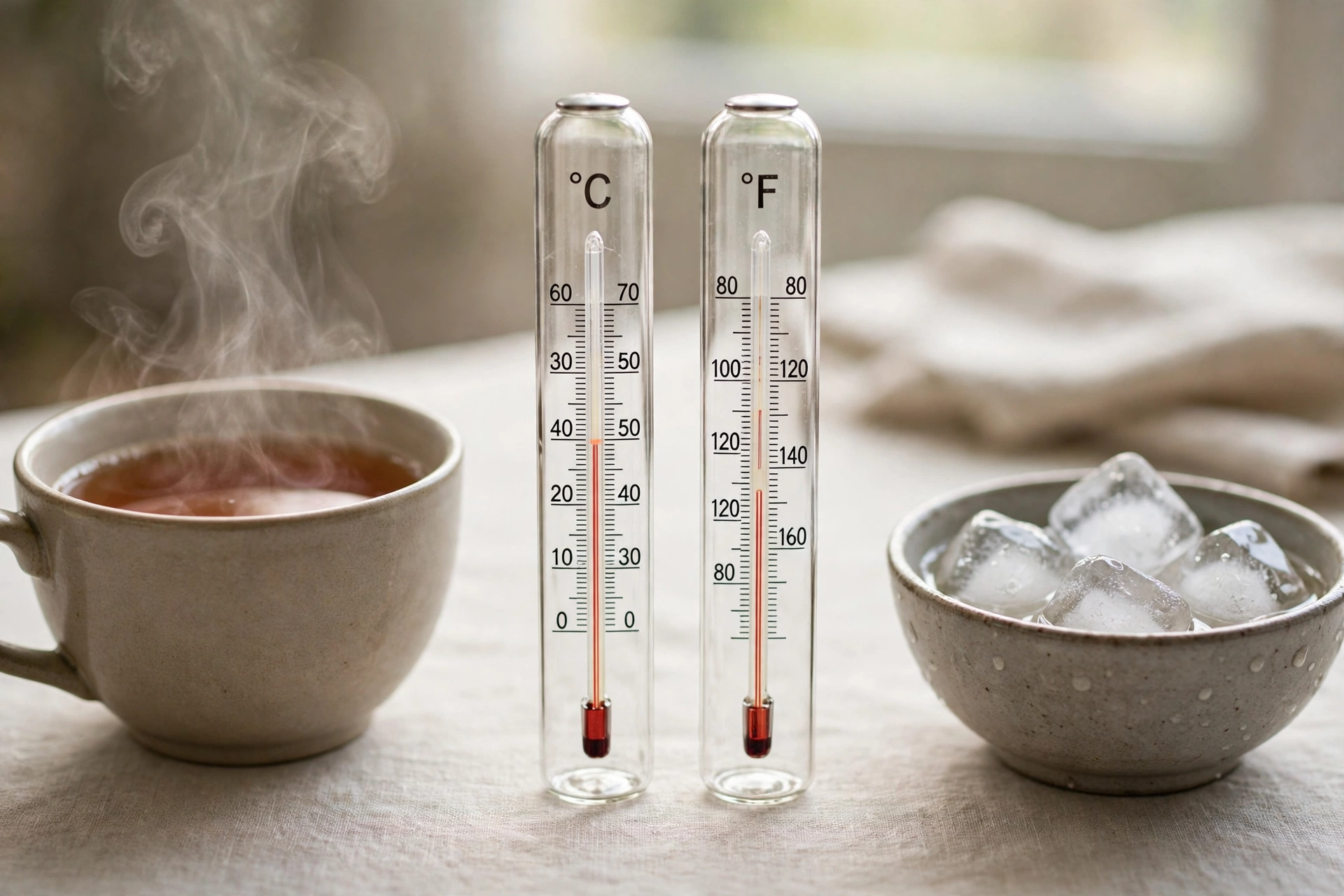

If you have ever landed in a new country, opened a weather app, and stared at a forecast that made no sense, you have run into the Celsius to Fahrenheit problem. One scale says 20, the other says 68, and both mean the same pleasant afternoon. This guide gives you the full conversion chart, the one formula you need, and a mental-math shortcut you can actually use without a calculator.
Celsius is the scale used in most of the world and in science everywhere. Fahrenheit is still the everyday scale in the United States. The two scales are built on the same physical facts — water freezes and boils — but they number those points differently. On the Celsius scale, water freezes at 0°C and boils at 100°C. On the Fahrenheit scale, water freezes at 32°F and boils at 212°F. That 100-degree span versus a 180-degree span is exactly why the conversion formula has a 9/5 in it.
The Celsius to Fahrenheit Formula
The formula is short, and it works for every temperature:
°F = (°C × 9/5) + 32
In other words, multiply the Celsius temperature by 1.8 and then add 32. The 1.8 comes from 180 divided by 100 — the Fahrenheit span between freezing and boiling, divided by the Celsius span. The 32 shifts the whole scale up, because Fahrenheit starts counting at 32 where Celsius starts at zero.
Worked example: 20°C
Multiply 20 by 9/5 (which is 1.8) to get 36, then add 32. The answer is 68°F. So a 20°C day — light jacket weather in most places — is a 68°F day in American terms.
Worked example: 0°C
Multiply 0 by anything and you still get 0, then add 32. Freezing point, 0°C, is 32°F. This is the anchor to check yourself against: if your answer for 0°C is anything other than 32°F, something went wrong.
Worked example: 100°C
Multiply 100 by 9/5 to get 180, then add 32. Boiling point, 100°C, is 212°F. The other anchor. Between these two anchors — 32°F and 212°F — every Celsius value has exactly one Fahrenheit partner.
Worked example: 37°C
Multiply 37 by 1.8 to get 66.6, then add 32 to get 98.6°F. That is the long-quoted average human body temperature, and it is a useful check: a thermometer reading near 37°C should land near 98.6°F, not near 100°F.
Celsius to Fahrenheit Conversion Chart
Use this chart for the temperatures people actually look up: weather, cooking, and body temperature. Values are rounded to one decimal place where the conversion does not land on a whole number.
| Celsius (°C) | Fahrenheit (°F) | What it feels like |
|---|---|---|
| -40 | -40 | The one point where both scales agree |
| -20 | -4 | Deep winter cold |
| -10 | 14 | Hard frost |
| 0 | 32 | Water freezes |
| 5 | 41 | Cold, coat weather |
| 10 | 50 | Cool spring day |
| 15 | 59 | Mild, light layers |
| 20 | 68 | Comfortable room temperature |
| 25 | 77 | Warm summer day |
| 30 | 86 | Hot, shade-seeking weather |
| 35 | 95 | Heatwave territory |
| 36.7 | 98.1 | Typical body temperature range |
| 37 | 98.6 | Average body temperature |
| 37.5 | 99.5 | Above normal, below the fever line |
| 38 | 100.4 | Fever threshold for most adults |
| 39 | 102.2 | High fever range |
| 40 | 104 | Very high fever range |
| 100 | 212 | Water boils |
If you only remember a few rows, remember these: 0°C is 32°F, 10°C is 50°F, 20°C is 68°F, 30°C is 86°F, and 37°C is 98.6°F. Those five anchors cover most weather forecasts and most thermometer readings you will ever need to translate.
Reading Weather in the Other Scale
Weather is where most people meet this conversion, and the numbers feel stranger than they are because the two scales stretch differently. A 10-degree rise in Celsius is an 18-degree rise in Fahrenheit. So when a forecast jumps from 20°C to 30°C, that is not a small nudge — it is the jump from 68°F to 86°F, from comfortable to properly hot.
Cold days: below 10°C (below 50°F)
Anything under 10°C is coat weather by most standards. At 5°C (41°F) you will want a real jacket; at 0°C (32°F) you are at freezing, and roads and pavements can ice over overnight even if the daytime high looks harmless.
Comfortable days: 15°C to 25°C (59°F to 77°F)
This is the band most people call pleasant. Around 20°C (68°F) is typical indoor comfort, and outdoor days from 18°C to 24°C (about 64°F to 75°F) are the ones travel guides describe as ideal for walking around a city. If a holiday forecast says 22°C, expect roughly 72°F — warm enough for short sleeves in the sun, cool enough to want a layer in the evening.
Hot days: 30°C and above (86°F and above)
At 30°C (86°F) the heat is the story of the day, and at 35°C (95°F) it is a health consideration, not just a comfort one: drink water, seek shade, and slow down. The scale difference matters here too — a forecast of 38°C sounds only a few degrees above 35°C, but in Fahrenheit that is 100.4°F versus 95°F, a gap you can feel.
Body Temperature and Fever, in Both Scales
Body temperature is the other place where a conversion mistake actually matters, so it is worth getting the landmarks right. Normal body temperature is usually quoted as 37°C (98.6°F), but healthy readings vary through the day and from person to person. Johns Hopkins Medicine puts the normal range at 97.5°F to 98.9°F (36.4°C to 37.2°C), lower in the morning and higher in the evening.
The fever line: 38°C (100.4°F)
Most healthcare providers consider a temperature of 100.4°F (38°C) or higher to be a fever. That single pair — 38 and 100.4 — is the one to memorise if you are reading a thermometer that uses the scale you are less used to. A reading of 37.5°C (99.5°F) is above average but below that line; a reading of 38°C has crossed it.
Why the method matters
The same body can give slightly different numbers depending on where the temperature is taken — mouth, ear, forehead, or underarm do not read identically. That is normal, and it is one reason a single borderline reading is less informative than how you feel and whether the reading is rising. This article is general information only, not medical advice: if you are worried about a fever, especially in a baby under three months old, talk to your clinician rather than relying on a conversion chart.
The Fast Mental-Math Trick
For weather and everyday estimates, you do not need the exact formula. Use this shortcut, which lands within a few degrees:
Step 1: Double the Celsius number
Take your Celsius temperature and multiply it by 2. For 20°C, that gives 40.
Step 2: Subtract 10 percent, then add 32
Take 10 percent off that doubled number (40 minus 4 is 36), then add 32. You get 68°F — exactly right for 20°C, because doubling minus 10 percent is the same as multiplying by 1.8.
Step 3: For a quicker, rougher guess, double and add 30
If you are in a hurry, double the Celsius number and add 30. For 20°C that gives 70°F, two degrees high. Good enough to decide what to wear, not good enough for cooking or a thermometer reading, where you should use the exact formula.
The trick also explains a common surprise: doubling alone overshoots, because the true multiplier is 1.8, not 2. Knocking 10 percent off the doubled figure corrects it exactly.
Going the Other Way: Fahrenheit to Celsius
Coming back from Fahrenheit, reverse the steps:
°C = (°F − 32) × 5/9
Subtract 32 first, then multiply by 5/9 (or divide by 1.8). So 77°F becomes (77 − 32) × 5/9 = 45 × 5/9 = 25°C. A useful check: 68°F should give you back 20°C, and 32°F should give you 0°C. If it does not, you probably multiplied before subtracting — the order matters.
Conversions between units follow the same idea as other unit changes: a fixed multiplier plus, in this case, a fixed offset because the two scales do not share a zero point. If you enjoyed untangling that, our guide to converting milliliters to milligrams works through a similar problem, where the missing piece is density rather than an offset.
Common Mistakes to Avoid
Forgetting the +32
This is the most common error, and it produces answers that look plausible but are badly wrong: 20°C becomes 36°F instead of 68°F. If your answer for a warm day comes out below freezing, you forgot the 32.
Using 9/5 backwards
Celsius to Fahrenheit multiplies by 9/5; Fahrenheit to Celsius multiplies by 5/9. Swapping them turns 20°C into about 43°F — cold enough to be obviously wrong, but only if you stop to check. Always sanity-check against an anchor: 20°C must be near 68°F.
Rounding too early
Round at the end, not in the middle. Multiplying 37 by 1.8 gives 66.6; rounding that to 67 before adding 32 gives 99°F instead of 98.6°F. For a fever reading, that half-degree gap is the difference between a normal reading and a worrying one.
Assuming -40 is a typo
It is not. At -40, the two scales meet: -40°C is exactly -40°F, the only temperature where the numbers match. It falls straight out of the formula — set °C equal to °F and solve — and it is a handy party fact as well as a useful check on your arithmetic.
Why Two Scales Still Exist
Celsius was built around water: 0 for freezing, 100 for boiling, a neat hundred steps between them. It fits the metric system, which is why science and most countries use it. Fahrenheit came first, from the early 1700s, and was designed around a brine mixture for zero and body temperature for its upper reference — later revised so that water freezes at 32°F and boils at 212°F, as Britannica’s Fahrenheit scale entry explains. The United States kept it, and so did a handful of other countries, which is why travellers, cooks following American recipes, and anyone reading an American weather forecast still need the conversion.
Neither scale is more correct; they are two rulers for the same thing. Once you know the formula, the chart, and the quick trick, you can read either one without thinking twice — and you will never again wonder whether 20 degrees means a jacket or a swimsuit.
Sources: the formula and scale definitions follow Britannica’s Celsius entry (0°C freezing, 100°C boiling, conversion °C = 5/9(°F − 32)) and its Fahrenheit entry; the normal body-temperature range and 100.4°F fever threshold follow Johns Hopkins Medicine.
What is the formula to convert Celsius to Fahrenheit?
Multiply the Celsius temperature by 9/5 (or 1.8) and add 32: °F = (°C × 9/5) + 32. For example, 20°C × 9/5 = 36, plus 32 = 68°F.
What is 20 degrees Celsius in Fahrenheit?
20 degrees Celsius is 68 degrees Fahrenheit. Multiply 20 by 1.8 to get 36, then add 32.
What is 37 degrees Celsius in Fahrenheit?
37 degrees Celsius is 98.6 degrees Fahrenheit, the long-quoted average human body temperature.
Is 38 degrees Celsius a fever?
Most healthcare providers consider 100.4°F (38°C) or higher to be a fever. A reading of 38°C has reached that threshold, while 37.5°C (99.5°F) is below it. This is general information only — talk to your clinician if you are worried.
How do you convert Fahrenheit to Celsius quickly?
Subtract 32 from the Fahrenheit temperature, then multiply by 5/9. For example, (77°F − 32) × 5/9 = 25°C. For a rough weather estimate, subtract 30 and halve the result, but use the exact formula for cooking or thermometer readings.
