
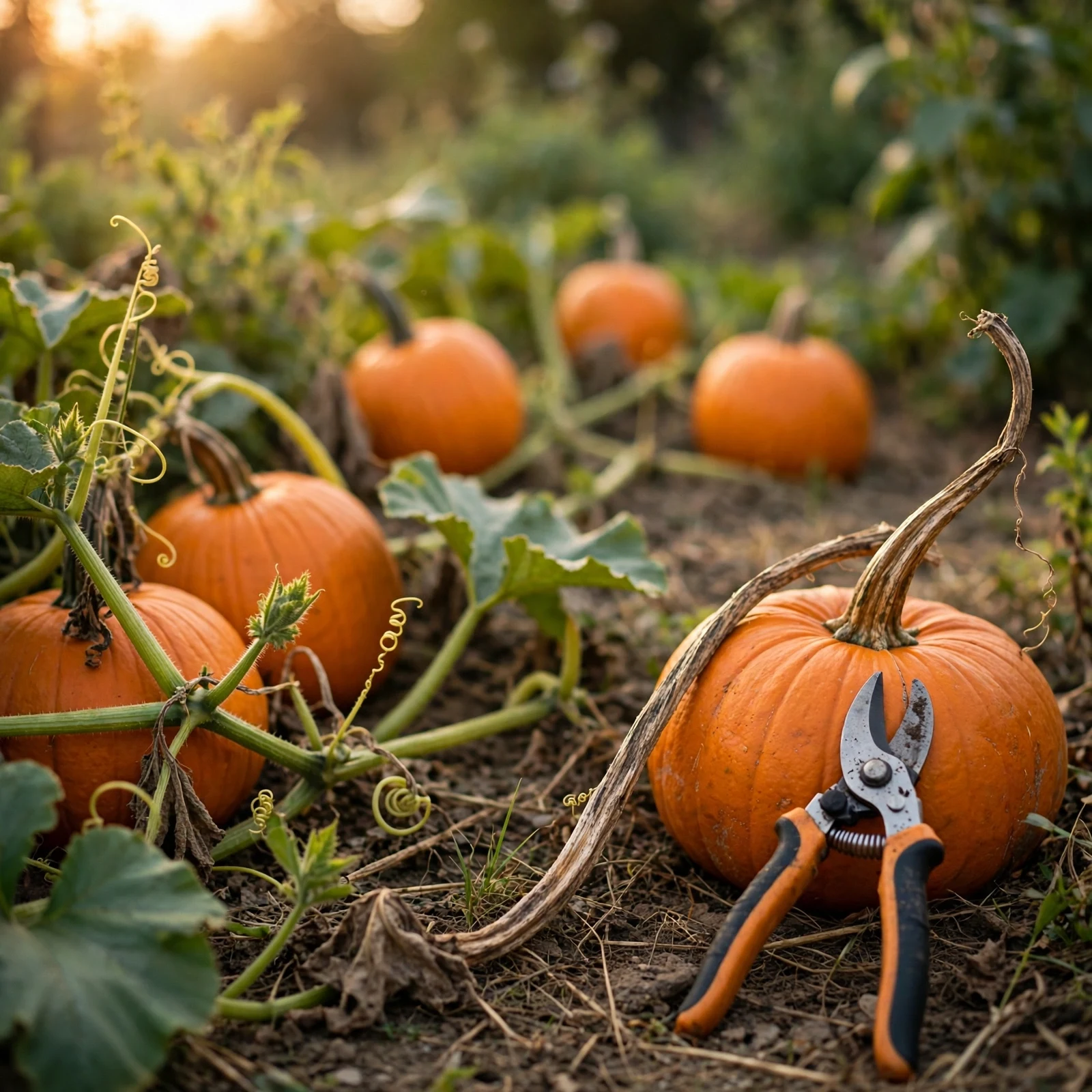

There’s a particular frustration that comes with growing pumpkins. You spend all summer watching vines sprawl across the garden, you count the swelling green orbs like money in the bank, and then September arrives and every pumpkin starts turning orange at once — and you have no idea which ones are actually done.
Pick too early and you get a pale, soft-shelled pumpkin that rots before Halloween. Pick too late and a hard freeze turns your whole harvest to mush overnight. The window is narrower than most gardeners expect, which is why knowing exactly when to harvest pumpkins matters more than almost any other decision you make for the crop.
The good news: pumpkins tell you when they’re ready, if you know how to read them. Three simple tests — thumbnail, stem, and thump — take about a minute per pumpkin, and a little curing and proper storage will keep your harvest firm from carving night all the way to Thanksgiving decor.
The Short Answer: When Do You Harvest Pumpkins?
Pumpkins are warm-season plants, sown in late spring or early summer after the last frost. Depending on the variety, they need roughly 85 to 120 days to mature — miniature types around 95 days, small decorative types about 105, small-to-medium around 110, and medium-to-large types a full 120, according to Oregon State University horticulture. South Dakota State Extension gives a range of 80 to 115 days, and Penn State’s cultivar tables land in the same 85-to-120 window.
In practice, that means most pumpkins are ready to harvest in September and October. Your seed packet’s “days to maturity” figure is the best starting estimate, though the University of Minnesota Extension notes the real date can land a bit on either side of it depending on the weather.
But here’s the catch: days-to-maturity is a prediction, not a verdict. Weather, watering, and variety all shift the schedule. So the calendar tells you when to start checking — and the three ripeness tests tell you when to pick.
The 3-Test Ripeness Checklist
Don’t rely on color alone. A pumpkin can look orange weeks before it’s truly mature, and not every variety turns orange anyway. Run all three tests before you cut.
Test 1: The thumbnail test
Press your thumbnail into the rind. On a ripe pumpkin, the shell has hardened enough that your nail can’t puncture or dent it — and the rind should look dull rather than glossy.
This is the single most-cited ripeness test in extension literature, for a simple reason: a hardened rind is the pumpkin’s storage armor. Soft-rind pumpkins bruise and rot. Colorado State University’s PlantTalk says pumpkins are ready “when the stems are dry and the skin resists penetration by a thumbnail,” and Iowa State Extension’s pumpkin harvest FAQ, the University of Minnesota, and K-State all teach the same thumbnail test.
Test 2: The stem check
Look at the stem. A mature pumpkin’s stem is dry, hard, and corky — sometimes with visible cork-like cracking. If the stem is still green and supple, the pumpkin is still feeding from the vine.
When the stem passes, cut the fruit from the vine with pruners or a sharp knife — never tear it, and never snap it off. Leave a 3- to 5-inch stem “handle” attached. Iowa State Extension notes that pumpkins with intact stems are less likely to rot, and both the Old Farmer’s Almanac and the Farmers’ Almanac agree on leaving several inches of stem. Then carry the pumpkin by its body, never by the stem — a broken stem leaves an open wound where rot starts.
Test 3: The thump test
Rap the pumpkin with your knuckles. A ripe one sounds hollow. The University of Minnesota Extension explains why: the hollow note means the interior has developed seeds and an air pocket. (One caveat from UMN: the hollow sound doesn’t apply to some squash varieties, so treat this as a confirming test rather than the deciding one.)
Pass all three — hard rind, dry corky stem, hollow thump — and that pumpkin is ready to come off the vine.
The Frost Rule
Pumpkins don’t have to beat a single cold night. A light frost won’t damage the fruit, and Iowa State Extension says mature pumpkins can be left in the field until a light frost or freeze kills the vines. Colorado State agrees: light frost isn’t damaging, but harvest before a hard freeze.
The hard freeze is the line. Mississippi State’s commercial vegetable guidance warns that frost penetrating the fruit causes rapid flesh deterioration and rot, and that fruit exposed to temperatures below 50°F for 10 days or more won’t store well. Purdue’s vegetable crops team adds that even a light frost might lead to fruit rot, though pumpkins can survive one or two cold nights in the field.
When a hard freeze is forecast and you’re out of time, harvest everything — even slightly under-ripe fruit. A pumpkin picked a little early won’t keep as long, so use those first.
Cure Before You Store
This is the step almost every home gardener skips, and it’s the difference between pumpkins that last weeks and pumpkins that last months. Curing heals cuts and scratches, hardens the rind further, deepens color, and even increases the sugar content, according to Purdue’s 2025 pumpkin postharvest guide.
The method is simple: set your harvested pumpkins in a warm, shaded, well-ventilated spot at 80 to 85°F and about 80% relative humidity for around 10 days (Iowa State; Purdue gives the same 10 days at 80–85°F, while Mississippi State says up to two weeks at 75–85°F). A warm garage, greenhouse bench, or sunny porch works — just not in direct sun.
Cure every pumpkin before it goes into storage. Pumpkins with the hardest skins benefit most, but the practice applies across the board.
How to Store Whole Pumpkins for Months
Once cured, a pumpkin wants conditions that mimic a cool autumn cellar: 50 to 55°F, dry air, good ventilation, stored in a single layer so the fruits don’t touch each other. Purdue specifies 50–55°F with 50 to 75% relative humidity; Iowa State emphasizes the single layer and airflow, which prevent moisture from forming on the rind.
Under those conditions, expect two to three months of storage — long enough for a September pumpkin to still look handsome at Thanksgiving. Colorado State cites the same 2-to-3-month figure, and the Old Farmer’s Almanac notes pumpkins stored this way “last all winter.”
What kills stored pumpkins:
- Piles. Stacking pumpkins traps heat between them, and Iowa State warns that heat leads to rotting.
- Damp spots. K-State advises against anywhere pumpkins can get damp at the base.
- Freezing and heat. Below 50°F risks chilling injury; above 55°F speeds weight loss, color loss, and quality decline (Purdue). Keep them between 50 and 55.
- Ethylene sources. Pumpkins are sensitive to ethylene gas, so don’t store them near apples, ripening tomatoes, or cantaloupes (Purdue).
Jack-o’-Lantern Pumpkins vs. Pie Pumpkins: Don’t Mix Them Up
Worth knowing before harvest day: the big carving pumpkins have stringy, bland-tasting flesh and are best used as decorations, according to the University of Minnesota Extension. If you want to eat your harvest, grow pie types — Penn State’s cultivar tables list varieties like Baby Pam, described as “excellent for pies,” maturing in about 100 days. Oregon State lists Small Sugar among the ~95-day miniature types. Giant pumpkins like Dill’s Atlantic Giant, which need 130 days or more, aren’t ideal for eating either (Oregon State).
If you’re growing for the table and want to bake your own purée later this season, plan for that at planting time — a carving pumpkin’s flesh won’t improve in the kitchen.
How to Make Carved Pumpkins Last Longer
A carved pumpkin is a race against mold and moisture loss: once you cut through the rind, the clock starts. With care, you can stretch the display life well past what an untreated jack-o’-lantern manages. And if you end up with more pumpkins than you can carve, our roundup of pumpkin painting ideas puts the extras to good use.
Wash with a dilute bleach solution
Before carving — or right after — wash or spray the pumpkin with a dilute bleach solution, about a 10% mixture (K-State recommends one part bleach to ten parts water; the University of Nevada Reno Extension suggests about a tablespoon of bleach per gallon of water). The bleach kills the surface mold, mildew, and bacteria that start the rotting process. South Dakota State and NC State Extensions both endorse this step, and NC State’s guide to preserving your carving adds that a light daily re-spray helps preserve the pumpkin longer.
For pumpkins destined for compost or wildlife food, NC State recommends a vinegar solution as the alternative wash instead of bleach. Never mix bleach and vinegar together.
Seal the cuts with petroleum jelly
Rub petroleum jelly over every exposed cut surface — inside and out. It locks in moisture and creates a barrier against bacteria, according to South Dakota State, K-State, and NC State Extensions. Coat the inside walls, the cut edges, and any carved-out details.
Skip the real candle
This matters doubly if you used petroleum jelly, which is flammable. But even without it, a real candle shortens a pumpkin’s life: the heat effectively cooks the flesh and speeds spoilage (NC State, UNR Extension, South Dakota State). Use a battery-operated candle, an LED, or a glow stick instead.
Keep it cool and carve late
Carved pumpkins do best at 50 to 60°F — warmer temperatures accelerate pathogen growth, and freezing damages the tissue, which decays fast once thawed (South Dakota State). Keep your jack-o’-lantern in a protected spot away from direct sun, rain, and frost, and refrigerate it on the days you’re not displaying it (NC State).
And time your carving: the Farmers’ Almanac recommends carving just three to five days before Halloween in most of the country. With the full preservation routine, NC State Extension reports a carved pumpkin can last 8 to 11 days (via secondary sources citing Utah State and NC State Extensions) — an untreated one lasts a fraction of that.
The Bottom Line
Start checking your pumpkins when the days-to-maturity window opens, run the thumbnail-stem-thump checklist, harvest before the first hard freeze, cure for ten warm days, and store them cool and dry. Your October pumpkins will carve beautifully — and the leftovers will still be greeting guests at the door when Thanksgiving arrives. When the vines die back and the garden season ends, our guide to caring for indoor plants keeps the green-thumb habit alive indoors.
Can I harvest pumpkins after a light frost?
Yes. A light frost won’t damage the fruit, and Iowa State Extension says mature pumpkins can stay in the field until the vines are killed by a light frost. Harvest before a hard freeze, though: frost that penetrates the fruit causes rapid deterioration and rot (MSU), and fruit exposed below 50°F for 10+ days won’t store well.
How long do pumpkins need to cure?
About 10 days at 80–85°F with roughly 80% relative humidity in a shaded, ventilated spot (Iowa State Extension, Purdue). Curing heals wounds, hardens the rind, deepens color, and increases sugar content.
How long can I store a whole pumpkin?
Two to three months at 50–55°F, in a dry, well-ventilated single layer so the fruits don’t touch (Purdue, Iowa State, Colorado State). Keep them away from damp spots, freezing, piles, and ethylene sources like apples.
Does bleach really make carved pumpkins last longer?
Yes. A dilute bleach solution kills the surface mold, mildew, and bacteria that start the rotting process (SDSU, K-State, NC State Extensions). Use a vinegar solution instead for pumpkins that will end up as compost or wildlife food — and never mix bleach and vinegar.
How long does a carved pumpkin last?
A carved pumpkin lasts only a few days (Utah State Extension). With the full preservation routine — bleach wash, petroleum jelly on the cuts, LED light, cool storage — NC State Extension reports 8 to 11 days (as reported by secondary sources citing Utah State and NC State Extensions). Carve three to five days before Halloween (Farmers’ Almanac).
