

How to Care for Indoor Plants: A Beginner’s Guide That Actually Works
Most houseplants don’t die of neglect. They die of too much love — too much water, too little light, and a schedule that has nothing to do with what the plant actually needs. If you’ve ever followed a care tag’s “water weekly” instruction and still watched your plant droop, the tag wasn’t wrong on purpose. It just couldn’t see your room.
This guide works differently. Instead of watering calendars and one-size-fits-all rules, you’ll get two diagnostic habits — checking the soil and reading your windows — plus five starter plants that forgive beginners. It’s the same advice university extension services give homeowners, minus the jargon.
Rule 1: Water by Feel, Not by Calendar
Clemson University’s horticulture specialists put it bluntly: the main cause of death of potted plants is over-watering. When roots sit in water they can’t take up oxygen, they rot, and the whole plant can die. The tricky part? Overwatering and underwatering look alike — both cause wilting — so adding more water to a wilting, overwatered plant makes things worse.
The finger test
Clemson’s “Indoor Plants – Watering” guide calls this the most accurate gauge: stick your finger into the mix up to the first joint; if it is dry at your fingertip, it needs water. No apps, no meters (which the guide notes vary widely in accuracy), no weekly calendar. Some plants, like pothos, are happy when the top 1.5 to 2 inches of soil dry out between waterings — your finger is the instrument.
Water thoroughly, then empty the saucer
When the finger test says go, commit: water until it runs out of the bottom of the pot. This does two jobs — it washes out accumulated salts and it guarantees the bottom two-thirds of the pot, where most roots live, actually gets wet. Then the part everyone skips: empty the saucer. A pot sitting in its own runoff is the classic route to root rot. Also worth knowing: use room-temperature water (roughly 62–72°F per Clemson’s guidance), not hot or cold.
Rule 2: Match the Plant to Your Window
Light is the other half of the equation, and “bright indirect light” on a tag means nothing until you know which way your window faces. Clemson’s beginner-plant guide breaks it down by orientation — find your window below and shop your plant collection accordingly:
South-facing window
The highest and brightest light available — bright direct sun most of the day if trees or buildings don’t shade it. Save this spot for sun-lovers, and keep it away from plants that scorch (most low-light plants hate direct southern sun).
West-facing window
Medium light. The sun arrives in the afternoon and can be intense and warm; it’s a solid spot for plants that like bright but not all-day sun. In summer, sheer curtains help here.
East-facing window
Low-to-medium light with gentle morning sun. This is the beginner sweet spot — bright enough for almost everything, mild enough to burn almost nothing.
North-facing window
The lowest light: no direct sun all day. Not a dead zone — the beginner-plant guide’s lighting breakdown confirms this suits low-light plants, and the cast iron plant below genuinely thrives here.
5 Unkillable Starter Plants
Buy from this list first. Each one tolerates beginner mistakes, and each one teaches a different lesson about reading plants.
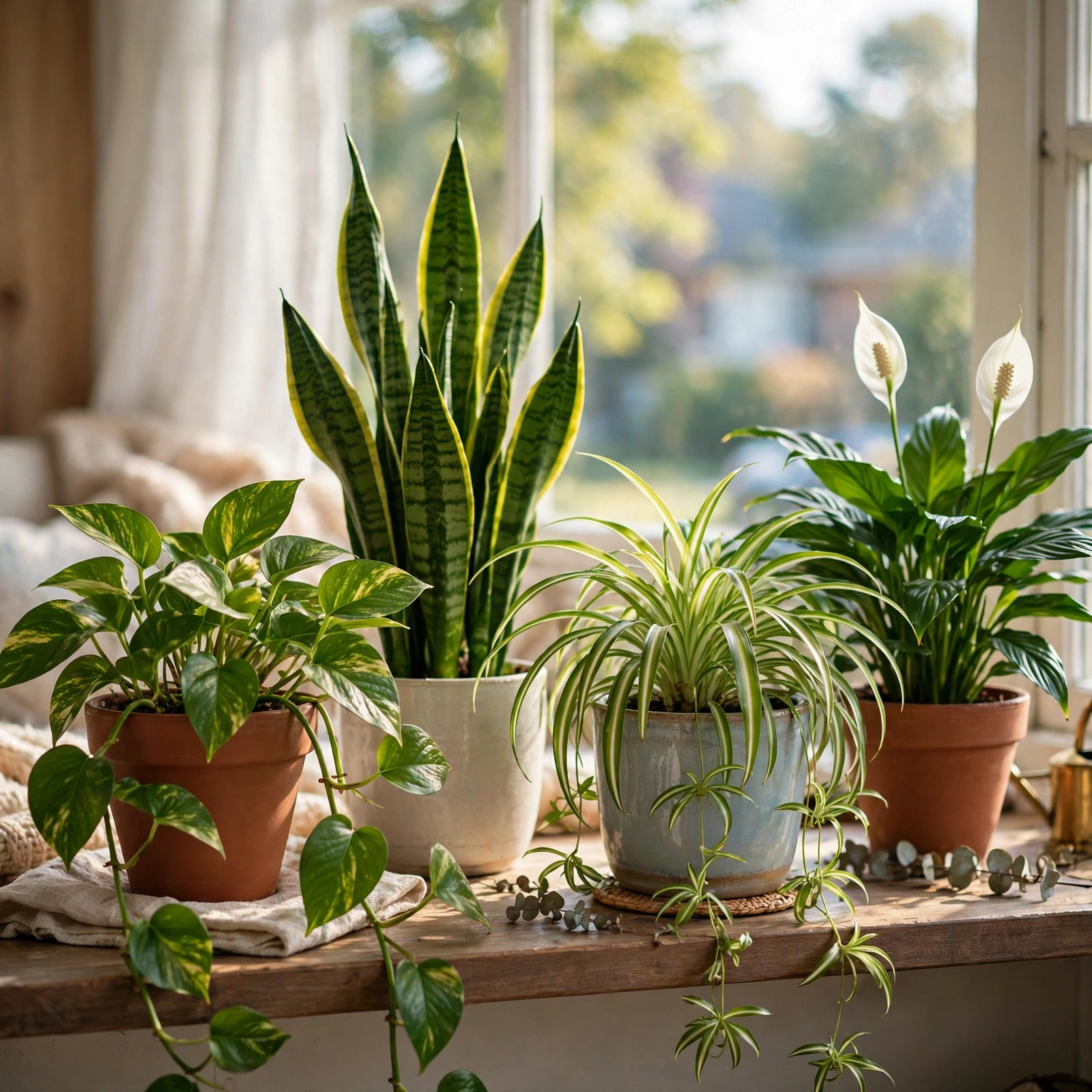
1. Pothos (Epipremnum aureum)
The classic first plant — Clemson calls pothos and its relatives “among the most popular houseplants” and easy to care for. It prefers bright, indirect light but will tolerate lower lighting conditions. Water when the top 1.5 to 2 inches of soil dry out. One caveat: all parts of a pothos are mildly toxic if chewed, containing calcium oxalate crystals — keep it away from curious kids and pets.
2. Snake plant (Dracaena trifasciata)
Also sold under its old name, Sansevieria trifasciata (botanists moved it to Dracaena in 2017). Clemson calls snake plants “a fantastic selection for beginners”: they tolerate many different lighting settings and don’t need frequent watering or high humidity. Watering every 2 to 4 weeks in the growing season is plenty — err on the side of less, since they’re famously prone to rotting when over-watered.
3. Spider plant (Chlorophytum comosum)
Thrives in bright to medium indirect light, and watering is simple: water when the top 1 to 2 inches of soil feel dry to the touch, and avoid overwatering to prevent root rot. Spider plants make “babies” — little plantlets on arching stems — which means free plants for every windowsill. Bonus: the ASPCA lists them as nontoxic to cats, making them the pet-friendly pick on this list.
4. Peace lily (Spathiphyllum)
The low-light specialist. Clemson’s light-requirements guide lists peace lily among the low-light plants that thrive in northern exposures, and it’s one of the few starter plants that actually flowers indoors. It’s also a built-in moisture meter: it droops dramatically when thirsty and perks back up within hours of watering. Heads-up: like pothos, it contains calcium oxalates and is toxic to dogs and cats if chewed — fine on a high shelf, risky at paw level.
5. Cast iron plant (Aspidistra elatior)
The name is the promise. Clemson describes it as “one tough plant” that can grow in deep shade and withstand drought — a houseplant for dark corners and forgetful owners. Place it in a north-facing window or another low-light spot, water when the soil is dry 2 to 3 inches down, and let it drain. Its only real demand is the same as everyone’s: don’t leave water standing in the saucer.
4 Mistakes That Kill Beginner Plants
Mistake 1: Watering on a schedule
“Every Sunday” ignores that a pothos in a sunny clay pot dries out three times faster than a snake plant in a cool ceramic one. The finger test adjusts for all of that automatically. Schedules kill; checks save.
Mistake 2: Pots without drainage holes
A decorative pot with no hole turns every watering into a gamble. Clemson recommends containers with a drainage hole plus a tray to catch excess water — then water thoroughly, let it flow through, and empty the tray. If you fell in love with a hole-less pot, use it as a cachepot: keep the plant in a plastic nursery pot inside it, and lift the plant out to water.
Mistake 3: Too little light
The number-two killer after water. A pothos will “tolerate” a dark corner, but tolerating isn’t thriving — growth stalls, leaves shrink, and watering gets riskier because wet soil sits longer. Match the plant to the window (Rule 2), and when a plant stops growing, check light before you reach for fertilizer.
Mistake 4: Never repotting
Plants outgrow their pots, and rootbound plants dry out within a day of watering — which looks exactly like a watering problem. Clemson’s repotting guide gives the tell: roots growing out of the drainage hole, a solid mass of roots around the rootball, or a plant that wilts shortly after watering. Move up one pot size, not three — a huge pot holds soggy soil the roots can’t drink.
A Note on Pets and Kids
Two of our five starters need a placement decision if you share the house with cats, dogs, or toddlers: pothos and peace lily are both mildly toxic when chewed (mouth irritation, drooling, vomiting per the ASPCA — uncomfortable, not usually dangerous). Put them up high or behind a barrier. Spider plants, snake plants (not tasty, but not listed as highly toxic), and cast iron plants are much lower-drama choices. When in doubt, check the ASPCA’s plant database before bringing anything home.
Your First-Month Routine
Weekly: the 60-second check
Walk the windowsill once a week. Finger-test each pot, look at the leaves (yellow + soft usually means too much water; brown crispy edges usually mean too little or too dry air), and turn each plant a quarter-turn so it grows evenly toward the light.
When something looks off: diagnose, don’t react
Drooping? Check the soil before reaching for the watering can — remember, rot and drought wilt alike. Yellowing? Ask about light and water before fertilizer. New growth pale and leggy? That’s a light shortage, full stop. Most plant “emergencies” resolve once you fix water or light and give the plant a week.
Monthly: the tidy-up
Wipe dust off leaves with a damp cloth — dusty leaves photosynthesize poorly. Trim dead or fully yellow leaves at the base. That’s the whole maintenance program; houseplants don’t need the fuss the internet sells you.
Pair this system with a home that supports it: our room-by-room decluttering guide frees up the very windowsills and surfaces your plants need — one home, one system.
How often should I water my indoor plants?
Don’t use a fixed schedule — water when the top inch or two of soil feels dry. Push your finger into the mix up to the first joint; if it’s dry at your fingertip, it’s time to water. When you do, water until it drains from the bottom, then empty the saucer.
How much light do indoor plants actually need?
It depends on the plant and the window. South-facing windows give the brightest light, west gives medium afternoon light, east gives gentle morning light, and north gives the lowest light. Beginners do best with low-light plants — pothos, snake plant, spider plant, peace lily, or cast iron plant — matched to an east or north window.
What is the easiest indoor plant for beginners?
Pothos and snake plants are the most forgiving. Pothos tolerates lower light and only needs water when the top 1.5–2 inches of soil dry out; snake plants thrive on watering every 2–4 weeks in the growing season. Just keep pothos out of reach of pets and kids, since it’s mildly toxic if chewed.
Are indoor plants toxic to pets?
Some are. Peace lily and pothos contain calcium oxalate crystals that cause mouth irritation and vomiting in cats and dogs if chewed — the ASPCA lists them as toxic. Spider plants are listed as nontoxic to cats. Check the ASPCA’s plant database before bringing any new plant home.
When should I repot an indoor plant?
When roots grow out of the drainage hole, form a solid mass around the rootball, or the plant wilts shortly after watering despite moist soil. Move up one pot size only — too big a pot holds soggy soil the roots can’t use.
