
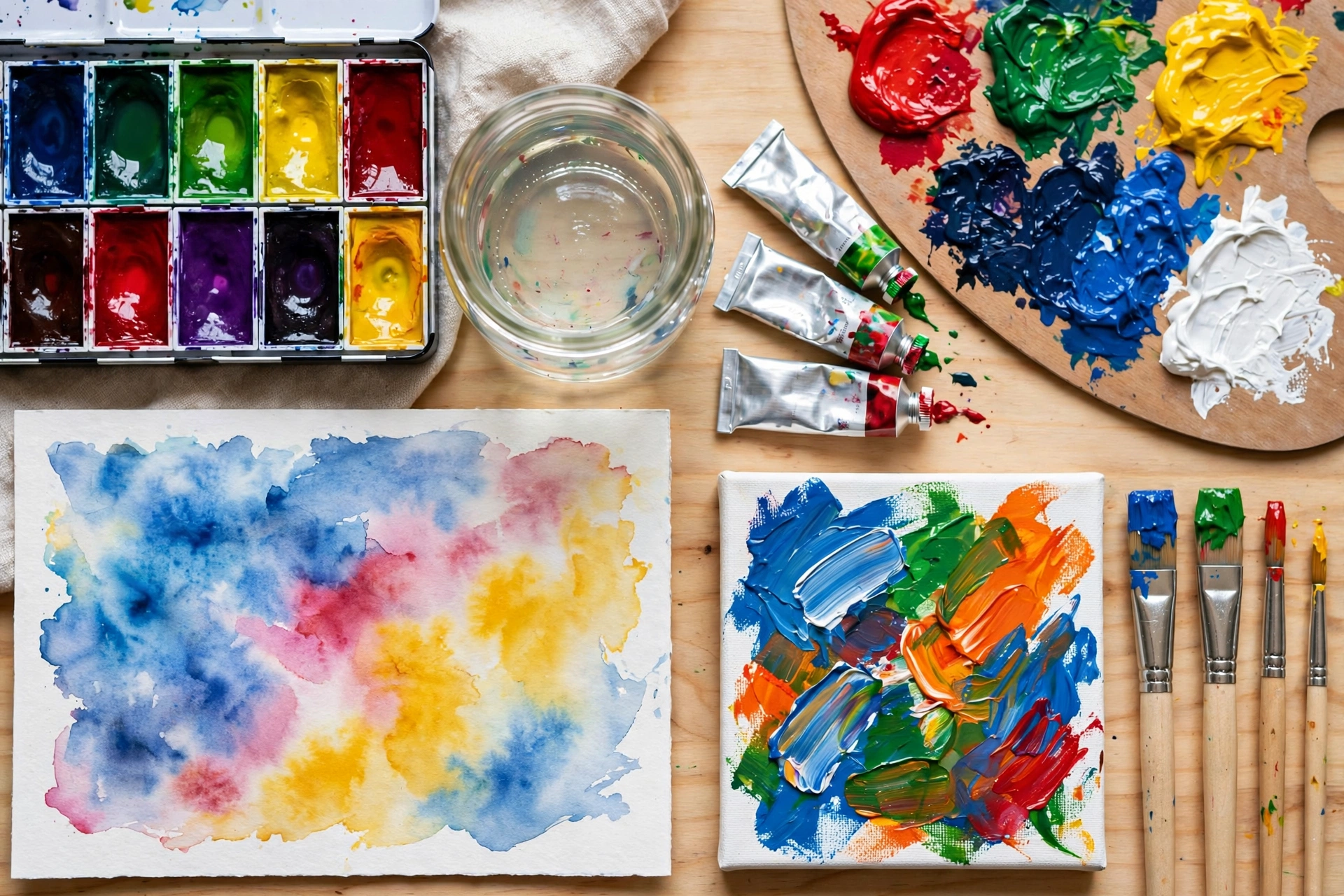

Ask any painting teacher what a beginner should start with and you’ll usually get one of two answers: “watercolor, it’s cheaper and cleaner” or “acrylic, it’s easier and forgives everything.” Both answers are honest. Both are incomplete. The right choice depends on how you paint, how much patience you have for mistakes, and what kind of mess you’re willing to live with.
If you’re weighing up watercolor vs acrylic for beginners, most guides give you a list of differences and leave you to figure out the rest. This one gives you a decision framework instead: five questions that point you to the right paint, plus the practical realities of what each one costs, needs, and feels like to use.
The One Difference That Decides Everything
Strip away the marketing and there’s a single physical fact underneath every watercolor-vs-acrylic argument: acrylic dries into a waterproof plastic film; watercolor never truly locks. Everything else — the forgiveness, the cleanup rules, the planning — follows from that.
Acrylics are made of pigment suspended in an acrylic polymer emulsion. Once the water evaporates, the polymer particles fuse into a permanent, water-resistant layer. Golden’s technical notes describe their Heavy Body acrylics as showing drying within five minutes and becoming relatively unmovable at thirty — and once that film forms, water won’t redissolve it. Liquitex describes the dried finish on its acrylic colors as “permanent, water-resistant.”
Watercolor works the opposite way. Pigment is suspended in gum arabic, a water-soluble binder, and dried paint on your palette is just waiting for water to wake it back up. Daniel Smith’s half pans, for example, are sold specifically on the promise that they “re-wet quickly and easily with a damp brush.” That reversibility is the whole medium in one word: mistakes can soften, colors can lift back off the paper with a damp brush, and a pan set you haven’t touched in a year works exactly like a new one.
So the real question isn’t “which paint is better.” It’s: do you want a paint that forgives mistakes by letting you paint over them (acrylic), or a paint that forgives mistakes by letting you lift them away (watercolor)?
What a Beginner Painting Session Actually Looks Like
With watercolor
You tape a sheet of watercolor paper to a board, fill two jars with water, and open a tin of twelve little pans. You wet a pan, touch the brush to it, and watch the color bloom across the damp paper. It’s lovely — until the wash dries darker than you expected, or a second color bleeds into the first, or you realize you forgot to save the white of the paper for the highlight and there’s no white paint in the tin to rescue you. Because watercolor is transparent, your whites come from the paper itself; you work from light to dark, and you have to plan.
Cleanup takes thirty seconds: rinse the brush, close the tin. The pans are ready again tomorrow, unchanged.
With acrylic
You squeeze blobs of paint onto a palette, grab a canvas or a sheet of thick paper, and start covering it. The paint sits on top of the surface, opaque and bold. You paint a sky too dark? Wait a few minutes and paint the lighter color right over it — the dried layer underneath won’t move. You finish, and there’s a moment of truth: if you don’t wash your brushes now, in soap and water, the paint hardens into plastic inside the bristles and the brush is ruined. That one discipline — wash immediately — is the price of acrylic’s forgiveness.
Ask around art schools and the verdict is consistent: acrylic is the easier first medium for most people, precisely because it forgives you — dry a layer, paint over it. Watercolor asks more planning of a beginner, because transparency means mistakes are hard to undo and light areas have to be mapped out from the first brushstroke.
Watercolor vs Acrylic: The Side-by-Side Comparison
| Factor | Watercolor | Acrylic |
|---|---|---|
| Dries to | A water-soluble layer that can be rewetted | A permanent, water-resistant plastic film |
| Fixing mistakes | Lift damp paint with a brush or blotter; hard once stained | Let it dry, paint over it |
| Getting lighter colors | Add more water; reserve the white paper | Mix in white paint |
| Cleanup | Rinse with water, any time | Soap and water — but only before it dries |
| Surfaces | Watercolor paper (needs the absorbent, heavyweight sheet) | Canvas, paper, wood, fabric, and more |
| Setup & portability | A tin of pans, a brush, two water jars — fits in a bag | Tubes, palette, water jar, rags — a tableful |
| Relative cost to start | Generally lower; a little paint goes a long way | Generally higher; tubes empty faster |
| Finishing a piece | Framed behind glass to protect it | Can be varnished once fully dry (thin layers: at least 24 hours; heavy texture: up to a week) |
A Decision Framework: Five Questions That Point to Your Paint
Forget “which is better.” Answer these five questions honestly and the choice makes itself.
1. How much do mistakes bother you?
If a visible mistake makes you want to throw the whole painting away, start with acrylic. Its opacity means every error is fixable with another layer — mix a new color and paint right over the problem. If you’re the type who finds working around a “happy accident” fun rather than stressful, watercolor’s transparency won’t scare you.
2. How much space and setup can you spare?
Watercolor wins this one outright. A pan set, one brush, and a cup of water is a complete studio that fits on a nightstand. Daniel Smith markets its half-pan sets explicitly as portable — built for travel, plein air work, and urban sketching. Acrylic needs tubes, a palette, water, rags, and somewhere to let a canvas dry undisturbed. If you paint at a kitchen table that has to be cleared for dinner, watercolor is the low-friction choice.
3. What’s your budget for the first shopping trip?
No fixed prices here — they vary too much by brand and country — but the relative math holds: a basic watercolor setup (pan set, a pad of watercolor paper, one decent brush) generally costs less than an acrylic setup (several tubes, canvas or canvas paper, a few brushes, a palette). Watercolor also stretches further: a single pan set can last months of regular painting because you’re thinning paint with water. Expect to replace acrylic tubes sooner.
4. What do you want to make?
Match the medium to the destination. Want to fill a sketchbook on trips, paint landscapes in the park, or make greeting cards? Watercolor’s portability and quick cleanup fit. Want to paint on canvas and hang big bold work on your wall, decorate a wooden box, or paint a mural? Acrylic adheres to canvas, wood, fabric, metal, and more — surfaces watercolor can’t touch. (If you go the acrylic-on-wood route, learn how to mix your colors first — and check our guide to the five brushes beginners actually need.)
5. Do you plan ahead, or do you improvise?
Watercolor rewards planners: you decide where the light areas are before the first brushstroke, because there’s no white paint to add later. Acrylic rewards improvisers: change your mind mid-painting, layer over yesterday’s work, build texture as you go. Neither is a personality verdict — but picking the medium that matches your natural style makes the first month of painting much more fun.
When Watercolor Is the Right First Medium: The Honest Counter-Case
Most comparison articles end with “acrylic wins for beginners” and move on. That’s lazy. Watercolor is the better first medium if any of this sounds like you:
- You have almost no space. A dorm desk, a shared apartment, a kitchen table — watercolor sets up and vanishes in minutes.
- You hate cleaning up. Rinse a brush and you’re done. No dried-plastic panic.
- You want to paint outside your home. Pan sets were made for parks, cafés, and travel sketchbooks.
- Your budget is tight. The entry setup costs less and the paint lasts longer.
- You like the look of watercolor. This matters more than any framework. If the transparent washes and soft edges are what made you want to paint in the first place, start there — motivation beats ease.
One practical note: use real watercolor paper. Winsor & Newton stresses this because the paper is engineered to absorb water without warping or falling apart. Beginners who try watercolor on printer paper get a crumpled, pilling mess and conclude the paint is at fault. It isn’t — the paper is.
When Acrylic Is the Right First Medium
Acrylic is the better first medium if:
- Mistakes stress you out. Painting over a dried layer is the most beginner-friendly safety net in art.
- You want bold, opaque color. Acrylic covers in one or two coats; watercolor builds in transparent layers.
- You want to paint on canvas, wood, or fabric. Acrylic’s adhesion to almost any surface is unmatched — though raw wood needs sealing before it sees paint.
- You learn by layering and experimenting. Acrylic invites it; watercolor punishes overworking a passage.
- You have a dedicated spot. A corner that can stay messy while paint dries removes acrylic’s main friction.
The one non-negotiable habit: wash your brushes before the paint dries. Soap, water, immediately. Everything else about acrylic is forgiving; this isn’t.
Your Starter Kit for Either Path
The watercolor starter kit
A 12-pan student set, a pad of 140 lb (300 gsm) watercolor paper, one round brush (size 8 or so), two water jars, and a roll of painter’s tape to hold the paper flat. That’s genuinely everything. Your first skill to practice: controlling how wet the paper is before the paint touches it — wet-on-wet for soft skies, wet-on-dry for crisp shapes.
The acrylic starter kit
A basic tube set (the primaries plus black, white, and a brown), three or four brushes in different shapes — here’s which five actually matter — a canvas pad or a few small canvases, a palette (or a disposable paper palette), a water jar, and rags. Your first skill to practice: mixing clean colors without turning everything muddy, and learning how fast thin layers set so you can plan your overpainting.
The Bottom Line
There is no wrong answer in the watercolor vs acrylic for beginners debate — only a faster route to paintings you enjoy making. If you want forgiveness, bold color, and canvas: start with acrylic, and wash your brushes like your art supplies depend on it. If you want portability, low cost, and gentle cleanup: start with watercolor, buy real watercolor paper, and plan your light areas first. And remember the deeper truth the comparison tables miss: the paint you actually pick up every week is always the right one.
Can beginners really start with watercolor, or is it too hard?
Beginners can absolutely start with watercolor — but expect a steeper first week than with acrylic. Watercolor is transparent, so mistakes are harder to cover and you work from light to dark, planning your light areas before you begin. Buy real watercolor paper (it stops the buckling that frustrates most newcomers) and start with simple washes before attempting detailed work.
Do acrylics dry too fast for beginners?
Usually not — fast drying is actually a beginner advantage, because it means you can fix a mistake by painting over it within minutes. Thin layers of acrylic can start setting in about five minutes (per Golden’s technical notes on its Heavy Body line), which keeps a session moving. The one thing speed punishes is brush care: wash brushes in soap and water before the paint dries, or the bristles harden permanently.
Which is cheaper to start, watercolor or acrylic?
Watercolor generally costs less to start: a pan set, a pad of watercolor paper, and one brush is a complete kit, and the paint lasts for months because you thin it with water. Acrylic setups need more tubes, brushes, a palette, and canvas or canvas paper — and tubes empty faster. Exact prices vary by brand and country, so compare starter sets rather than individual tubes.
Can you use watercolor and acrylic in the same painting?
You can paint acrylic over fully dried watercolor, because dried acrylic bonds to the paper over it. Going the other direction doesn’t work as expected: once acrylic dries it’s water-resistant, so watercolor applied on top of dried acrylic won’t behave like watercolor — it beads and lifts. Most artists who combine them use watercolor washes underneath and acrylic details on top.
Which paint is better for painting on canvas?
Acrylic, without question. Acrylic adheres to canvas, wood, fabric, and many other surfaces and covers opaquely in one or two coats. Watercolor is made for absorbent watercolor paper — on canvas it sits on the surface, lifts easily, and never behaves properly. If canvas painting is your goal, start with acrylic.
