
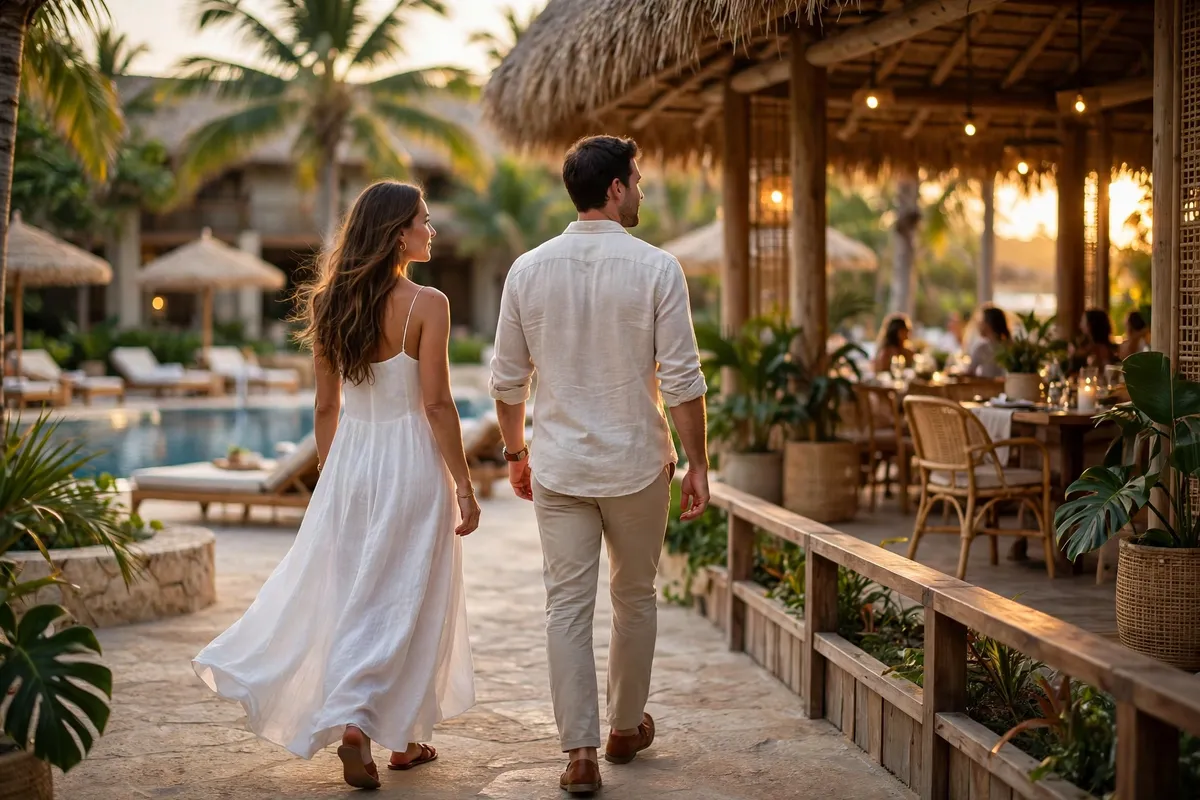

Packing for a resort is a strange kind of stress. The suitcase is small, the trip is supposed to be relaxing, and yet one wrong outfit can cost you a dinner reservation. Most people solve this by overpacking — three extra dresses, two spare shirts, shoes they never wear — and still feeling unsure on the first night.
It doesn’t have to be that way. Resort dressing runs on a simple pattern, and once you know it, you can pack light and still be right for every part of the day. This guide covers the clothes to wear at a resort from the pool to the dinner table, for women and men, plus a packing checklist and a capsule wardrobe that fits in a carry-on.
The one rule that answers almost every outfit question
Resort dress codes are not one rule for the whole property. They change with two things: the time of day and where you are standing. Swimwear is welcome at the pool and the beach. The same swimsuit will get you turned away at the steakhouse.
So before every outfit, ask two quick questions. What time is it, and where am I going? Morning at the pool means swimwear and a cover-up. Evening at a sit-down restaurant means something a step dressier. That one habit covers about 90 percent of the decisions you’ll make all week.
One warning: “resort casual” does not mean the same thing everywhere. One property’s version is shorts and a polo; another’s expects a collared shirt after 6 p.m. The labels are a starting point, not a promise — which is why the last section shows you how to check your own resort’s rules before you pack.
The four dress-code tiers, decoded
Almost every resort uses some version of the same four tiers. The names change — resort chic, elegant casual, smart casual — but the pattern holds. Kempinski’s published attire guide lays out the system clearly, and it is a good template for how most resorts think about it.
| Tier | When you’ll see it | Men | Women | Footwear |
|---|---|---|---|---|
| Resort casual | Daytime dining, cafés, beach bars — usually until around 6 p.m. | Shorts, T-shirt or polo | Cover-up, sundress, shorts or capris | Sandals, sneakers, flip-flops often fine |
| Resort evening | Dinner restaurants, bars after dark | Dressier shorts, trousers or nice jeans with a collared shirt | Sundress, skirt and top, elegant separates | Elegant sandals or closed-toe shoes |
| Elegant casual | Upscale restaurants, show lounges | Long-sleeve shirt with trousers and dress shoes — no shorts, T-shirts or sandals | Skirt or trousers with a nice top, or a dress | Dressier shoes |
| Formal resort | Weddings, galas, special events | Suit, or a dinner jacket with trousers | Full-length dress, gown or trouser suit | Dress shoes or dressy heels |
Notice the switch point. In the Kempinski guide, resort casual runs from breakfast until 6 p.m., and the evening tiers take over after that. Most resorts follow a similar line, even if they don’t print it. If you’re dressed for dinner by 6 p.m., you’re rarely wrong.
What to wear at a resort during the day
Daytime is the easy part. Comfort comes first, because you’ll be walking, swimming and sitting in the sun. The trick is choosing daytime pieces that can also walk into a restaurant with a quick change.
At the pool and the beach
Wear the swimsuit you actually like swimming in, not the one that only looks good in photos. A secure fit matters more than style when you’re getting in and out of the water all day. Pack two or three swimsuits so one is always dry — putting on a damp suit in the morning is a small misery you can skip entirely.
Over the suit, a cover-up does the heavy lifting. A linen shirt, a kaftan, a sarong or a light sundress all work. The test is simple: would you feel fine walking into a beachfront café wearing it? If yes, it’s a good cover-up. For a beach day at a park like Al Mamzar, the same rule applies — swimwear at the water, a cover-up the moment you head for food or shade.
Sun protection belongs here too, because clothing is the easiest sunscreen you’ll ever use. A wide-brim hat, sunglasses and a long-sleeve rash guard or linen shirt do more than any lotion on your shoulders, and they never need reapplying.
Around the resort in the daytime
For breakfast, lunch and wandering the grounds, think light and loose. Women can wear a sundress, linen shorts with a cotton top, or a matching set. Men can wear chino or linen shorts with a polo or a short-sleeve button-down. Sneakers or walking sandals cover the daytime shoe question — save the flip-flops for the pool deck, because they’re tiring on long walks and look out of place indoors.
One detail people forget: dry off before lunch. Restaurants generally require shirts and footwear, and wet swimwear is often banned from dining-room chairs. A dry cover-up over a dry suit takes thirty seconds and keeps you welcome everywhere.
What to wear at a resort in the evening
Evenings are where resort dressing actually matters. This is the part people get wrong, and it’s almost always because they packed for the beach and forgot the dining room exists.
Women: evening outfits that work
A midi or maxi sundress in a light fabric is the hardest-working evening piece you can pack. It reads as dressed-up without any effort, and it works from a beachfront grill to a proper restaurant. A skirt with a silky or linen top does the same job, and a jumpsuit is a strong option if you prefer trousers — one piece, no matching decisions, and it looks polished straight out of the suitcase.
Wide-leg linen trousers with a dressy blouse are worth packing too, especially if your resort has an air-conditioned dining room. They feel as cool as a dress but give you more coverage. For shoes, dressy sandals, wedges or flats all work. Skip stilettos unless the whole evening is indoors — they sink in sand and gravel paths, and a twisted ankle is a bad souvenir.
Pack one light wrap or shawl. Dining rooms are often cold after a day in the sun, and a wrap over bare shoulders solves it in seconds. It also turns a daytime dress into an evening one, which is the kind of double duty that keeps a suitcase light.
Men: evening outfits that work
Men have a simpler formula, and that’s good news. A collared shirt is the single most useful thing you can pack. Add lightweight long pants — linen or cotton chinos — and you will pass nearly everywhere. Loafers, leather sandals or clean closed-toe shoes finish it.
The safest packing choice, if you want one rule to remember, is this: at least one collared shirt, one pair of lightweight long pants and one pair of closed-toe shoes. Travel writers who have visited hundreds of all-inclusive resorts recommend exactly that combination, because it covers the stricter restaurants at most properties. If a restaurant allows dress shorts, great — you can relax. If it doesn’t, you’re still covered.
What doesn’t work in the evening: sleeveless shirts, gym shorts and beach flip-flops. The sleeveless shirt is the single most commonly banned item for men at resort restaurants, even at places that otherwise accept shorts. A polo or a short-sleeve button-down gives you the same comfort without the risk.
Beach to dinner: the ten-minute change
The best resort outfits are the ones that change with you. Swim and sunbathe in your suit, then shower, change into your evening outfit, and walk to dinner. Ten minutes, and the day feels like two different holidays.
If you’re short on time, a cover-up that doubles as a dress is the shortcut. A kaftan or a wrap dress over a dry swimsuit, plus dressy sandals and a bit of jewellery, reads as an outfit rather than a cover-up. Keep a small bag with your evening sandals and a dry top in your beach bag, and you can make the switch without going back to the room at all.
One more trick: take a quick photo of each outfit on the first day. By day four you won’t remember which top went with which trousers, and a photo of your own combinations is faster than standing in front of a suitcase. When you get home, remember to back up your holiday photos automatically so the whole trip doesn’t live only on one phone.
Fabrics that actually work in the heat
Fabric matters more than style at a resort. The wrong fabric turns a good outfit into a sweaty, wrinkled regret by lunchtime.
Linen is the resort classic for a reason. It breathes, it dries fast, and it looks relaxed even when it wrinkles — which it will. Pure linen wrinkles a lot, so linen blends (linen mixed with cotton or viscose) are the practical choice: most of the airflow, far fewer creases. Cotton is the safe all-rounder, soft and breathable, though it dries slowly if it gets wet. Lightweight silk and chiffon work for evening, because they drape well and feel cool against the skin.
What to avoid: heavy denim, wool, thick polyester and anything with a lot of structure. Dark, heavy jeans are the classic mistake — hot, slow to dry, and they eat suitcase space. If you love jeans, bring one dark, clean, non-ripped pair for daytime only, and wear linen trousers in the evening instead. Clean, dark jeans pass in many daytime settings but can fail at stricter evening venues, so don’t let them be your only dinner option.
The 7-night packing checklist
Here is a realistic list for one person for a week at a warm-weather resort. It fits in a carry-on with room to spare, and it covers every tier in the table above.
| Item | How many | Notes |
|---|---|---|
| Swimsuits | 2–3 | So one is always dry |
| Cover-ups / kaftans | 2 | One doubles as a dress |
| Daytime tops | 4–5 | Linen, cotton or polos |
| Daytime bottoms | 3 | Shorts, skirt or capris |
| Evening outfits | 3–4 | Dresses, or collared shirt + long pants for men |
| Lightweight long pants | 1–2 | Essential for stricter restaurants |
| Light wrap or shawl | 1 | For cold dining rooms |
| Shoes | 3 pairs | Sandals, sneakers, one dressy pair |
| Hat + sunglasses | 1 each | Sun protection that never runs out |
| Underwear + sleepwear | 7 + 2 | Pack a spare set in your carry-on |
That list looks short, and that’s the point. Most people wear about half of what they pack. If something is missing, resort shops sell it — at resort prices, which is a good reason to pack the essentials and skip the “just in case” items.
The 12-piece capsule wardrobe
If you want to go further, build your resort wardrobe as a capsule: twelve pieces that mix into more than a dozen outfits. Pick three colours that go together — say white, sand and coral — and make sure every top matches every bottom.
A capsule that works: two swimsuits, two dresses, two tops, one linen shirt, one pair of linen trousers, one pair of shorts, one skirt, one cover-up and one wrap. Add three pairs of shoes and your accessories. Every piece earns its place by working in at least two outfits, and nothing in the bag clashes with anything else. A matching set counts as two pieces but looks like a whole outfit, which is why sets are the capsule’s best friend.
For dressing for a party night at the resort — a theme evening, a beach party, a New Year’s-style celebration — the capsule still works. Swap in a bolder dress or a brighter shirt, add statement jewellery, and the same pieces read as festive instead of everyday.
Outfits for the rest of the resort
Dinner isn’t the only thing on the schedule. A few activities have their own dress sense, and none of them need special shopping.
The spa and the gym
For the spa, pack the swimsuit you already have and a robe or cover-up for walking between treatments — the spa provides the rest. For the gym or a fitness class, bring one set of workout clothes and proper trainers. Gym wear stays in the gym, though: it reads as underdressed everywhere else at a resort.
Excursions and theme nights
Boat trips, hikes and town visits need closed shoes and clothes you don’t mind getting dusty or wet. A T-shirt, shorts and trainers are right here. Pack a light rain layer if the forecast is uncertain, and leave the white linen at the hotel — boat spray and red dust don’t forgive it.
Many resorts run a white night, a beach party or a cultural evening once a week. Check the schedule when you arrive, not when you’re already dressed. A white dress or a white shirt covers most theme nights, and a colourful scarf or accessory is usually enough to join in without buying a costume.
Don’t forget the cold: air conditioning and cooler resorts
The surprise of many warm-weather resorts is how cold they are indoors. Dining rooms, theatres and lobbies are often air-conditioned to a level that feels chilly after a day in the sun. That light wrap, a long-sleeve linen shirt, or a thin cardigan earns its place for this reason alone.
Cooler resorts need a different version of the same list. Mountain resorts, desert resorts and shoulder-season trips all have evenings that drop sharply after sunset. Add a light jacket or a soft knit, long trousers instead of shorts for the evening, and closed shoes. The dress-code tiers don’t change — only the fabrics get a little heavier.
What to leave at home
Some things never earn their suitcase space. Heavy denim and wool suits are too hot and too heavy. Stilettos sink in sand and gravel. Gym clothes belong at the gym, not at dinner. A bathrobe belongs in the room, not the lobby. And the novelty outfit you’ll wear once — the sequinned top, the third pair of shoes “just in case” — is the first thing to cut when the bag won’t close.
White is worth a warning too. A white dress at a beach wedding can clash with the bride, and white linen shows every splash of sauce and sand. Pack white for yourself, not for someone else’s wedding, and check the invitation first.
Mistakes that get guests turned away
Most turned-away guests make the same few mistakes. Flip-flops and sleeveless shirts at dinner are the classic pair. Assuming every restaurant has the same rules is the next — at many resorts only one or two restaurants require long pants for men, so the rule you heard may not match the venue you booked. Wet swimwear indoors, bare torsos in bars, and packing only casual clothes for a resort that lists elegant dining are the other usual suspects.
The fix for all of them is the same: pack one outfit that meets the strictest standard, even if you never need it. A dress or a collared shirt with long pants takes up almost no space, and it is the difference between eating where you want and eating at the buffet because you had no choice.
How to check your resort’s real rules before you pack
A label like “resort casual” is a guideline. The restaurant’s own page is the rule. Before you pack, open your resort’s dining or FAQ page and look for each restaurant’s dress code by name. Note which venues require long pants, closed-toe shoes or collared shirts, and whether swimwear is banned in dining areas. Check for theme nights too — a white night or a formal evening changes what you pack.
If the website is vague, email the resort or ask your travel advisor to confirm with the property directly. Policies change, and a review from three years ago is not a reliable source. Five minutes of checking before you pack beats a changed outfit — or a missed dinner — on the first night.
Resort dressing is simpler than it looks. Learn the tiers, pack light fabrics that mix and match, and bring one outfit that’s dressier than you think you’ll need. The rest of the week takes care of itself — and you’ll have room in the suitcase for whatever you buy on the way home.
Can you wear jeans at a resort?
Yes, in the daytime — dark, clean, non-ripped jeans are fine at most resorts for casual daytime dining. For evening restaurants, linen trousers or chinos are safer, because stricter venues can turn jeans away. Don’t let jeans be your only dinner option.
Can men wear shorts to dinner at a resort?
Sometimes. Casual restaurants often allow tailored or dress shorts, but many fine-dining rooms require long pants for men after around 6 p.m. Pack one pair of lightweight long pants so you’re covered either way.
What should you wear to dinner at an all-inclusive resort?
Something a step up from the beach: a sundress, a skirt and top, or elegant separates for women; a collared shirt with long pants for men, plus closed-toe or dressy shoes. Skip swimwear, gym clothes, sleeveless shirts and flip-flops.
Do you need formal clothes for a resort?
No, unless you’re attending a wedding or a gala. Most resorts top out at “elegant casual” — a dress, or a collared shirt with trousers. A suit is only needed for formal resort events.
What shoes should you pack for a resort?
Three pairs cover it: sandals for the pool and beach, comfortable sneakers for walking and excursions, and one dressy pair — loafers, leather sandals or dress shoes — for dinner.
