
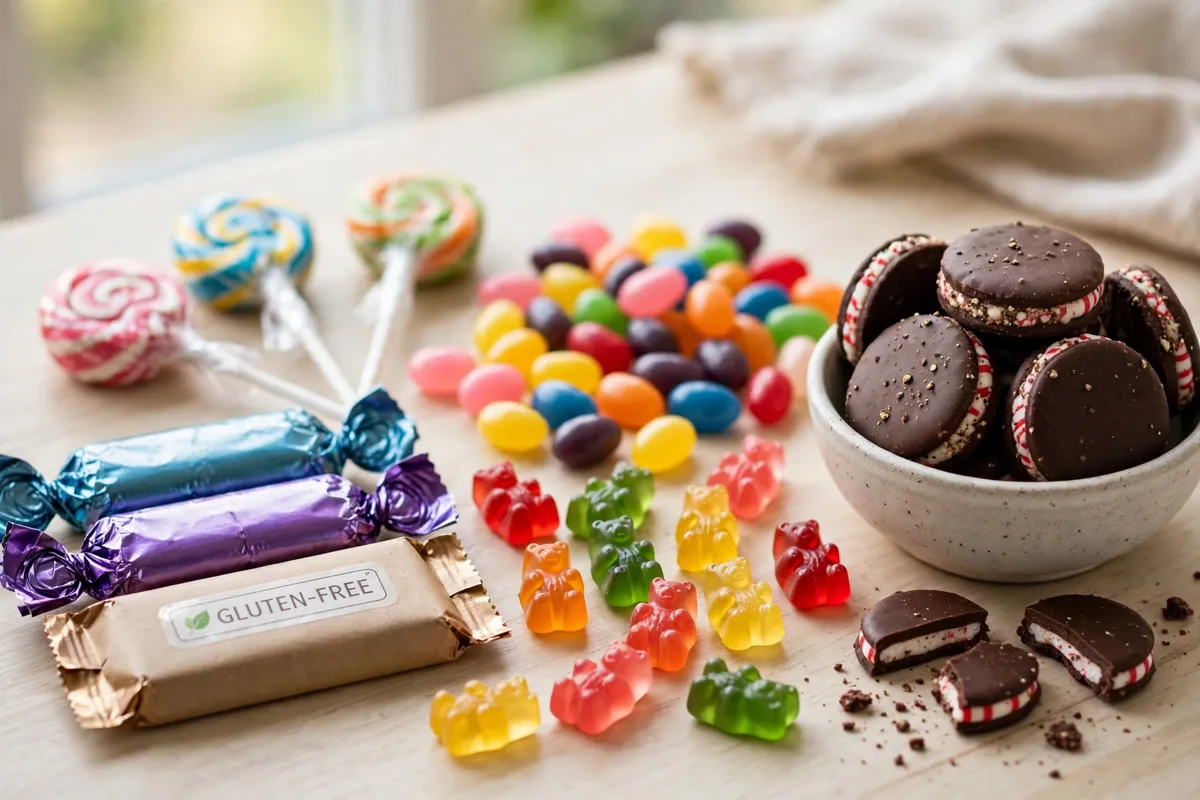

Standing in the candy aisle with a gluten-free diet feels harder than it should. The bag looks safe. The name sounds safe. Then you turn it over and the label tells a different story. Some candy is clearly labelled gluten-free. Some has no gluten in it at all but never says so. And some of the most familiar bars hide wheat or barley malt in plain sight.
This is a checker, not just a list. You will learn what the words on the wrapper actually mean, how to check any candy in under a minute, which popular candies are safe, and which ones trip people up every year. Lists change — makers change recipes and factories — so the pack in your hand is always the final word. If you have celiac disease, follow your clinician’s guidance on top of anything you read here.
What “Gluten-Free” on a Candy Label Actually Means
In the United States, “gluten-free” is not just a nice word on the pack. It has a legal meaning. The Food and Drug Administration (FDA) says a food labelled gluten-free must contain less than 20 parts per million (ppm) of gluten. That is the rule that has applied since 2013, and it covers the phrases “gluten-free”, “no gluten”, “free of gluten” and “without gluten”.
There is also a stricter mark. The Gluten-Free Certification Organization (GFCO) certifies products to 10 ppm or less — half the FDA limit — and it audits the factory and tests products off shop shelves. When you see the GFCO mark, a third party has checked the product, not just the maker.
That gives you three levels of trust, and they matter:
- Certified gluten-free — third-party tested to 10 ppm or less. The safest bet on a shelf.
- Labelled gluten-free — the maker states it meets the FDA’s under-20-ppm rule. Trustworthy, but the testing is the maker’s own.
- No gluten ingredients, not labelled — nothing in the recipe contains gluten, but the maker has not made the claim. Cross-contact on shared lines is the open question here, and it is why celiac shoppers treat this group with more care.
Keep those three levels in mind. Most of the confusion in the candy aisle comes from mixing them up.
How to Check Any Candy in 4 Steps
You do not need an app or a memorised list. Four quick checks on the wrapper itself settle most candies.
Step 1: Look for the words “gluten-free” on the pack
Start here. If the pack says “gluten-free” or carries a certified gluten-free mark, you are done — that is the claim, and it carries the legal meaning above. Check the front and the back; the claim is sometimes small and near the ingredients.
Step 2: Read the ingredients for wheat, barley and rye
No claim? Read the ingredients list. You are looking for wheat, barley, rye, and anything made from them: wheat flour, barley malt, malt extract, malt flavouring, malt syrup and brewer’s yeast. If any of those appear, put it back. Also watch for cookie pieces, wafer, graham cracker and crisped rice — those are almost always wheat or barley in disguise.
Step 3: Read the “Contains” line and the warning underneath
Under the ingredients you will usually see a “Contains” statement. United States law requires makers to flag wheat as a major allergen — but only wheat. Barley and rye are not named allergens under that law, so a “Contains” line that says nothing about wheat does not clear a candy of barley malt. Below that, you may see a voluntary warning such as “may contain wheat” or “made on shared equipment with wheat products”. Those warnings are not regulated by the FDA, and makers use them differently. Treat “may contain wheat” as a no for celiac disease, and as a judgment call for a milder sensitivity.
Step 4: Check the maker’s own list — or ask them
Big makers keep gluten-free lists on their own websites, and Hershey’s, for one, updates theirs regularly. If a candy is not on any list and the label is unclear, a two-minute check on the maker’s site beats guessing. When even that fails, there is a section below on exactly what to ask.
The Hidden Gluten Words on Candy Labels
Gluten rarely announces itself as “gluten”. It hides behind ordinary-sounding ingredients. Learn these six and you will catch most of the traps:
| Word on the label | What it usually means |
|---|---|
| Barley malt, malt extract, malt flavouring, malt syrup | Made from barley. The single most common hidden gluten in candy. |
| Wheat flour, wheat starch | Wheat. Wheat starch is only safe if it has been processed to remove gluten and the product still tests under 20 ppm. |
| Modified food starch | Usually corn in the US, but it can be wheat. If it is wheat, the label must say so — check the source. |
| Maltodextrin | Usually corn or potato in the US. Wheat-based maltodextrin is rare, and must be declared when it is wheat. |
| Oats, oat flour | Oats are often grown and processed with wheat. Only oats labelled gluten-free are a safe bet. |
| Licorice, liquorice extract | Most black licorice is made with wheat flour. It is the classic “but it looks safe” candy. |
One more thing the label will not tell you: cross-contact. A candy can have a clean ingredient list and still pick up traces of gluten on a line shared with a wheat product. That is why “no gluten ingredients” and “gluten-free” are not the same thing, and why the safest candies are the ones made on dedicated lines.
Gluten-Free Candy: The Quick Lists
These lists are drawn from the makers’ own statements and from Beyond Celiac’s candy guide, last reviewed in September 2026. Recipes and factories change, so always re-check the pack. The lists below are for candy sold in the United States — the same candy can be made differently in other countries.
Chocolate bars that are labelled gluten-free
Hershey’s keeps the most useful official list in the business. On it you will find Almond Joy (all except Almond Joy Pieces), Mounds, Payday, Heath, Skor, Milk Duds, Hershey’s Milk Chocolate bars, Hershey’s Nuggets, Brookside dark chocolate, Reese’s Peanut Butter Cups (all except seasonal shapes and unwrapped minis), Reese’s Pieces (except seasonal shapes), Reese’s Fast Break, Rolo Caramels in milk chocolate (except Rolo Minis) and York Peppermint Patties (except York Pieces, Minis and Shapes).
Butterfinger’s original bar is also listed gluten-free by its maker — but not Butterfinger Crisp, and not seasonal versions. Tootsie goes further: as of September 2026 the company states that all of its products are gluten-free, from Tootsie Rolls and Tootsie Pops to Dots, Charleston Chew, Junior Mints and Sugar Babies.
Chocolate with no gluten ingredients — but not labelled
Mars Wrigley does not label any of its products gluten-free, yet several of its candies have no gluten-containing ingredients: 3 Musketeers, Skittles, Starburst, Snickers, and M&M’s (except pretzel, crispy and some seasonal varieties). These are the “riskier options” in Beyond Celiac’s words — many people on a gluten-free diet eat them happily, but for celiac disease the lack of a claim and of dedicated lines is a real consideration. The same goes for Dove chocolate, except the graham cracker, cookies and cream and cinnamon varieties.
Hard candy, chewy candy and gummies
This is the easiest part of the aisle. Most plain hard candy and fruit chews are fine: Jolly Ranchers, Dum Dums (made on dedicated gluten-free equipment, according to Spangler), Lemonheads, Life Savers, Tic Tacs, Starburst, Skittles, Laffy Taffy, Airheads, Hot Tamales, Mike and Ike, and Tootsie Pops. Jelly Belly jelly beans are gluten-free, and Smarties are explicitly stated by their maker to be safe for people with celiac disease. Ferrara’s Atomic Fireballs, Fun Dip, Gobstoppers and Laffy Taffy have no gluten-containing ingredients — but watch out for Lemonhead ropes and SweeTarts ropes, which contain wheat while the regular versions do not.
Chocolate that contains gluten — the skip list
These are the familiar names that catch people out: Twizzlers, Kit Kat and Whoppers all contain gluten. So do the original Milky Way (barley malt), 100 Grand (barley malt), Mars Bars (barley malt) and the Nestlé Crunch bar. The pattern is worth learning: if a bar has a wafer, a malted centre or crisped rice, assume it contains gluten until the label proves otherwise.
The Candies That Trip People Up
Most gluten-free mistakes are not about unknown brands. They are about familiar candies in unfamiliar forms.
Seasonal and holiday shapes
The same candy can be safe in its everyday shape and unsafe as a pumpkin, egg or bunny. Hershey’s says so plainly: Reese’s seasonal shaped items may contain gluten, and the same warning applies to York Shapes, Rolo seasonal items and M&M’s seasonal varieties. Holiday production runs use different lines and recipes. Never assume the Christmas version matches the regular one.
Fun-size and mini versions
Mini and fun-size candies sometimes have different ingredients from the full-size bar. Reese’s unwrapped minis, Rolo Minis and York Minis are all excluded from their makers’ gluten-free lists, even though the full-size versions are on them. Fun-size bags often have no ingredient list on the individual piece at all — check the outer bag, and if the bag is already open, look the candy up before eating it.
Licorice
Black licorice is the most common surprise. Most of it is made with wheat flour as a binder, and it rarely tastes of wheat at all. Red licorice-style candy is not automatically safe either — check it the same way. If you love licorice, look for a brand that is specifically labelled gluten-free rather than assuming any of it is fine.
Malted chocolate bars
Anything described as “malted” is a red flag. Malt means barley, and barley means gluten. That is what rules out Whoppers, Maltesers, the original Milky Way and 100 Grand. The one exception worth knowing is Milky Way Midnight, the dark chocolate version, which does not contain barley malt — but it is still not labelled gluten-free, so it sits in the “no gluten ingredients” group, not the safe list.
Anything with wafer, cookie or crisped rice inside
Kit Kat’s wafer, the cookie crunch in a Cookies and Cream bar, the crisped rice in a Crunch bar — these are wheat and barley delivery systems. A chocolate bar is only as safe as what is inside it. If you cannot see the filling on the wrapper, assume the worst and check.
What to Do When a Candy Isn’t on Any List
Some candy will not be on any list you can find — a local brand, an imported sweet, a new flavour. Do not guess. Here is the two-minute process:
- Search the maker’s own site for “gluten-free” plus the product name. Maker statements beat third-party lists every time.
- Call or email the maker and ask three questions: Does this product contain wheat, barley or rye? Is it made on a line shared with gluten products? Do you test the finished product for gluten, and to what level?
- Check a celiac source such as Beyond Celiac or the Celiac Disease Foundation, which keep maker-by-maker candy lists and review them regularly.
- If you still cannot confirm it, skip it. A candy is never worth the uncertainty, and there is always a labelled alternative on the same shelf.
Brands That Only Make Gluten-Free Candy
If you want to skip the label-reading entirely, a few brands build their whole business around gluten-free sweets. Enjoy Life makes its candy and chocolate in a facility certified gluten-free by the GFCO. YumEarth’s lollipops, gummy fruits and Giggles are gluten-free, and Surf Sweets gummy bears, gummy worms and DelishFish carry certified gluten-free status. Smarties, as noted above, are explicitly stated safe for celiac disease. These are also the brands to reach for when you need treats for a classroom or a party, because the labelling does the explaining for you.
Halloween and Party Checklist
Candy matters most when it is handed out by the bagful — Halloween, birthday parties, school treats. A little planning saves the label-reading scramble:
- Buy labelled candy for the bowl. Stick to the labelled gluten-free list above, and keep the bags so you can re-check them.
- Check every bag, every year. Recipes change, and last year’s safe candy is not automatically this year’s safe candy.
- Keep a separate safe bowl at parties so gluten-free treats do not mix with loose unwrapped candy.
- For trick-or-treating, sort at home. Check each piece against the list before it is eaten — especially fun-size and seasonal pieces, which are the ones most likely to differ from the full-size bar.
- Tell the host in advance. A short message with two or three safe brands is easier for a host than a lecture on barley malt, and it usually works.
And if you are planning a holiday table, the same label-first habit helps with the rest of the food too — our Thanksgiving dinner planning guide walks through a full menu the same careful way.
The Short Version
Gluten-free candy is easy once you know the system. Look for the words “gluten-free” or a certified mark first. If there is no claim, read the ingredients for wheat, barley, rye and malt, and read the “Contains” line knowing it only has to flag wheat. Treat “no gluten ingredients” as a maybe, not a yes. Watch the traps — seasonal shapes, fun-size pieces, licorice and anything malted — and when a candy is not on any list, ask the maker or skip it. The pack in your hand is always the final word, and if you have celiac disease, your clinician’s guidance comes first. The candy aisle is full of safe choices; the trick is knowing which ones they are before you reach the checkout. Planning your food shopping ahead, as in our meal prep guide for beginners, makes the whole thing easier — a short list beats a long guess in the aisle.
Is all chocolate gluten-free?
No. Plain chocolate itself has no gluten, but many chocolate bars do — Kit Kat has a wheat wafer, Whoppers and Maltesers are malted with barley, and the original Milky Way contains barley malt. Safe bets are bars that are actually labelled gluten-free, such as Hershey’s Milk Chocolate bars, Almond Joy, Mounds, Payday and Reese’s Peanut Butter Cups (except seasonal shapes).
Are Skittles gluten-free?
Skittles contain no gluten ingredients, but Mars Wrigley does not label any of its products gluten-free, so they are not on the official safe list. Many people on a gluten-free diet eat them, but for celiac disease the lack of a gluten-free claim and dedicated production lines is a real consideration — always check the pack.
Is licorice gluten-free?
Most black licorice is not gluten-free, because it is made with wheat flour as a binder. Red licorice-style candy is not automatically safe either. If you love licorice, look for a brand that is specifically labelled gluten-free.
What does “may contain wheat” mean on a candy wrapper?
It is a voluntary warning that the candy may have come into contact with wheat on shared equipment. These warnings are not regulated by the FDA, and makers use them differently. Treat “may contain wheat” as a no if you have celiac disease, and as a judgment call for a milder sensitivity.
Are fun-size candies gluten-free if the full-size bar is?
Not always. Mini and fun-size versions sometimes have different ingredients from the full-size bar — Reese’s unwrapped minis, Rolo Minis and York Minis are all excluded from their makers’ gluten-free lists. Fun-size bags often have no ingredient list on the individual piece, so check the outer bag before eating.
