

What Is Mindfulness, in Plain Words
You have probably heard the word mindfulness a hundred times — in apps, on cereal boxes, in work emails about wellbeing. Yet most explanations sound too vague to use or too academic to enjoy. So here is the plain version: mindfulness is paying attention, on purpose, to what is happening right now — your thoughts, your feelings, your body, the room around you — without judging any of it. That is the whole idea. The rest of this guide unpacks it: where it came from, what it is not, what the research says, and a two-minute way to try it today.
Jon Kabat-Zinn, who brought mindfulness into hospitals and clinics, defined it as “paying attention in a particular way: on purpose, in the present moment and nonjudgmentally.” Four small ideas are doing all the work there. On purpose means you choose where your attention goes. In the present moment means right now — not yesterday’s argument, not tomorrow’s deadline. And nonjudgmentally means you notice what shows up without labelling it good or bad. You can be mindful in traffic or while washing a cup. It is not a special state to reach — it is a way of paying attention.
The three ingredients
Psychologists often break mindfulness into three parts: intention — you decide to pay attention; attention itself — you actually notice what is happening, the tight shoulders, the buzzing phone, the taste of the coffee; and attitude — you meet whatever you find with curiosity instead of criticism. Miss one and it is something else: attention without kindness is just surveillance, and kindness without attention is just a nice mood.
A skill, not a mood
Think of mindfulness as a skill, like learning an instrument: nobody plays fluently on day one. Your mind will wander, and noticing that it wandered is the practice — each time you come back, you are doing one more rep. People who have done this for years still get distracted; they just notice sooner and mind less.
Where Mindfulness Comes From
The word comes from sati, a Pali word from early Buddhist texts, meaning something like remembering to pay attention. For centuries, close attention to the present moment was part of Buddhist meditation. In 1979, Jon Kabat-Zinn, a scientist at the University of Massachusetts Medical School, took the attention training out of its religious setting and built a course around it: Mindfulness-Based Stress Reduction, or MBSR — an eight-week programme for hospital patients living with chronic pain and stress. It worked well enough that clinics, schools and workplaces copied it, and researchers have since run thousands of studies on it. The practice most people meet today is that secular version: no beliefs required, no robes, no incense.
What Mindfulness Is Not
Half the confusion comes from what people think it is. Clearing that up first saves a lot of frustration.
It’s not emptying your mind
Your brain makes thoughts the way your lungs make breaths. It will not stop, and it is not supposed to. Mindfulness asks you to notice thoughts and let them pass, like watching cars go by without getting into every one. Trying to force your mind blank is the fastest way to feel like you are failing at something that was never the goal.
It’s not just relaxing
You might feel calmer after a few minutes of watching your breath. That is a side effect, not the point. The point is noticing what is actually there — the tension, the boredom, the itch. Some sessions feel restful, some restless. Both count.
It’s not positive thinking
Mindfulness does not ask you to swap a bad thought for a good one. It asks you to see the thought clearly — “Here is the worry that I will mess up the presentation” — and let it sit there while you get on with the next thing. You do not have to believe it, argue with it, or paint over it.
It’s not a religion
Mindfulness grew out of Buddhist meditation, but the version taught in clinics and workplaces is secular: no beliefs to adopt, and it does not clash with any faith — or with having none.
What the Evidence Actually Shows
Mindfulness has been studied a lot. The honest picture is encouraging but not magical.
For stress, anxiety and low mood, the evidence is strongest. The NHS says studies show mindfulness can help with all three, and the UK’s National Institute for Health and Care Excellence (NICE) recommends mindfulness-based therapies for less severe depression. In one 2022 study of 276 people with anxiety disorders, an eight-week mindfulness course worked about as well as the medication escitalopram — with fewer side effects. That is one study, not a verdict, and it does not mean mindfulness replaces medicine. If you take prescribed medication, do not stop it: think of mindfulness as something that sits alongside treatment, not instead of it. If you live with anxiety, depression or another mental health condition, talk to your clinician before starting any new practice.
For the brain itself, the results are mixed — worth saying plainly. One 2019 study found 40 days of mindfulness training changed grey-matter volume in first-time meditators; but a 2022 study of 585 older adults found no differences in brain scans between people who did a mindfulness programme and people who did nothing. The research is still young, and the big claims online — that mindfulness rewires your brain in weeks — run ahead of what the studies show.
And it is not for everyone. The NHS is blunt: some people find mindfulness does not help, or that it makes them feel worse. If sitting quietly with your thoughts feels distressing, stop — try a moving version like mindful walking, or talk to your clinician about whether it suits you.
How to Try It: A Two-Minute Starter
No app, no mat, no quiet room. Two minutes and a chair will do.
1. Sit down and get comfortable
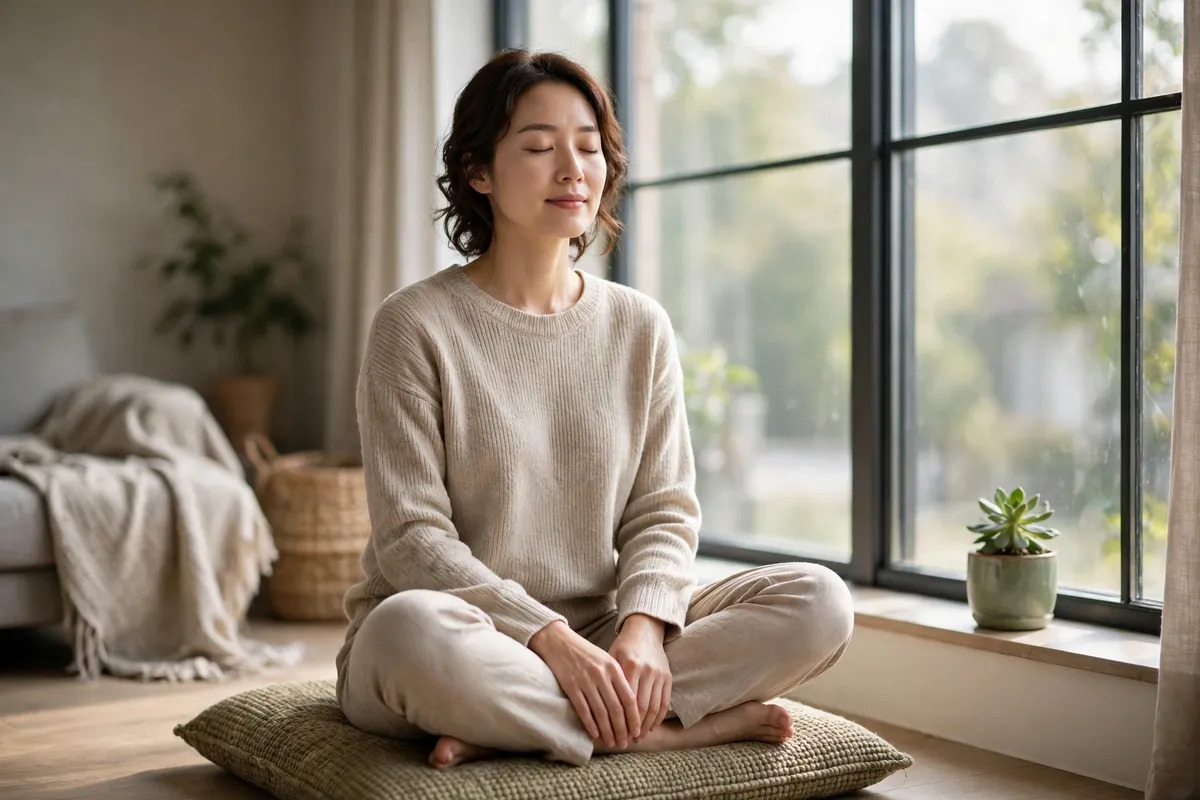
Sit in a chair with your feet on the floor, or cross-legged on a cushion. Sit upright but not stiff, hands in your lap, eyes closed or gazing softly at the floor.
2. Pick one anchor
An anchor is one thing to keep coming back to, and the breath is the easiest: feel the air coming in through your nose and going out again, or feel your chest rise and fall. You are not trying to breathe in a special way — just notice the breath you already have.
3. Notice when your mind wanders
It will, probably within seconds — an email, dinner plans, wondering if you are doing this right. That is normal. The moment you notice you have wandered, you have done the exercise.
4. Come back, kindly
Gently bring your attention back to the breath — no scolding, no sighing at yourself. Kindness is part of the method, not a bonus. Then let it wander and come back again. That loop — wander, notice, return — is the whole workout.
5. Stop after two minutes
Open your eyes and notice how you feel — that is it. Two minutes, once a day, is a real start — stretch it to five next week, then ten. If it feels pointless after a few days, try the moving version below before giving up.
Mindfulness Without Sitting Still
Some people hate sitting still. Good news: mindfulness is not a posture — it is attention, and attention goes anywhere.
Eat one bite slowly
Take a single bite — a raisin, a piece of chocolate, a spoonful of lunch — and notice its texture, its temperature, the way the flavour changes as you chew. Most of us eat on autopilot. One slow bite is a complete exercise, taking about thirty seconds.
Walk to the shop
On your next short walk, leave the headphones in your pocket. Feel your feet meet the pavement, one step at a time, and notice the air on your face and the sounds you usually filter out. Walking slowly on purpose turns a chore into practice.
Wash one thing properly
Pick one ordinary job — washing a mug, folding a towel, clearing a drawer — and do it slowly, paying attention to what your hands are doing: the warmth of the water, the weight of the plate, the sound it makes. If your mind drifts to the meeting at three o’clock, notice it, and come back to the mug. If clearing a drawer turns into a full clear-out, our room-by-room decluttering guide walks you through it.
Beginner Mistakes That Put People Off
Most people who quit do so over one of these four mistakes. None of them means you are bad at it.
Trying to stop your thoughts
Thoughts are not the enemy. Fighting them is what makes sitting still feel like a wrestling match. Notice them, name them, let them pass.
Grading yourself
There is no score. A session where your mind wandered forty times and you noticed forty times is a good session — the noticing is the skill.
Expecting instant calm
Mindfulness is not a tranquilliser. Some days you will finish a session feeling exactly the same as when you started. The effects, when they come, show up quietly — you catch yourself mid-spiral sooner, or pause before snapping. Give it a few weeks before deciding.
Sitting too long too soon
Twenty minutes of forced stillness on day one is a recipe for quitting. Two minutes a day beats twenty minutes once — build the habit small, then let it grow.
How to Keep Going
Once you have tried it, a little structure helps: pick a regular time — first thing in the morning, or your lunchtime walk — and tie the practice to something you already do. The NHS suggests exactly this: choose a moment that repeats every day and use it as your reminder. Guided sessions help too — free ones exist from the NHS and several apps; pick one voice you like and ignore the rest. A few lines in a journal after each session can show patterns you would otherwise miss. Our beginner’s journaling guide is a good place to start. And if mindfulness brings up feelings that feel too big to sit with alone, talk to your clinician — not a sign you failed, just a sign to get support.
Mindfulness is a small idea with a long history: pay attention, on purpose, right now, without judging. Two minutes is enough to start. The rest is just doing it again tomorrow.
For the fuller picture: the NHS guide to mindfulness, the American Psychological Association’s mindfulness page, the Greater Good Science Center at UC Berkeley, and Healthline’s guide to the research on benefits.
Is mindfulness a religion?
No. Mindfulness grew out of Buddhist meditation, but the version taught in clinics, schools and workplaces is secular — it asks for no beliefs and fits alongside any faith, or none. The practice is attention training, not worship.
Do I have to meditate to be mindful?
No. Sitting meditation is one way to practise mindfulness, but it is not the only one. Paying full attention while you eat, walk or wash the dishes counts too. Many people who dislike sitting still do all their mindfulness on the move.
How long does it take before mindfulness helps?
There is no set timetable. Most research programmes run for about eight weeks, and people who practise a few minutes a day often notice small changes — catching a spiral sooner, pausing before reacting — within a few weeks. Treat it like exercise: the benefits build quietly, and skipping days does not erase them.
Can mindfulness make anxiety worse?
For some people, yes. The NHS notes that mindfulness is not right for everyone and that some people find it makes them feel worse, especially when sitting quietly brings difficult thoughts to the surface. If that happens, stop, try a moving practice like mindful walking, and talk to your clinician.
Is mindfulness the same as meditation?
Not quite. Meditation is one way to practise mindfulness, but mindfulness is the wider skill: paying attention on purpose, in the present moment, without judging. You can be mindful without ever sitting down to meditate.
