
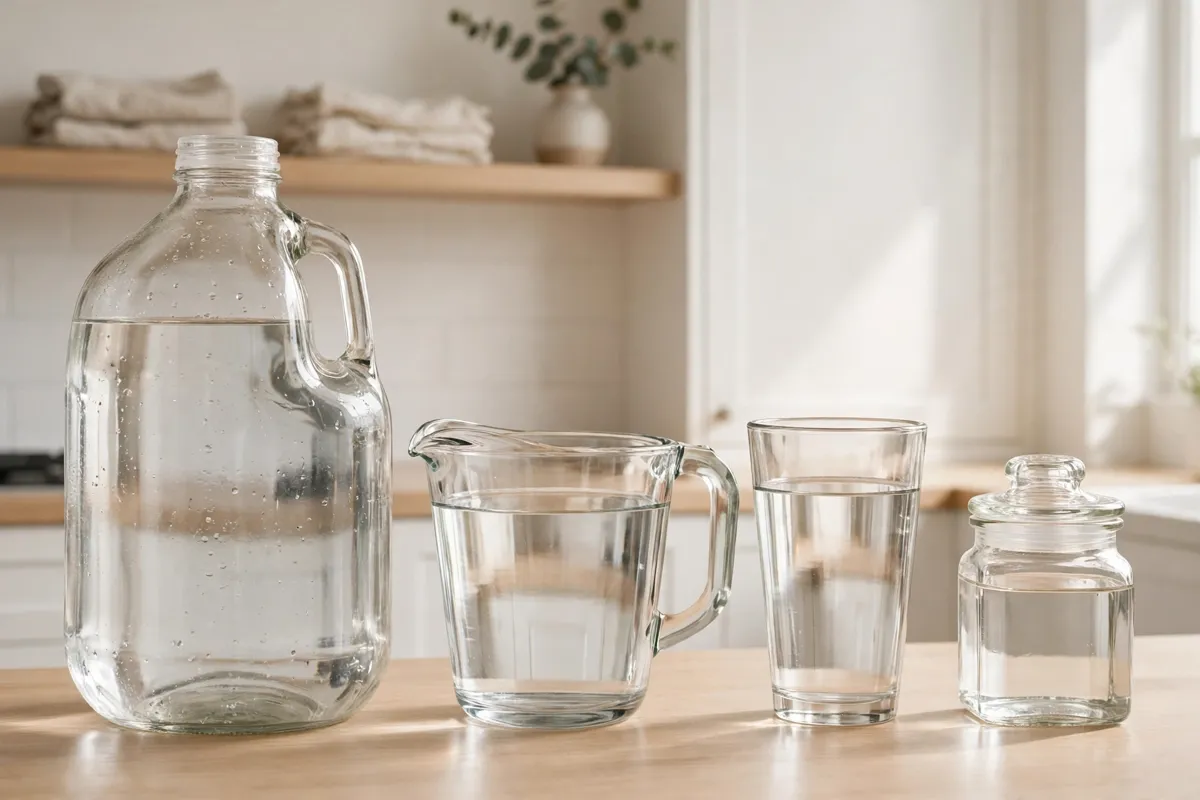

One US gallon holds 128 US fluid ounces. That is the whole answer for most people, most of the time — and it is exact, not rounded. But if you have ever followed a British recipe, poured fuel abroad, or tried to convert millilitres on a shampoo bottle, you will know the number can change. A UK gallon holds 160 imperial fluid ounces, and the two fluid ounces are not the same size either.
This guide gives you the quick answer first, then the full chart, the US vs UK difference, the pint and the 100 ml conversions people actually search for, and the one mistake that quietly ruins recipes: mixing up fluid ounces with weight ounces.
The Short Answer: 128 Fluid Ounces in a US Gallon
In the United States, a liquid gallon is defined as 231 cubic inches. That definition comes from the National Institute of Standards and Technology, in its Handbook 44 tables of units of measurement. A US fluid ounce is defined as exactly one 128th of that gallon, so the arithmetic is built into the definition itself — no rounding, no approximation.
The chain is easy to remember because every step doubles or halves cleanly:
1 gallon = 4 quarts = 8 pints = 16 cups = 128 fluid ounces.
Each step down halves the last one. A quart is 32 fluid ounces, a pint is 16, a cup is 8. Once you know that a cup holds 8 fluid ounces, you can work out any of the rest in your head.
One thing to get straight early: the ounces in this article are fluid ounces (fl oz), the unit for volume. The ounce on a kitchen scale is a unit of weight. They share a name and almost nothing else. More on that below, because it is the single most common source of confusion.
The Full Conversion Chart: Gallons, Quarts, Pints, Cups and Ounces
Here is the whole US liquid ladder in one table, with millilitres included so you can jump between systems without a second search.
| US unit | Fluid ounces | Cups | Pints | Quarts | Millilitres |
|---|---|---|---|---|---|
| 1 gallon | 128 fl oz | 16 | 8 | 4 | 3,785 ml |
| 1/2 gallon | 64 fl oz | 8 | 4 | 2 | 1,893 ml |
| 1 quart | 32 fl oz | 4 | 2 | 1 | 946 ml |
| 1 pint | 16 fl oz | 2 | 1 | 1/2 | 473 ml |
| 1 cup | 8 fl oz | 1 | 1/2 | 1/4 | 237 ml |
| 1 fluid ounce | 1 fl oz | 1/8 | 1/16 | 1/32 | 29.57 ml |
For smaller amounts, the kitchen units slot in neatly underneath: one cup is 16 tablespoons, one fluid ounce is 2 tablespoons, and one tablespoon is 3 teaspoons. So a fluid ounce is 6 teaspoons.
How to Convert Gallons to Ounces (and Back)
The formula is one multiplication. To go from gallons to fluid ounces, multiply by 128. To go the other way, divide by 128.
Gallons to fluid ounces: fluid ounces = gallons × 128
Fluid ounces to gallons: gallons = fluid ounces ÷ 128
Example 1: Three gallons of lemonade
You are making lemonade for a party and the recipe is written in gallons, but your measuring jug is marked in fluid ounces. Three gallons × 128 = 384 fluid ounces. That is 24 pints, or 48 cups.
Example 2: Ninety-six fluid ounces of stock
A soup recipe calls for 96 fluid ounces of stock and you buy it by the gallon. 96 ÷ 128 = 0.75, so you need three quarters of a gallon. Buy one gallon jug and you will have a quart left over.
Example 3: Half a gallon of milk
The half-gallon carton in the fridge holds 64 fluid ounces — eight cups, or four pints. It is the size most American households buy, and the one people most often need to convert, because recipes rarely say “half a gallon” and cartons rarely print “64 fluid ounces” in big type. Both are true.
US Gallon vs UK Gallon: Why the Answer Changes
The 128-ounce answer only holds in the US system. In the United Kingdom, a gallon holds 160 imperial fluid ounces. The imperial gallon is about 20 percent bigger than the US gallon: 4.546 litres against 3.785 litres.
The split goes back to 1824, when Britain standardised its gallon as the volume of 10 pounds of distilled water weighed at 62°F. The United States kept the older English wine gallon of 231 cubic inches instead.
Most conversion pages stop there. But the number that actually trips people up is the one in between.
The trap most pages skip: a US gallon is not 160 UK ounces
Because the imperial fluid ounce is smaller than the US fluid ounce — 28.41 ml against 29.57 ml — the two systems do not swap cleanly. Pour one US gallon into imperial-ounce measures and you fill about 153.72 of them, not 160 and not 128. The other way round, one imperial gallon is about 133.23 US fluid ounces.
That matters in real life. A British recipe that calls for a gallon of stock needs 160 imperial ounces; an American reading it as 128 US ounces would come up a fifth short. Fuel economy is the same trap in reverse: miles per imperial gallon and miles per US gallon are different numbers for the same car, because the gallons are different sizes.
When a recipe, a fuel figure or a product label does not say which gallon it means, check where it was written. American sources mean the 128-ounce gallon. British sources mean the 160-ounce one.
How Many Ounces in a Pint?
A pint is where the two systems meet most often — at the bar, in the kitchen, and on a tub of sour cream.
A US pint holds 16 fluid ounces: two cups, or 473 ml. A UK pint holds 20 imperial fluid ounces: 568 ml, about 20 percent more.
There is also a third pint that catches people out at the farmers market. A US dry pint — the little green basket berries come in — is a measure of dry volume, and it holds about 18.62 fluid ounces’ worth of space. A pint of blueberries weighs around 12 ounces on a scale, because the berries do not fill the basket solidly. Volume and weight again: same word, different answer.
The old rhyme “a pint’s a pound the world around” is almost true, in US units at least. A pint of water weighs about 1.04 pounds — close enough that cooks have used the rhyme for generations. It only works for water and liquids like it. A pint of honey weighs far more, and a pint of flour far less.
100 ml to oz: The Travel-Sized Answer
One US fluid ounce is 29.5735 ml, so the conversion is a division: fluid ounces = millilitres ÷ 29.5735.
100 ml = 3.38 US fluid ounces. In UK measures it is 3.52 imperial fluid ounces, because the imperial ounce is smaller.
This is the number behind the airport liquids rule. The TSA’s 3-1-1 rule limits carry-on liquids to containers of 3.4 ounces (100 ml) or less — the same limit written in two systems. A 100 ml bottle is 3.38 fluid ounces, just under the line. A 3.5 oz bottle is over it.
A few more millilitre values people look up constantly:
- 250 ml = 8.45 US fl oz — a small bottle of water
- 500 ml = 16.91 US fl oz — the standard water bottle, labelled 16.9 fl oz
- 750 ml = 25.36 US fl oz — a standard wine bottle
- 1 litre = 33.81 US fl oz — just over a quart
For rough work in your head, divide millilitres by 30. It lands within about 1.5 percent, which is close enough for a recipe and for judging whether a bottle will pass through security. The same millilitre maths shows up in medicine, where the question is usually how many milligrams are in a millilitre — and that answer depends on the liquid, not the unit.
Fluid Ounces Are Not Weight Ounces
This is the section to read twice, because it is where most conversion mistakes happen.
A fluid ounce measures space. An ounce measures weight. For water the two are close — one US fluid ounce of water weighs about 1.04 ounces — which is why people mix them up. For almost anything else they are not close at all.
A gallon of water weighs about 8.33 pounds. That is roughly 133 ounces by weight, not 128. A gallon of milk weighs about 8.6 pounds. A gallon of honey weighs about 12 pounds. Same volume, three different weights. And flour breaks the idea completely: a gallon of flour weighs roughly 4.5 to 5 pounds, because flour is mostly air.
So “128 ounces in a gallon” is a volume statement, and it is only ever true for volume. The moment a recipe talks about weight — grams, ounces on a scale, pounds — you need a different conversion, one that depends on what the ingredient is. That is why converting millilitres to grams needs the ingredient’s density, and why a cup of flour and a cup of honey never weigh the same.
Everyday Examples: How Big Is a Gallon, Really?
Glasses of water. The familiar “eight glasses a day” advice means eight 8-ounce glasses — 64 fluid ounces, or half a gallon. A full gallon is 16 of those glasses.
Water bottles. A standard 16.9 fl oz bottle (500 ml) is a little under an eighth of a gallon. It takes about seven and a half of them to make a gallon. Buy a case of eight and you have just over a gallon.
The milk jug. The gallon jug in the dairy aisle is 128 fluid ounces. The half-gallon carton next to it is 64. The quart carton is 32, and the little single-serve bottle is usually 8 or 12 fluid ounces — one cup, or a cup and a half.
At the pump. A US gallon of petrol is 128 fluid ounces, checked by state weights-and-measures inspectors against the same NIST definitions.
What About the Dry Gallon?
Almost every page about ounces in a gallon quietly leaves this one out. The United States also has a dry gallon, defined as 268.8025 cubic inches — bigger than the liquid gallon — holding about 148.95 dry fluid ounces. It belongs to the old dry-volume system used for grain and produce, alongside the dry quart and the dry pint, and it hardly ever appears in a modern kitchen.
Unless a recipe or a market stall explicitly says “dry”, assume the liquid gallon. Every conversion in this article, and every chart above it, uses the liquid gallon: 128 fluid ounces, 231 cubic inches, 3.785 litres.
The Answer, In One Line
One US gallon is 128 US fluid ounces. One UK gallon is 160 imperial fluid ounces. A pint is 16 US fluid ounces, 100 ml is 3.38 US fluid ounces, and fluid ounces measure volume — never weight. Keep those five facts straight and no recipe, fuel figure or airport security line will catch you out.
How many ounces are in a gallon?
One US gallon holds 128 US fluid ounces. A UK (imperial) gallon holds 160 imperial fluid ounces — about 20 percent more liquid.
How many ounces are in a pint?
A US pint holds 16 fluid ounces (2 cups, 473 ml). A UK pint holds 20 imperial fluid ounces (568 ml). A US dry pint, the basket berries come in, is about 18.62 fluid ounces.
How many 8 oz glasses of water are in a gallon?
Sixteen. One gallon is 128 fluid ounces, and 128 divided by 8 is 16. The familiar “eight glasses a day” is half a gallon, or 64 fluid ounces.
How many ounces is 100 ml?
100 ml is 3.38 US fluid ounces (3.52 imperial fluid ounces in the UK). It is the size behind the airport liquids rule: containers of 3.4 oz (100 ml) or less.
Is a fluid ounce the same as an ounce?
No. A fluid ounce measures volume and an ounce measures weight. They are close only for water — one fluid ounce of water weighs about 1.04 ounces. A gallon of water weighs about 8.33 pounds, not 128 ounces.
