
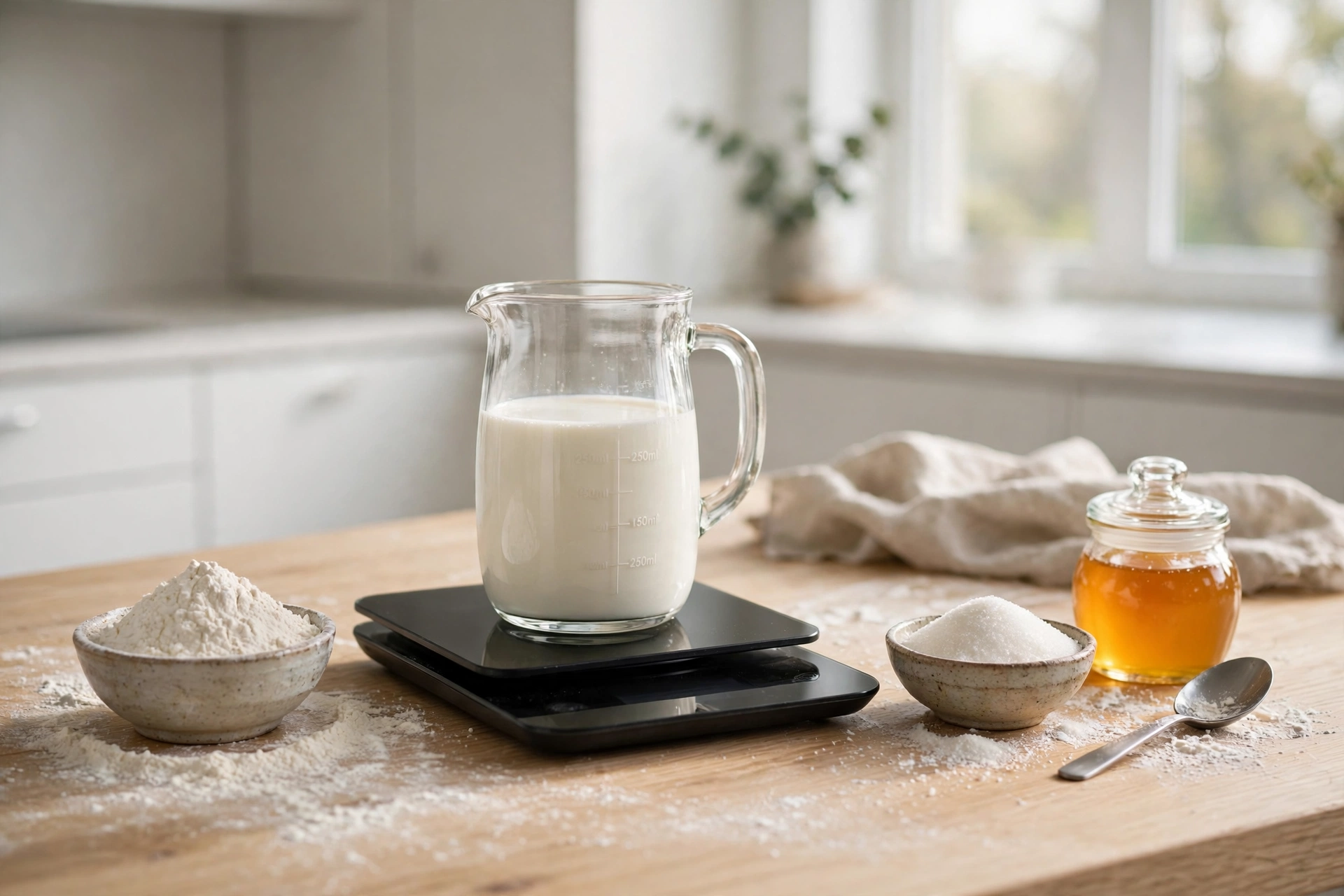

Your recipe says 100 ml of milk. Your kitchen scale only shows grams. Do you pour, guess, or dig out the measuring jug? If you have ever stood in the kitchen doing that sum in your head, this page is for you.
Here is the short version. For water, 100 ml is 100 g, and you are done. For almost everything else, you need one number — the density of the ingredient — and one quick multiplication.
The Short Answer: How Many Grams in 10 ml and 100 ml?
If you only need one number, this is the table to use. It covers the six ingredients people search for most, at the two amounts that come up again and again in recipes: 10 ml (two teaspoons) and 100 ml.
| Ingredient | 1 ml | 10 ml | 100 ml |
|---|---|---|---|
| Water | 1 g | 10 g | 100 g |
| Whole milk | 1.03 g | 10.3 g | 103 g |
| Vegetable oil | 0.92 g | 9.2 g | 92 g |
| Honey | 1.42 g | 14.2 g | 142 g |
| All-purpose flour (spooned and levelled) | 0.51 g | 5.1 g | 51 g |
| Granulated sugar | 0.85 g | 8.5 g | 85 g |
The pattern is easy to see. Water sits at exactly 1 gram per millilitre. Milk is a touch heavier. Oil is lighter. Honey is much heavier. Flour is about half the weight of water for the same volume. These figures are rounded to whole grams where it makes sense — your kitchen scale cannot tell 10.3 g from 10 g, and neither can your cake.
The Only Formula You Need
Millilitres measure volume: how much space something takes up. Grams measure mass: how heavy it is. You cannot turn one into the other without knowing how heavy one millilitre of that particular ingredient is. That number is its density, written in grams per millilitre (g/ml).
The formula is one line:
Grams = millilitres × density
Three quick examples show how it works in a real kitchen:
250 ml of milk. Milk has a density of about 1.03 g/ml. So 250 × 1.03 = 257.5 g, or 258 g rounded. That is the milk for a batch of pancakes, weighed straight into the bowl.
60 ml of honey. Honey is dense, about 1.42 g/ml. So 60 × 1.42 = 85.2 g, or 85 g. Notice how 60 ml of honey weighs nearly as much as 85 ml of water.
15 ml of oil — one tablespoon. Oil sits at about 0.92 g/ml. So 15 × 0.92 = 13.8 g. A tablespoon of oil is just under 14 grams.
Going the other way is just as simple. Divide instead of multiply: millilitres = grams ÷ density. A recipe that calls for 200 g of granulated sugar works out to 200 ÷ 0.85 = 235 ml.
Why 1 ml Isn’t Always 1 Gram
The neat 1-to-1 match between millilitres and grams belongs to water alone — and even then, only exactly at 4°C, the temperature where water is at its densest. At room temperature it is 0.998 g/ml, close enough to 1 that no recipe will notice.
That is no accident. The gram was originally defined as the mass of one cubic centimetre — one millilitre — of water. Everything else has its own density. Syrups and milk are heavier than water, so a millilitre of them weighs more than a gram. Oils and most powders are lighter, so a millilitre weighs less. There is nothing wrong with your scale when 100 ml of flour reads 51 g and 100 ml of honey reads 142 g. That is just what those ingredients weigh.
ML to Grams for Common Kitchen Ingredients
This is the working chart. Densities are for room temperature, around 20°C. Liquid figures are reliable to within a percent or two. Dry ingredients are approximate, because how you fill the cup changes the number.
| Ingredient | Density (g/ml) | 100 ml weighs |
|---|---|---|
| Water | 1.00 | 100 g |
| Whole milk | 1.03 | 103 g |
| Cream | 0.99–1.01 | about 100 g |
| Vegetable / olive oil | 0.91–0.92 | 91–92 g |
| Butter, solid | about 0.96 | about 96 g |
| Honey | 1.42 | 142 g |
| Maple syrup | 1.32 | 132 g |
| Granulated sugar | about 0.85 | 85 g |
| All-purpose flour | about 0.51 | 51 g |
Density figures for the baking staples come from the King Arthur Baking ingredient weight chart and the USDA FoodData Central database. Liquid densities match the standard reference values used by conversion tools such as the Calculator Park ml-to-grams converter. Where two good sources disagree slightly — flour is the famous case — the table says so rather than pretending there is one true number.
Why Flour Numbers Disagree Everywhere
If you have ever looked up how much 100 ml of flour weighs and found three different answers, you are not imagining it. Published figures for all-purpose flour run from about 0.51 to 0.59 g/ml — 120 to 140 grams per US cup, a swing of nearly 20 percent on the ingredient a cake is mostly made of.
None of those numbers is wrong. They describe different ways of filling the cup. Flour is mostly air. Spoon it gently into the cup and level it off with a knife, and a US cup holds about 120 grams — the King Arthur Baking standard, which works out to 0.51 g/ml. The USDA’s own testing gives 125 grams for the same cup, or 0.53 g/ml. Dip the cup straight into the bag and scoop, and you pack the flour down; the same cup can hold up to around 148 grams.
That packing effect is the single biggest reason a cake made from a cup recipe comes out dry. The recipe writer spooned; you scooped; your cake got a quarter more flour than intended. It is also why every serious baking source tells you to weigh flour rather than measure it by volume. If you must use millilitres for flour, use the spooned-and-levelled figure — 0.51 g/ml — and spoon the flour into your measuring jug the same gentle way. If a recipe gives flour in grams, never convert it back to millilitres. Weigh it.
Sugar, by contrast, behaves itself. Granulated sugar pours the same way every time, so 0.85 g/ml holds up from one kitchen to the next.
Convert a Whole Recipe in 4 Steps
Converting one ingredient is a party trick. Converting a whole recipe is the skill that actually saves time, because once every liquid is in grams, you can weigh everything into one bowl and skip the washing up. Here is how it works on a simple muffin recipe: 240 ml milk, 80 ml vegetable oil, 60 ml honey.
Step 1: List every liquid in millilitres
Write the wet ingredients down with their volumes: milk 240 ml, oil 80 ml, honey 60 ml. Leave the dry ingredients alone — if they are already in grams, they are already in the right unit.
Step 2: Multiply each one by its density
Milk: 240 × 1.03 = 247 g. Oil: 80 × 0.92 = 74 g. Honey: 60 × 1.42 = 85 g. Round each to the nearest whole gram.
Step 3: Put the bowl on the scale and zero it
Press the tare button with the empty bowl on the scale so the display reads zero. Now everything you pour in is the weight of the ingredient alone, not the bowl.
Step 4: Pour in a running total
Pour the milk until the scale reads 247 g. Then pour the oil until it reads 321 g — that is 247 plus 74. Then the honey until it reads 406 g. Three ingredients, one bowl, no measuring jug to wash. This is the real payoff of converting ml to grams: weighing is faster and more accurate than filling jugs and spoons, especially for sticky things like honey.
The Cup Trap: Not Every Cup Holds the Same ml
Many recipes still use cups, and cups are a trap of their own. A US cup holds 236.6 ml, a metric cup — the one used in Australian and many European recipes — holds 250 ml, and an imperial cup, from older British books, holds 284.1 ml.
That difference flows straight into grams. A US cup of all-purpose flour, spooned and levelled, is 120 g. The same flour in a metric cup is about 127 g, and in an imperial cup about 144 g. Sugar shows the same spread: 198 g in a US cup, about 209 g in a metric cup. Before you convert anything from a cup recipe, check which cup the recipe means. If it came from an American site, assume the US cup; from Australia, the metric cup. A recipe that gives weights in grams removes the question entirely.
4 Mistakes That Throw Your Baking Off
1. Assuming every liquid weighs 1 gram per millilitre
This is the big one. It works for water, milk and cream, and it fails for everything else. A recipe with 250 ml of honey is not 250 g of honey — it is 355 g. Getting this wrong throws the wet-to-dry balance of a batter off by a wide margin.
2. Dividing by density instead of multiplying
To go from millilitres to grams, you multiply: grams = ml × density. Dividing gives you a smaller number that looks plausible and is completely wrong. If your answer comes out lighter than the volume you started with for a heavy ingredient like honey, you divided by mistake.
3. Measuring flour by volume when the recipe gives grams
If a recipe lists flour in grams, the author weighed it, and the amount matters. Converting grams of flour back into millilitres reintroduces exactly the packing error the grams were there to avoid.
4. Converting medicine doses with a density
Never do this. Liquid medicines are dosed in millilitres on the label, and the dose is the dose. Millilitres and milligrams are different units — our guide to how many mg are in a ml explains the difference — but for any medicine, follow the measuring device and the dose on the label, and ask a pharmacist if you are unsure.
How to Find the Density of Any Ingredient
What if your ingredient is not in any table? You can measure its density yourself in under a minute with the jug and scale you already own.
Put a measuring jug on the scale and press tare so it reads zero. Fill it to exactly 250 ml. Read the weight in grams. Divide that number by 250. If 250 ml of your syrup weighs 330 g, its density is 1.32 g/ml, and from then on you can convert any amount of it with the same formula: grams = ml × 1.32.
That is all there is to it. The whole conversion rests on one idea: a millilitre is a space, a gram is a weight, and density is the bridge between them. Learn the densities of the half-dozen ingredients you cook with most, and you will never need a calculator again.
Once your ingredients are weighed, the oven does the rest. If your recipe lists its temperature in Celsius and your oven speaks Fahrenheit, our guide to 180°C to Fahrenheit sorts that out — and the same weigh-first habit makes meal prep noticeably faster.
How do you convert ml to grams?
Multiply the millilitres by the ingredient’s density in grams per millilitre: grams = ml × density. For water the density is 1, so 100 ml is 100 g. For milk (1.03) 100 ml is 103 g, and for honey (1.42) 100 ml is 142 g. To go the other way, divide grams by density.
How many grams is 100 ml of water?
100 grams. Water has a density of 1 gram per millilitre, so the number of millilitres and the number of grams are the same. That is only true for water — other ingredients weigh more or less for the same volume.
How many grams is 100 ml of flour?
About 51 grams, if the flour is spooned into the measure and levelled off. Flour is light and full of air, so the figure changes with how you fill the cup — scooping straight from the bag can push it to 60 grams or more per 100 ml, which is why weighing flour is more accurate.
How many grams is 10 ml?
It depends on the ingredient. 10 ml of water is 10 g, 10 ml of milk is about 10.3 g, 10 ml of vegetable oil is about 9.2 g, 10 ml of honey is about 14.2 g, and 10 ml of spooned-and-levelled flour is about 5.1 g.
Why do different websites give different answers for flour?
Because flour’s density depends on how it is packed. Spooned gently into a cup and levelled, all-purpose flour weighs about 120 grams per US cup (0.51 g/ml). Scooped from the bag, the same cup can hold up to around 148 grams. The websites are measuring different filling methods, not disagreeing about the flour itself.
