
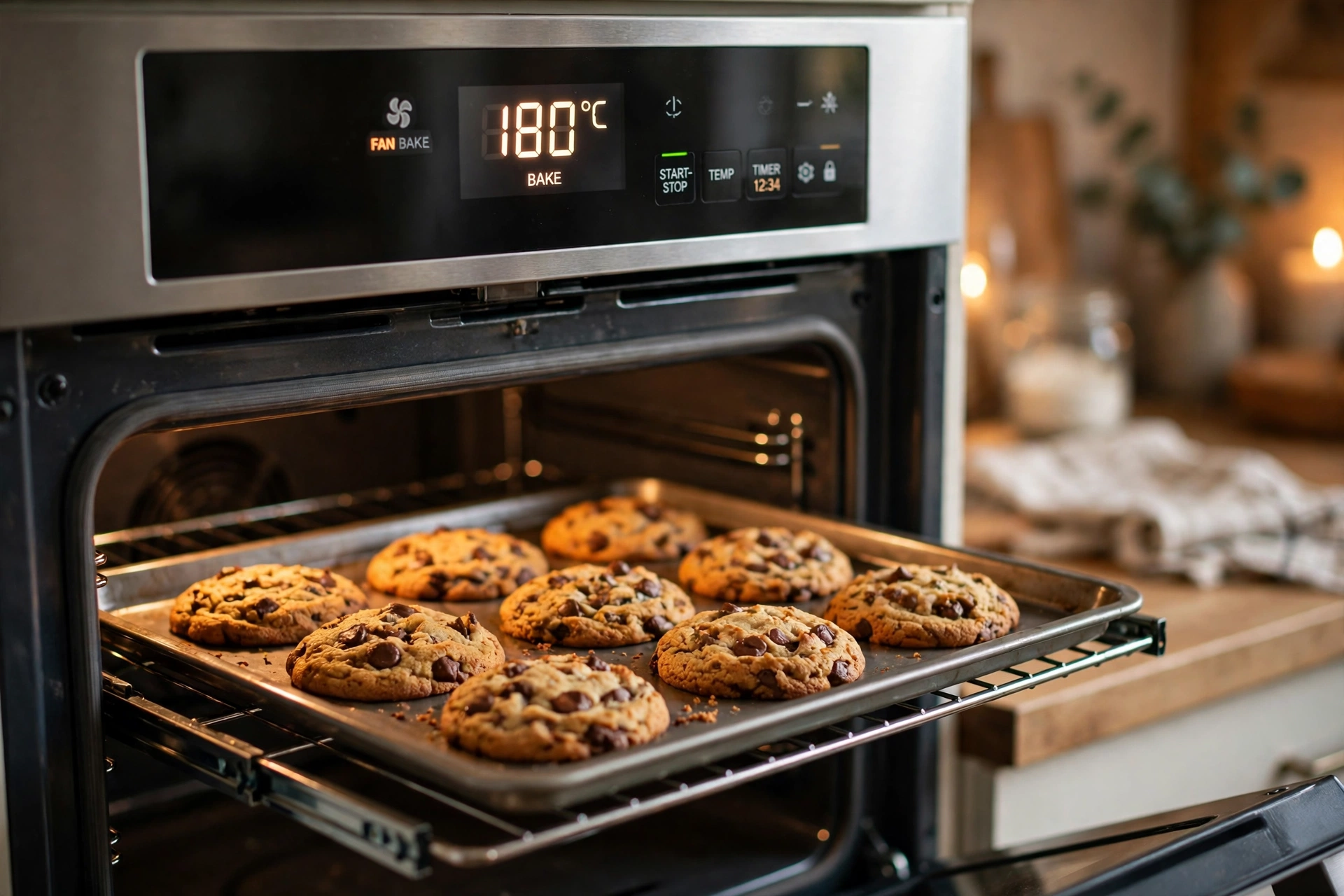

The Short Answer: 180°C = 356°F
180°C is 356°F. That is the exact answer — and it is also not the number you will ever type into an oven. Every recipe rounds it to 350°F, which is Gas Mark 4 on a British gas oven and 160°C if your oven has a fan.
So if your recipe says 180°C and your oven speaks Fahrenheit, set it to 350°F and carry on. The 6-degree gap is smaller than the swing of most home ovens, which drift 10–15°F as the element clicks on and off.
One quick note before we start: this page is about oven temperatures. If you were converting a body temperature, that is a different job — see 36.7°C to Fahrenheit: what it means for body temperature.
One Recipe, Four Settings
The same temperature on every kind of oven:
| Recipe says | Conventional oven | Fan oven | US oven (°F) | Gas mark | Air fryer |
|---|---|---|---|---|---|
| 180°C | 180°C | 160°C | 350°F | 4 | 160°C, about 20% less time |
| 200°C | 200°C | 180°C | 400°F | 6 | 180°C, about 20% less time |
Why Every Recipe Says 350°F Instead of 356°F
It is not laziness. It is the dial. Most American ovens let you pick temperatures in 5-degree steps, and plenty of older ones move in 25-degree jumps. There is no 356°F on the dial. The nearest real setting is 350°F, so that is what every cookbook prints. Some digital ovens offer 355°F, the closest match of all, but 350°F is the standard — 350°F is 176.7°C, only about 3 degrees off the recipe’s 180°C.
The same logic runs the other way. A British recipe that says 180°C is really asking for the “moderate oven” every cook knows, and 350°F is the Fahrenheit name for that same moderate oven.
How to Convert Celsius to Fahrenheit
The formula works for any oven temperature:
°F = (°C × 9/5) + 32
For 180°C: 180 × 1.8 = 324, plus 32 = 356°F.
The Mental-Math Shortcut
No calculator? Double the Celsius, knock off 10%, then add 32. For 180°C: 360 minus 36 is 324, plus 32 is 356°F. Five seconds, and exact.
There is also a rough shortcut for weather — double the number and add 30. For 180°C that gives 390°F, 34 degrees too hot. Fine for jackets, not for cakes.
Going the Other Way: Fahrenheit to Celsius
American recipe, European oven? The reverse formula is °C = (°F − 32) × 5/9. For the classic 350°F: subtract 32 to get 318, multiply by 5/9, and you land on 176.7°C — which you round up to 180°C on your dial. That is why 350°F and 180°C are treated as the same temperature in every cookbook, 3 degrees apart.
200°C to Fahrenheit: The Other Temperature You Will Need
If 180°C is the temperature for cakes, 200°C is the one for crunch — and the second conversion every cook ends up searching for, usually while the roast potatoes wait.
200°C = 392°F. The maths: 200 × 1.8 = 360, plus 32 = 392°F. Recipes round it to 400°F, which is Gas Mark 6, and 180°C in a fan oven.
What cooks at 200°C? Roast potatoes and root vegetables, puff pastry, bread rolls, anything you want crisp outside. It drives off surface moisture fast — that is what makes skin crackle and pastry puff. Drop to 180°C and the same potatoes go soft.
The Full Oven Temperature Conversion Chart
The whole ladder, from very slow to very hot, with the fan setting and gas mark for each step. The numbers are the rounded values recipes use — your oven cannot select a decimal. Almost everything you bake sits between 160°C and 220°C, and 180°C sits right in the middle of that band.
| Oven | °C (conventional) | °C (fan) | °F | Gas mark | What cooks here |
|---|---|---|---|---|---|
| Very cool | 110°C | 90°C | 225°F | ¼ | Meringues |
| Cool | 120°C | 100°C | 250°F | ½ | Drying, keeping warm |
| Very slow | 140°C | 120°C | 275°F | 1 | Slow casseroles |
| Slow | 150°C | 130°C | 300°F | 2 | Custards, cheesecake |
| Moderately slow | 160°C | 140°C | 325°F | 3 | Sponge cakes |
| Moderate | 180°C | 160°C | 350°F | 4 | Cakes, cookies, roasts |
| Moderately hot | 190°C | 170°C | 375°F | 5 | Scones, pastry |
| Hot | 200°C | 180°C | 400°F | 6 | Roast potatoes, pastry |
| Hot | 220°C | 200°C | 425°F | 7 | Pizza, breads |
| Very hot | 230°C | 210°C | 450°F | 8 | Flatbreads, loaves |
| Very hot | 240°C | 220°C | 475°F | 9 | Maximum heat |
Fan Ovens and Air Fryers: The 20-Degree Rule
A fan oven does the same job, but moving air strips away the thin layer of cool air around the food, so heat reaches it faster. The rule every recipe book uses: subtract 20°C (about 25°F) when a conventional recipe goes into a fan oven.
So 180°C conventional becomes 160°C fan. 350°F conventional becomes 325°F fan. 200°C becomes 180°C fan. One subtraction, done.
Air fryers follow the same rule — they are small, fierce fan ovens. Set one 20°C below the recipe’s conventional temperature and start checking about 20% earlier. Cookies that take 12 minutes at 180°C in a big oven might be done in 9 or 10 in an air fryer.
When Fan Is Not Better
Fan is not always the right choice. Delicate bakes like custards, flans, and some meringues can set unevenly in moving air, and the fan can blow lightweight batters into odd shapes. If a recipe says “do not use fan,” trust it.
When a recipe just says “180°C” with no qualifier, assume conventional — unless it comes from a source that bakes fan-first. British recipes usually spell it out (“180°C / 160°C fan / gas 4”); American recipes never mention fan, because most American ovens do not have one.
Gas Mark, Explained
Gas marks are the numbered scale on gas ovens in the UK, Ireland, and some Commonwealth countries. Gas Mark 4 is 180°C. Gas Mark 6 is 200°C. There is no formula behind the numbers — they are a fixed ladder of settings, so you look them up instead of calculating them.
Two things catch people out. First, the ladder has half steps at the bottom — Gas Mark ¼ and ½ — and some ovens print half marks like 2½ or 4½; treat those as in-between settings, not a separate scale. Second, the marks are not exact: Gas Mark 4 is officially 350°F, which is 177°C, not 180°C — but recipes have treated the two as identical for decades.
If a recipe gives you only a gas mark, use the chart above to find the matching temperature. The ladder is the conversion. For a second reference, Which? publishes a full oven temperature conversion table covering gas marks, fan settings and Fahrenheit.
“Moderate Oven” and Other Old-Fashioned Words
Older cookbooks often skip numbers entirely and just say “moderate oven” or “slow oven.” Those words are not vague — they are the old names for the same ladder: very slow 110–140°C, slow 150°C, moderate 180°C, moderately hot 190–200°C, hot 220°C, very hot 230–240°C. So when your grandmother’s recipe says “bake in a moderate oven,” it means 180°C — 350°F, Gas Mark 4, or 160°C fan.
5 Mistakes People Make Converting Oven Temperatures
1. Mixing Up 200°C and 200°F
This is the classic disaster. 200°F is only 93°C — barely warm. A recipe that says 200°C baked at 200°F will sit there doing nothing for an hour. Always check the unit before you touch the dial.
2. Converting Twice
Convert the temperature, then apply the fan reduction — never both, and never in the other order. A recipe at 180°C conventional in a fan oven means 160°C. One conversion, one adjustment, done.
3. Trusting the Dial
Your oven’s display is a promise, not a measurement. Many home ovens run 10–25°C off, and they cycle above and below the set temperature as the element switches on and off. If your bakes keep failing at the “right” temperature, the temperature is probably not right.
4. Treating Gas Mark Like a Formula
Gas marks do not follow the °C-to-°F formula. They are a fixed ladder with uneven steps — Gas 3 to Gas 4 is a 20°C jump, Gas 1 to Gas 2 is only 10°C. Look them up in the chart; do not calculate them.
5. Changing the Temperature and the Time Together
If a bake goes wrong, change one thing. Dropping the temperature and adding ten minutes at the same time tells you nothing about which fix worked. Fix the temperature first, keep the time, and judge by how the food looks — not by the clock alone.
Is Your Oven Really at 180°C?
Here is a ten-minute check that pays off on every bake after it. Hang an oven thermometer from the centre rack — the cheap dial kind costs very little and is the most useful baking purchase after a set of scales. Preheat to 180°C, wait a full 15 to 20 minutes, then read it.
If it says 165°C, your oven runs 15°C cool: set 195°C whenever a recipe says 180°C. If it says 195°C, it runs hot, and you set 165°C instead. Write the offset on a sticky note inside a cupboard door.
The back runs hotter than the front, and the top browns faster than the bottom — the centre of the middle rack is the most even spot, which is why recipes keep telling you to use it. And preheating matters: a cake that goes into an oven still climbing bakes its first ten minutes at the wrong temperature, and extra time never fully fixes a bad start.
Oven Temperature Is Not Food Temperature
One last distinction, and it matters for safety. The dial shows the temperature of the air in the oven, not the food. A chicken roasting at 180°C is only safe when the thickest part reaches 74°C (165°F) all the way through — and only a food thermometer can tell you. The USDA’s safe minimum internal temperatures, verified on FoodSafety.gov, are the numbers to cook to:
| Food | Safe internal temperature |
|---|---|
| Poultry (whole, pieces, ground, stuffing) | 165°F / 74°C |
| Ground meat (beef, pork, lamb) | 160°F / 71°C |
| Steaks, roasts and chops | 145°F / 63°C, then rest 3 minutes |
| Fish | 145°F / 63°C |
| Egg dishes (frittata, quiche) | 160°F / 71°C |
| Casseroles and leftovers | 165°F / 74°C |
So 180°C gets your roast chicken cooked — but the thermometer tells you when it is safe. A Thanksgiving turkey roasted at 180°C follows the same rule: the oven temperature sets the pace, the internal temperature decides when dinner is ready. And if you cook a week’s meals in one session, our meal prep guide leans on the same 180°C workhorse temperature for sheet-pan dinners.
That is the whole story of 180°C. It is 356°F on paper, 350°F on the dial, Gas Mark 4 on a British cooker, and 160°C with the fan on. Learn those four numbers and every recipe in the world becomes readable.
180 degrees Celsius equals 356 degrees Fahrenheit. The maths is 180 × 9/5 + 32 = 356°F. In practice every recipe rounds it to 350°F, which is Gas Mark 4 — and 160°C in a fan oven.
Not exactly. 180°C is 356°F, while 350°F converts to 176.7°C. The 6°F difference is smaller than the swing of most home ovens, so recipes treat them as the same temperature.
200°C equals 392°F — recipes round it to 400°F. It is Gas Mark 6, and 180°C in a fan oven. It is the temperature for roast potatoes, puff pastry and bread rolls.
160°C (320°F). Fan ovens circulate hot air, so subtract 20°C from the conventional temperature — and start checking about 20% earlier than the recipe’s time.
Gas Mark 4. Gas marks are the numbered scale on gas ovens in the UK and Ireland; they are a fixed ladder, not a formula, so look them up rather than calculating them.
