
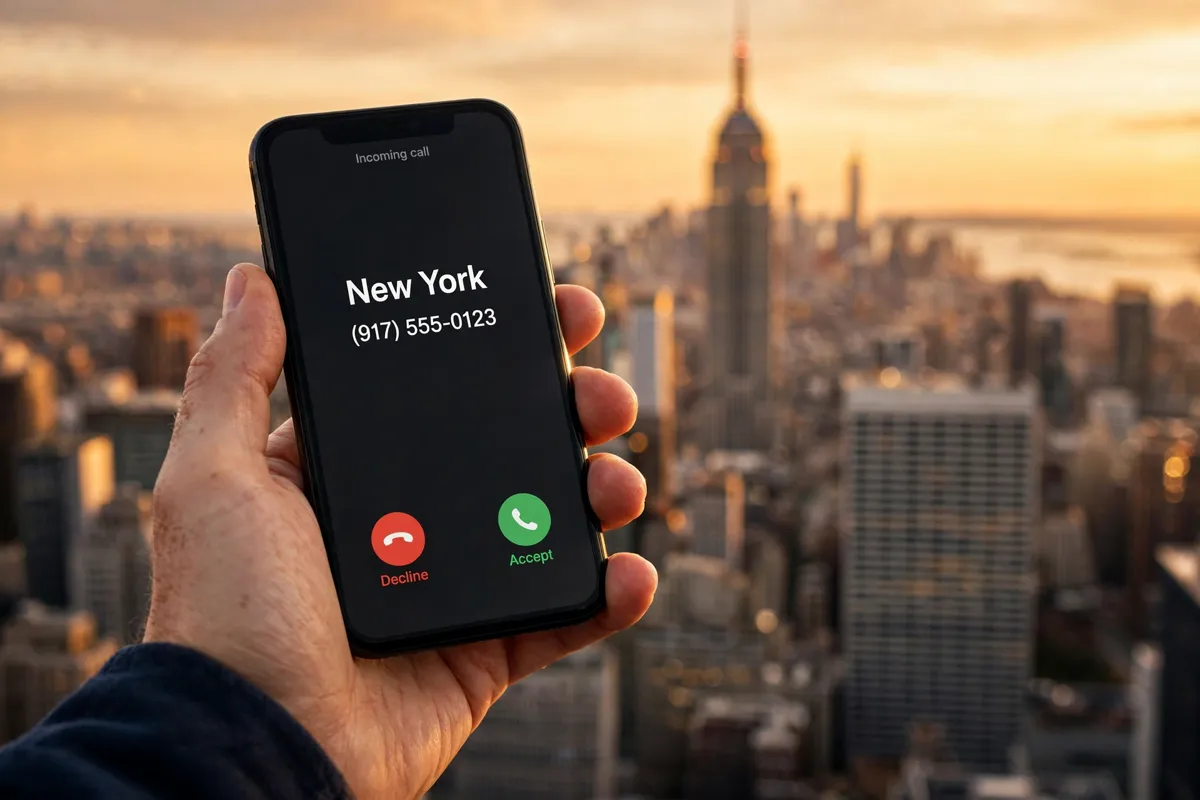

A 917 number just called you, and you want to know where it’s from. Short answer: it’s a real New York City area code — the one that covers all five boroughs. It has been in service since February 4, 1992, it runs on Eastern Time, and calling one costs the same as calling any other US number.
917 is also the most interesting area code in the country. It was the first overlay area code ever created in North America, the only one ever launched for a single type of phone, and for its first decade it was how you knew someone in New York had a cellphone. So this guide covers both sides: where 917 is, how to dial it, and how to tell a real 917 call from a fake one.
Where Is the 917 Area Code?
The 917 area code belongs to New York City — all of it. Manhattan, Brooklyn, Queens, the Bronx and Staten Island all sit inside its footprint, which makes it different from every other New York code. 212, 646 and 332 belong to Manhattan. 718, 347 and 929 belong to the outer boroughs. 917 is the only code that overlays the whole city at once, on top of all six of them.
| Detail | Answer |
|---|---|
| Location | New York City, New York — all five boroughs |
| Boroughs served | Manhattan, Brooklyn, Queens, the Bronx, Staten Island, plus Marble Hill |
| Time zone | Eastern Time (UTC-5 in winter, UTC-4 in summer) |
| In service since | February 4, 1992 |
| Shares territory with | 212, 646, 332 (Manhattan) and 718, 347, 929, 465 (outer boroughs) |
| Dialing | 10 digits for every local call (1 + area code + number) |
The five boroughs it covers
Manhattan. The city’s financial and media core, about 1.6 million people on a narrow island. Midtown, the Upper East Side, the Village, Harlem — a 917 number here is a mobile number with history, because 917 was the city’s cellphone code before it was anything else.
Brooklyn. The most populous borough, roughly 2.7 million people — more than most American cities on their own. From Williamsburg and Greenpoint to Park Slope, Bay Ridge and Coney Island, any Brooklyn neighborhood can have a 917 number.
Queens. The most spread-out borough, often called the most ethnically diverse urban area on Earth. Astoria, Flushing, Jamaica, Forest Hills, Long Island City — every corner of Queens can carry a 917 number.
The Bronx. The city’s northernmost borough, home to Yankee Stadium, the Bronx Zoo and the New York Botanical Garden. A 917 number here is as local as it gets — whole streets run on a mix of 718, 347, 929 and 917 numbers side by side.
Staten Island. The smallest borough by population, about half a million people, and the most suburban in feel. Neighborhoods like St. George, Great Kills and Tottenville all sit inside the 917 footprint.
Then there’s the odd one out: Marble Hill. It’s a Manhattan neighborhood, but it sits on the mainland north of the Harlem River, on the Bronx side. Because of that quirk of geography, Marble Hill uses the outer-borough codes — including 917 — even though it belongs to Manhattan on paper.
Neighborhoods where 917 numbers show up
Any neighborhood in the five boroughs can have a 917 number, because the code was never tied to one place — it was tied to one kind of phone. In Manhattan, look for Midtown, Chelsea, the Upper East Side and Harlem. In Brooklyn, Williamsburg, Park Slope, Bay Ridge and Flatbush. In Queens, Astoria, Flushing, Jamaica and Forest Hills. In the Bronx, Fordham, Kingsbridge, Riverdale and the streets around Yankee Stadium. On Staten Island, St. George and Great Kills.
A few of the main ZIP codes in the 917 area: 10001 (Chelsea, Manhattan), 10003 (East Village, Manhattan), 10011 (Chelsea and the West Village), 11201 (Brooklyn Heights and Downtown Brooklyn) and 10451 (Concourse, by Yankee Stadium in the Bronx).
What 917 does not cover
Three mix-ups come up again and again. First, 917 is not a country code. A number starting +91 is India’s country code, not New York. A real 917 call always starts +1 917 from abroad, because +1 is the North American country code. Second, 917 stops at the city line. Nassau County on Long Island uses 516, Westchester County to the north uses 914, and the New Jersey towns across the Hudson use 201 and 908. Third, some lookup sites list extra towns under 917 that sit outside the city — if the address isn’t in one of the five boroughs, it isn’t 917.
917 Area Code Time Zone
Every 917 number runs on Eastern Time — UTC-5 in the winter (Eastern Standard Time) and UTC-4 in the summer (Eastern Daylight Time). Daylight saving time in 2026 ran from March 8 to November 1, so from early November through mid-March, New York is five hours behind UTC.
That matters more than it sounds. Ringing a business in Manhattan from the West Coast? Your 9 a.m. is already noon in New York.
Best time to call a 917 number
For a business call, aim for 9 a.m. to 5 p.m. New York time. Here’s what that means wherever you’re calling from:
| Calling from | Best time to call (your time) |
|---|---|
| Eastern Time | 9 a.m. to 5 p.m. |
| Central Time | 8 a.m. to 4 p.m. |
| Mountain Time | 7 a.m. to 3 p.m. |
| Pacific Time | 6 a.m. to 2 p.m. |
| United Kingdom | 2 p.m. to 10 p.m. |
Evenings work fine for personal calls — most people are reachable until about 9 p.m. Eastern. After that, an unknown 917 number late at night is exactly the kind of call most people let go to voicemail.

How to Dial a 917 Number
Because seven area codes share the same streets, seven-digit dialing stopped working in New York City years ago. Every local call needs the full ten digits — even calling your next-door neighbor means dialing the area code.
| Calling from | Dial |
|---|---|
| Inside New York City | 917 + 7-digit number (10 digits total) |
| Elsewhere in the US | 1 + 917 + 7-digit number |
| From a mobile phone | +1 917 + 7-digit number |
| From the UK or Europe | 00 + 1 + 917 + 7-digit number |
From abroad, always start with your country’s exit code (00 in most of Europe, 011 from the US and Canada) followed by 1, the North American country code, then 917 and the seven-digit number. On a mobile, the + sign does the same job: +1 917 and the number works from anywhere in the world.
Why New York City Has So Many Area Codes
New York has eight area codes because it keeps running out of numbers — and each time, the fix has been to layer a new code over the same map instead of making anyone change theirs. The story starts in 1947, when 212 was assigned to the whole city. By 1984 the city had grown enough that Brooklyn, Queens and Staten Island were split off into 718, leaving 212 for Manhattan and the Bronx.
Then cellphones arrived, and the numbers started vanishing fast. In 1990 the phone company proposed giving the Bronx its own new code, 917 — the plan was reported in the New York Times that June, and the state regulator turned it down. Two years later, the numbering administrator came back with a bolder idea: instead of carving the city up again, add 917 as an overlay covering all five boroughs at once, and move every cellphone and pager in the city onto it. On February 4, 1992, that is what happened. Every mobile phone in New York switched to 917 overnight, which freed up the entire 212 and 718 pools for landlines. The Bronx moved into 718 the same year, and 212 became Manhattan-only.
It worked so well that the overlay became the standard fix for every crowded American city after that — there are now hundreds of overlays across the country, and all of them descend from the model 917 set. The code also had one quirk no other American area code ever had: it was launched for a specific service. A 917 number meant a cellphone or a pager, never a landline. The Federal Communications Commission later ruled that service-specific area codes were not allowed — but it grandfathered 917, so New York kept the only one.
Demand kept growing, so the layers kept coming: 646 for Manhattan and 347 for the outer boroughs in 1999, 929 for the outer boroughs in 2011, 332 for Manhattan in 2017, and 465 for the outer boroughs in 2026. Today about 8.8 million people live inside the 917 footprint, and a single street can hold numbers from four or five different codes.
Every New York City area code, side by side
| Area code | In service since | Where it applies |
|---|---|---|
| 212 | 1947 | Manhattan (originally the whole city) |
| 718 | 1984 | Outer boroughs (Brooklyn, Queens, Staten Island; the Bronx joined in 1992) |
| 917 | February 4, 1992 | All five boroughs — the first overlay in North America |
| 646 | 1999 | Manhattan overlay |
| 347 | October 1, 1999 | Outer boroughs overlay |
| 929 | April 16, 2011 | Outer boroughs overlay |
| 332 | 2017 | Manhattan overlay |
| 465 | June 18, 2026 | Outer boroughs overlay — the newest code |
Is a 917 Call a Scam?
No. 917 is a legitimate, active area code for New York City, in service for over thirty years and used by real businesses, government offices and residents. But like any big-city code, scammers spoof it — they fake a 917 caller ID because a New York number looks familiar and people pick up. The code is real; the caller might not be.
One thing worth knowing: 917 numbers are getting scarce. The newest overlay, 465, was activated on June 18, 2026 to add fresh numbers for the outer boroughs, but its numbers are only handed out once the existing 347, 718, 917 and 929 numbers run out — which the New York Public Service Commission projects for the third quarter of 2027. Until then, new lines in the city still get 917 numbers, and a 917 number still reads as a long-tenured New York mobile — someone who has been here a while.
The 917 scam scripts going around
The government-impersonation call. Someone claiming to be from the IRS, Social Security or the police says you owe money or your number will be suspended, and demands payment right now. Real agencies never call out of the blue and never demand gift cards, wire transfers or crypto.
The bank or package text. A message about a frozen account or a missed delivery, with a link to a login page. The link harvests your password. Banks and delivery companies don’t ask you to log in from a text.
The one-ring call. The phone rings once from a 917 number and stops. The trick is to make you call back — sometimes to a premium-rate line. If you don’t know the number and there’s no voicemail, don’t return it.
The job-offer text. A too-good-to-be-true remote job, usually asking you to pay for training or equipment first. Real employers never charge you to start work.
A 30-second check before you call back
Run through this before you return any unexpected 917 call:
- No voicemail? Let it go. Real callers leave a message. Scammers almost never do.
- Don’t trust caller ID alone. Spoofing lets anyone display any number, including your own. A missed call from your own number is never worth returning.
- Look for the verified checkmark. Carriers now authenticate calls under a system called STIR/SHAKEN, and a verified mark means the number wasn’t faked. No mark doesn’t prove a scam — but treat the call with more caution.
- Call the organization back yourself. If someone claims to be your bank, hang up and dial the number on the bank’s official website or your card. Never use a number the caller gives you.
- Never pay under pressure. Gift cards, wire transfers and crypto are how scammers like to be paid, because the money can’t be clawed back. Any caller demanding one of those is a scammer.
- Report it. Forward scam texts to 7726 (SPAM), and file unwanted calls at reportfraud.ftc.gov. Reports feed the complaint data that powers spam blocking.
How to Get a 917 Number
If you want a 917 number for yourself or a business, any carrier serving New York City can assign one — but you can’t request 917 specifically. Which code you get depends on what’s available when you sign up, so a new line in Brooklyn today could come back as 917, 347, 929 or 718. VoIP providers also sell virtual 917 numbers that ring through to any phone, which is how small businesses get a local New York presence without a New York office.
If you already have a 917 number, you can keep it when you switch carriers. Federal rules give you the right to take your number with you — a process called porting — and a straightforward single-line transfer has to be completed within one business day. Don’t cancel your old service before the new carrier starts the port — disconnect first and you can lose the number entirely.
For its first decade, having a 917 number meant something specific: you carried a cellphone in a city where most people didn’t. By the late 1990s, “give me your 917” had become New York shorthand for “give me your mobile number” — a usage that stuck around long after 917 stopped being mobile-only. A 917 number today reads as long-tenured New York mobile in a way the newer codes don’t. Area codes work the same way in every big city — one map, many layers. Our 480 area code guide covers how Phoenix’s East Valley ended up with its own overlay story.
Where is the 917 area code located?
The 917 area code serves all five boroughs of New York City — Manhattan, Brooklyn, Queens, the Bronx and Staten Island — plus the Marble Hill neighborhood of Manhattan. It is the only code that overlays the whole city at once, sharing the territory with 212, 646 and 332 in Manhattan and 718, 347, 929 and 465 in the outer boroughs.
Is 917 a scam area code?
No. 917 is a legitimate New York City area code, in service since February 4, 1992. But scammers often spoof 917 numbers, so judge the caller — not the code. If there’s no voicemail, let it go, and never pay anyone who demands gift cards or wire transfers.
What time zone is area code 917 in?
Eastern Time — UTC-5 in winter (Eastern Standard Time) and UTC-4 in summer (Eastern Daylight Time). In 2026, daylight saving time ran from March 8 to November 1.
Do I have to dial 10 digits to call a 917 number?
Yes. Because seven area codes share the same streets, every local call needs the full 10-digit number (1 + area code + number). Seven-digit dialing stopped working in New York City years ago.
What is the 465 area code?
465 is the newest overlay for New York City’s outer boroughs, activated on June 18, 2026. Its numbers are only assigned once the existing 347, 718, 917 and 929 numbers run out — projected for the third quarter of 2027. Existing numbers don’t change.
