
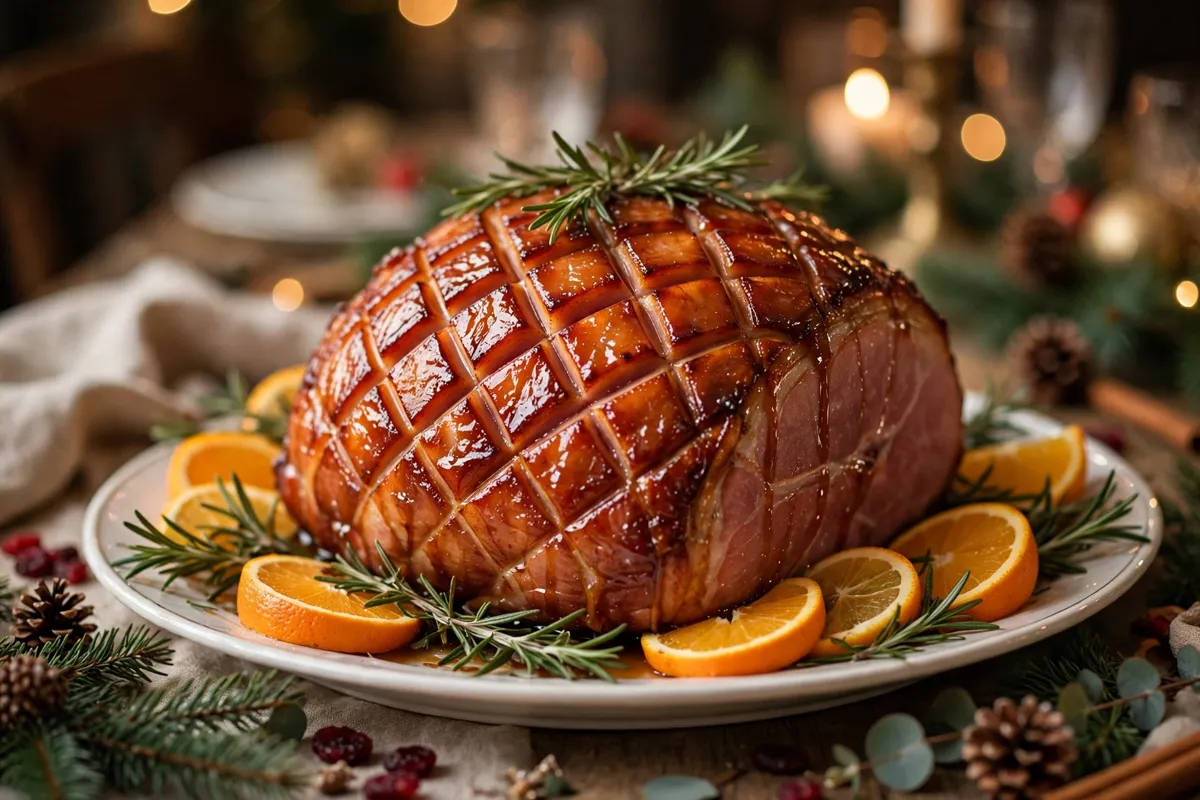

A baked ham is the easiest impressive thing you can put on a Christmas table. Most hams in the shops are already cooked, so your job is mostly to warm one through, give it a glossy glaze, and not dry it out. This guide covers how to bake a ham step by step, with the USDA time chart for every type of ham, two glazes that actually work, and a dinner-day plan so you know exactly when to put it in the oven. Christmas Day 2026 falls on Friday, December 25, so the plan below is built around that date.
First, Read the Label: What Kind of Ham Do You Have?
Everything about how to bake a ham starts with the label. Hams look alike in the shop, but they are not the same product. The three words to look for are “fully cooked,” “cook before eating,” and “fresh.”
Fully cooked ham
This is what most supermarkets sell, including most spiral-cut hams. It was cooked at the plant and can be eaten cold straight from the packet. Heating it is about warmth and flavour, not safety. The USDA says to reheat one packaged in a USDA-inspected plant to 140°F. If it was repackaged at the shop, or it is a leftover, the target is 165°F instead.
Cook-before-eating ham
Cured and often smoked, but not cooked enough to be safe. The label will say “cook thoroughly” and carry cooking directions. Treat it like raw meat: it must reach 145°F, then rest for at least three minutes.
Fresh ham
An uncured leg of pork. It looks pale pink or beige, like a pork roast, rather than the deep rose of cured ham, and the label includes the word “fresh.” Cook it like a pork roast: 145°F with a three-minute rest.
If you are unsure which kind you have, the label settles it. “Fully cooked” means reheat. “Cook before eating” or “fresh” means cook it through. When in doubt, cook it to 145°F and rest it. Country ham is the exception: dry-cured and very salty, it needs soaking for 4 to 12 hours in the fridge, then simmering in water at 20 to 25 minutes per pound — never bake it like a city ham.
How Long to Bake a Ham: The USDA Time Chart
The USDA Food Safety and Inspection Service publishes one timetable for ham, and every serious cooking site quotes from it. The oven is always set to 325°F, never lower: a slow oven keeps the meat in the danger zone too long. Times are minutes per pound, and they are estimates — the thermometer decides when the ham is done, not the clock.
| Ham type | Weight | Minutes per pound at 325°F | Done at |
|---|---|---|---|
| Smoked, fully cooked, whole, bone-in | 10–14 lb | 15–18 | 140°F |
| Smoked, fully cooked, half, bone-in | 5–7 lb | 18–24 | 140°F |
| Spiral-cut, whole or half | 7–9 lb | 10–18 | 140°F |
| Vacuum-packed, boneless | 6–12 lb | 10–15 | 140°F |
| Canned ham, boneless | 3–10 lb | 15–20 | 140°F |
| Arm picnic shoulder, boneless, fully cooked | 5–8 lb | 25–30 | 140°F |
| Smoked, cook-before-eating, whole, bone-in | 10–14 lb | 18–20 | 145°F + 3 min rest |
| Smoked, cook-before-eating, half, bone-in | 5–7 lb | 22–25 | 145°F + 3 min rest |
| Smoked, cook-before-eating, shank or butt portion | 3–4 lb | 35–40 | 145°F + 3 min rest |
| Fresh ham, whole leg, bone-in | 12–16 lb | 22–26 | 145°F + 3 min rest |
| Fresh ham, whole leg, boneless | 10–14 lb | 24–28 | 145°F + 3 min rest |
| Fresh ham, half, bone-in | 5–8 lb | 35–40 | 145°F + 3 min rest |
Three worked examples:
- An 8 lb spiral-cut ham: 10 to 18 minutes per pound gives 80 to 144 minutes, or about 1 hour 20 minutes to 2 hours 25 minutes. Plan on the long end; spiral hams dry out fast if you overshoot.
- A 10 lb fully cooked whole bone-in ham: 15 to 18 minutes per pound gives 150 to 180 minutes, or 2½ to 3 hours.
- A 12 lb fresh whole leg, bone-in: 22 to 26 minutes per pound gives 264 to 312 minutes, or about 4 hours 25 minutes to 5 hours 10 minutes. A fresh ham is a full cooking job, not a reheat, so give it the morning.
Why three different targets? A fully cooked ham is safe cold, so 140°F is just serving temperature. A fresh or cook-before-eating ham is raw meat, so it needs 145°F plus a three-minute rest. A cooked ham that has been repackaged, or any leftover ham, goes to 165°F. Plenty of guides say 140°F for every ham; the USDA draws the line by label and packaging.
How Much Ham Per Person?
Buy too little and someone gets a thin slice and a polite smile. Buy too much and you are eating ham sandwiches until New Year. The USDA’s serving guide is simple: allow ¼ to ⅓ lb per person for boneless ham, and ⅓ to ½ lb per person for bone-in ham.
| Guests | Boneless ham to buy | Bone-in ham to buy |
|---|---|---|
| 6 | 1½–2 lb | 2–3 lb |
| 8 | 2–3 lb | 3–4 lb |
| 10 | 2½–3½ lb | 3½–5 lb |
| 12 | 3–4 lb | 4–6 lb |
| 16 | 4–5½ lb | 5½–8 lb |
| 20 | 5–7 lb | 7–10 lb |
Those numbers are for dinner only. If you want leftovers on purpose, buy about half a pound per person for a bone-in ham: a 10 lb bone-in ham for 12 guests leaves a generous pile for sandwiches and soup. Our guide to how much turkey per person uses the same serving maths for a second main dish.
How to Bake a Ham, Step by Step
This is the method for the ham most people buy: a fully cooked, bone-in or spiral-cut ham. It works at 325°F from start to finish, and the glaze goes on at the end, never at the start.
Step 1: Take the chill off and set up the pan
Take the ham out of the fridge 30 minutes before it goes in the oven: a fridge-cold ham cooks unevenly, the outside drying while the middle catches up. Heat the oven to 325°F with a rack in the lower third. Set the ham cut-side down in a shallow roasting pan and pour about a cup of water, stock, or apple juice into the bottom — the liquid steams gently and keeps the slices from drying out. Line the pan with foil first for an easy clean-up: glaze drips bake on hard.
Step 2: Score the fat
If your ham is not spiral-cut, score the fat cap in a diamond pattern, cutting about a quarter inch deep — through the fat, not into the meat. The cuts give the glaze somewhere to grip. Skip this for a spiral-cut ham: it is already sliced, and scoring it further just dries it out. Press a whole clove into each diamond if you like the classic look.
Step 3: Cover and bake
Cover the pan tightly with foil and bake at 325°F for the time your ham’s row in the chart gives you, starting to check at the short end of the range. For a spiral-cut ham, the foil matters most: the slices are already cut, so hot air dries them from every side.
Step 4: Check the temperature
Push an instant-read thermometer into the thickest part, away from the bone — the bone conducts heat and reads hotter than the meat, so a reading taken against it will lie to you. Aim for 140°F for a fully cooked ham, or 145°F for a fresh or cook-before-eating ham. Start glazing when the ham is about 10 degrees short of its target, usually in the last 30 minutes.
Step 5: Rest before carving
Take the ham out, tent it loosely with foil, and rest it for 15 minutes. The juices settle back into the meat, and the glaze sets into a tacky shine instead of sliding off onto the board.

How to Glaze a Ham
A glaze is sugar, acid, and a little spice, cooked just long enough to thicken. The sugar is the point and the problem: it caramelises into that sticky amber crust, but it also burns. So every good glaze goes on in the last 20 to 30 minutes, never at the start — put it on early and you get a black, bitter shell over a ham that is still cold in the middle.
Two glazes that cover most tastes — each makes enough for a 7 to 10 lb ham. Simmer the ingredients in a small pan for about five minutes, until the sugar dissolves and the mixture thickens slightly, then brush it on.
Classic brown sugar and honey glaze
One cup of brown sugar, half a cup of honey, two tablespoons of Dijon mustard, two tablespoons of apple cider vinegar, and a quarter teaspoon of ground cloves. The mustard cuts the sweetness and helps the glaze cling. The Kitchn’s version adds a little butter and simmers it until it darkens and turns syrupy — exactly the texture you want.
Pineapple and brown sugar glaze
One cup of brown sugar, half a cup of pineapple juice, two tablespoons of Dijon mustard, and a pinch of ground ginger. The juice keeps the glaze loose enough to brush between spiral slices.
How to apply the glaze
When the ham is about 30 minutes from done, take it out, pull the foil off, and brush on a third of the glaze — into the score marks, and between the slices for a spiral ham. Put it back in uncovered. Brush on another third after 15 minutes, and the rest in the final few minutes. If the glaze darkens too fast, tent the ham loosely with foil. You can make any of these glazes up to five days ahead; keep them in the fridge and warm gently before brushing.
How to Carve a Ham
Resting done, move the ham to a cutting board with the flat cut side down so it sits steady. For a spiral-cut ham, slice along the bone to free the rounds, then let the slices fall. For a whole bone-in ham, cut a few slices off the narrow end first, then slice down toward the bone in even cuts, working your way around it. Cut across the grain, about a quarter inch thick. Save the bone — it makes a better soup than anything you can buy, and it freezes well.
What Time to Put the Ham In: A Christmas Dinner Plan
Work backwards from dinner, and plan on the long end of the cooking range plus 15 minutes of rest. Here is the plan for an 8 lb spiral-cut ham, the most common Christmas size, with dinner at 5:00 pm on Friday, December 25, 2026:
- 2:20 pm — ham goes into a 325°F oven, covered in foil.
- 4:15 pm — foil off, first brush of glaze. Two more coats over the next 25 minutes.
- 4:45 pm — ham comes out at 140°F, tented with foil to rest.
- 5:00 pm — carve and serve.
For a 2:00 pm dinner with the same ham, shift everything three hours earlier: in the oven at 11:20 am, glaze from 1:15 pm, out at 1:45 pm, serve at 2:00 pm. If your ham is bigger, add the extra cooking time to the start, not the end. And if the ham is done early, tent it in foil and leave it on the counter — a whole ham holds its heat for a good half hour. Done early is a small problem; done late is a hungry room.
Ham Problems and How to Fix Them
| Problem | What went wrong | The fix |
|---|---|---|
| Ham is dry | Baked uncovered, or cooked past 140°F | Next time, keep the foil on until glazing and trust the thermometer, not the clock. Today, serve with warm pan juices spooned over the slices. |
| Glaze burned | Glaze went on too early or the oven ran hot | Scrape off the blackened patches, brush on a thin fresh coat, and finish uncovered for five minutes only. |
| Glaze slid off | Ham was not scored, or the glaze was too thin | Simmer the glaze longer next time until it coats a spoon. Today, serve the extra glaze warm in a jug at the table. |
| Middle is still cold | Ham went in fridge-cold or the oven was crowded | Put it back in, covered, at 325°F and check every 15 minutes. A cold middle is normal in a big ham; the outside lies about it. |
| Ham is too salty | Usually a country ham, or a very salty cure | Serve with something sweet and sharp, like the pineapple glaze or cranberry sauce. Soak a country ham before cooking next time. |
| Spiral slices fell apart | Overcooked, or carved before resting | Serve the slices fanned on the platter with the glaze spooned over. Rest 15 minutes before carving next time. |
Leftover Ham: Storage and Reheating
Wrap leftover ham tightly and get it into the fridge within two hours of serving. Bacteria grow fast between 40°F and 140°F, which the USDA calls the danger zone. In the fridge, cooked ham keeps for three to four days. In the freezer, it keeps its best quality for one to two months if you wrap it well.
Reheat leftover ham to 165°F — a higher target than the first cook, because the ham has been handled, sliced, and stored since it left the oven. Warm slices gently in a covered pan with a splash of stock or water over low heat. Slices also go well cold in sandwiches, diced into soup, or fried with eggs the next morning. If you are planning the whole holiday meal, our Thanksgiving dinner planning guide has the same kind of timing and storage thinking for the rest of the table.
Know your ham type, set the oven to 325°F, trust the thermometer, and save the glaze for the last half hour.
How long does it take to bake a ham?
It depends on the type and weight. At 325°F, a fully cooked spiral-cut ham needs 10–18 minutes per pound, a fully cooked bone-in ham 15–18, and a fresh ham 22–26. An 8 lb spiral ham takes about 1 hour 20 minutes to 2 hours 25 minutes. Use a thermometer: 140°F for fully cooked ham, 145°F for fresh ham.
What temperature should ham be cooked to?
Fully cooked ham packaged in a USDA-inspected plant reheats to 140°F. Fresh ham and ham labelled “cook before eating” must reach 145°F and rest for 3 minutes. Leftover ham and repackaged cooked ham reheat to 165°F.
Do you cover a ham when baking it?
Yes — cover it tightly with foil for most of the bake so it stays moist, especially a spiral-cut ham. Take the foil off for the last 30 minutes when you glaze it, so the glaze can set and caramelise.
When do you put the glaze on a ham?
In the last 20–30 minutes of baking. Brush it on in thirds, about 15 minutes apart. Glaze applied earlier burns before the ham finishes cooking.
How long does leftover ham last?
Three to four days in the fridge, or one to two months in the freezer for best quality. Reheat leftovers to 165°F, and get them into the fridge within two hours of serving.
