
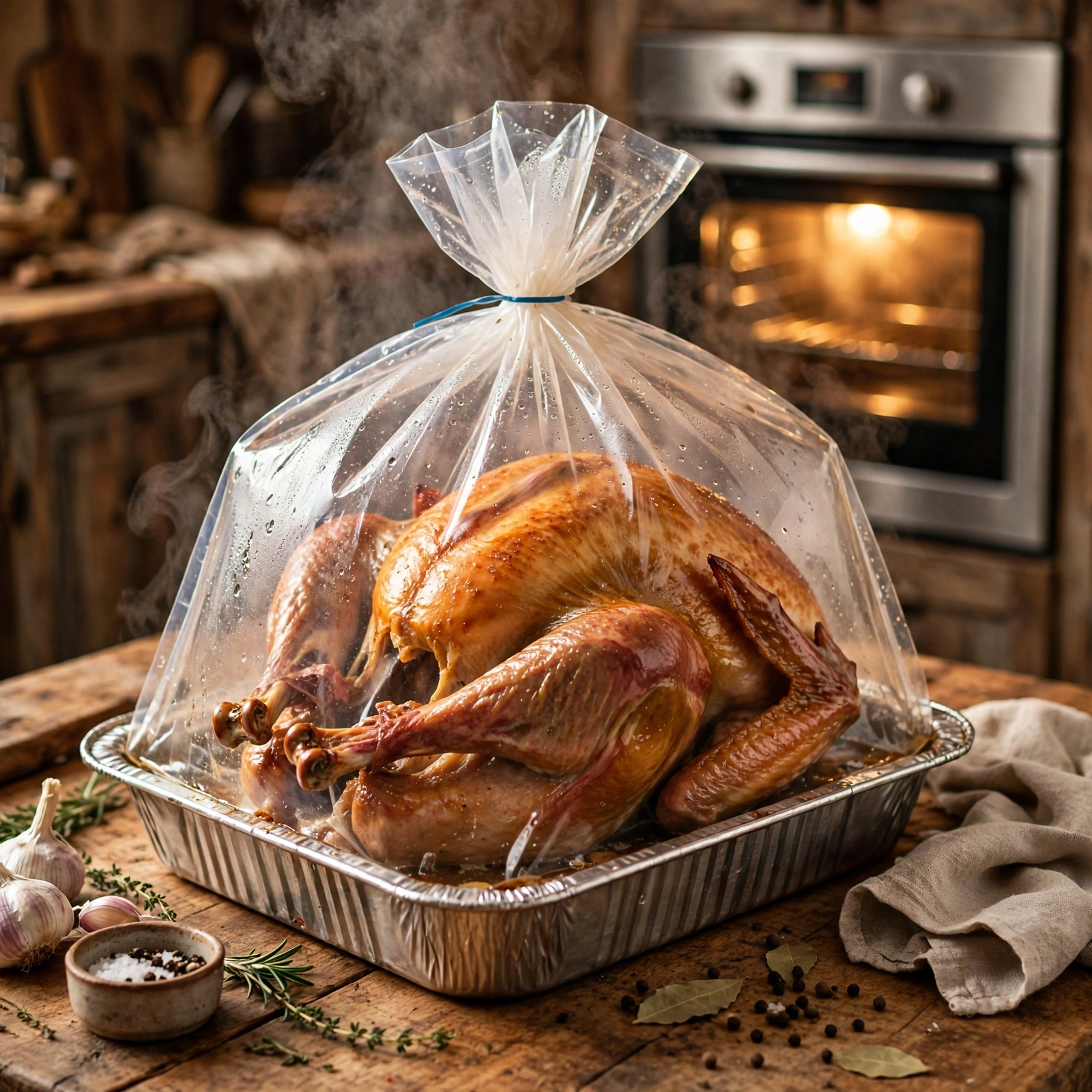

Why the Bag Method Wins
If you’ve ever stood in front of a raw turkey with a basting schedule taped to the fridge, here’s some relief: cooking a turkey in an oven bag is the closest thing to a hands-off Thanksgiving bird. The bag traps steam around the meat, which does two jobs at once — it bastes the turkey continuously without you lifting a finger, and it moves heat around faster than dry oven air. The practical result: a bag turkey cooks noticeably faster than an uncovered one, the breast stays juicy, and cleanup is one discarded bag instead of a scrubbed roasting pan.
It’s also one of the most-searched Thanksgiving questions every year. Let’s answer it properly: how long to cook a turkey with a bag, by weight, for stuffed and unstuffed birds — with every number verified against USDA guidance at the time of writing.
How Long to Cook a Turkey in a Bag: The Weight Chart
The U.S. Department of Agriculture publishes cooking times for turkey in an oven cooking bag at 350°F, and they’re shorter than most people expect. For a stuffed bird, USDA’s guidance is simple: add 30 minutes to the unstuffed time.
| Turkey weight | Unstuffed | Stuffed |
|---|---|---|
| 8–12 lb | 1½–2 hours | 2–2½ hours |
| 12–16 lb | 2–2½ hours | 2½–3 hours |
| 16–20 lb | 2½–3 hours | 3–3½ hours |
| 20–24 lb | 3–3½ hours | 3½–4 hours |
Treat these as planning estimates, not guarantees. Ovens lie about their temperature more often than people admit, and a bird that started partly frozen will take longer than the chart says. The only finish line that matters is the thermometer reading — more on that below. If you’re still working out your whole-day timeline, including when to start thawing and when the bird needs to go in, our Thanksgiving dinner planning guide maps out the full day.
The 165°F Rule: The Only Doneness Test That Counts
A turkey is safely cooked when it reaches a minimum internal temperature of 165°F — that’s the USDA’s number, and it applies to every part of the bird. Check it in three places: the innermost part of the thigh, the innermost part of the wing, and the thickest part of the breast. If you stuffed the bird, the stuffing itself has to hit 165°F too, not just the meat around it.
Two things worth knowing before you roast:
- Start checking early. Begin testing the temperature about 30–45 minutes before the chart’s minimum time. Ovens run hot, smaller birds finish fast, and there’s no prize for an extra half hour at 350°F.
- 165°F is the floor, not the finish line. Carryover cooking nudges the temperature up a few degrees during the rest. Dark meat eaters who prefer more-rendered thighs can take the thigh higher — the USDA minimum is what makes it safe, not what makes it perfect.
How to Cook a Turkey in an Oven Bag, Step by Step
The method is simple, but the bag has a few non-obvious rules. Get these right and it’s the easiest turkey you’ll ever roast.
Step 1: Set the stage
Preheat the oven to 350°F and put the rack on the lowest position. Set a roasting pan that’s at least 2 inches deep on the counter — this is what the bag will sit in.
Step 2: Flour the bag
Shake 1 tablespoon of flour inside the oven bag and distribute it. This is the anti-burst insurance: the flour keeps the bag from puffing up unevenly and splitting. (It also thickens the drippings slightly, which is a happy accident for gravy.)
Step 3: Prep the turkey
Remove the giblets and neck from the cavities and pat the bird dry. Season it the way you like — salt, pepper, and whatever aromatics you favor. A handful of fresh herbs tucked in the cavity does real work here, and keeping those herbs fresh until cooking day matters more than people think, since wilted herbs perfume nothing.
Step 4: Bag and tie
Set the turkey breast-side up inside the bag, then close it with the nylon tie that comes in the box. Tuck the corners of the bag in toward the pan and fold any excess bag material back beyond the tie.
Step 5: Vent the bag
Cut 6 half-inch slits in the top of the bag. This is non-negotiable: steam has to escape in a controlled way, or the bag balloons and can burst or press against hot oven surfaces.
Step 6: Check the clearances, then roast
Make sure no part of the bag can touch the oven walls, the racks above, or any heating element. Oven bags are rated safe up to 400°F, but they are not for broilers, countertop roaster ovens, convection settings (unless your manufacturer’s bag allows it), toaster ovens, or grills. Slide the pan in and don’t open the door to baste — the bag is already doing that job.
Step 7: Rest before carving
When the thermometer reads 165°F in all three spots, pull the pan out and let the turkey rest in the bag for 15 minutes. Cut the bag open carefully — there’s a lot of hot steam in there — and tip it so the juices run back into the pan for gravy.
Turkey Breast in an Oven Bag
Feeding a small crowd or just preferring white meat? A bone-in turkey breast roasts beautifully in a bag, and the USDA’s whole-bird chart doesn’t cover it, so these times come from Reynolds’ manufacturer cooking chart (also tested at 350°F):
| Breast weight | Cooking time |
|---|---|
| 8–12 lb, bone-in breast | 1¾–2¼ hours |
| 8–12 lb, boneless breast | 2½–3 hours |
The same 165°F finish rule applies — check the thickest part of the breast. Boneless breasts take longer per pound than people guess because the rolled shape is dense; don’t leave the thermometer in the drawer.
6 Mistakes That Ruin a Bag Turkey
1. Skipping the flour
The flour shake feels optional. It isn’t. Without it, the bag can balloon and split mid-roast, dumping your bird’s steam bath all over the oven.
2. Using the wrong kind of bag
Only bags labeled for oven use — they’re heat-rated nylon. Grocery bags, trash bags, and paper bags will melt, burn, or poison your dinner. If it doesn’t say “oven bag,” it doesn’t go in the oven.
3. Letting the bag touch oven surfaces
A bag pressed against a hot oven wall or element can melt through. Tuck it in, trim the excess, and give it room on the lowest rack.
4. Basting anyway
Opening the bag to baste defeats the entire point — every peek dumps the trapped steam and adds cooking time. The turkey is already basting itself. Trust the method.
5. Going by time instead of temperature
The charts get you in the neighborhood; the thermometer gets you home. Start checking early and pull the bird when it hits 165°F everywhere it needs to, not when the clock says so.
6. Carving immediately
The 15-minute rest isn’t optional padding in the recipe. It lets juices redistribute and the temperature settle. Carve too soon and the juices end up on the cutting board instead of in the meat.
After the Bird: Leftovers Done Right
Strip the meat from the carcass within a couple of hours and refrigerate it — the clock for leftovers starts the moment the bird leaves the oven. The same storage discipline that makes weekly meal prep safe applies here: shallow containers, refrigerate promptly, and use the meat within a few days or freeze it.
And don’t throw the bag’s drippings away with the bag. That concentrated, flour-thickened juice at the bottom of the roasting pan is the best gravy base of the year — strain it, whisk it, and thank the bag later.
Can you cook a turkey in an oven bag?
Yes — use bags specifically labeled for oven use (heat-rated nylon), never grocery or trash bags. Seal the turkey in with the included nylon tie, cut 6 half-inch slits in the top for steam, keep the bag clear of oven walls and heating elements, and roast at 350°F.
How long do you cook a 20-pound turkey in a bag?
At 350°F, a 20–24 lb unstuffed turkey in an oven bag takes 3–3½ hours per USDA guidance, plus 30 minutes if stuffed. Always confirm doneness with a thermometer — 165°F in the thigh, wing, and thickest part of the breast — rather than going by time alone.
What temperature should a turkey in a bag reach?
165°F minimum internal temperature everywhere: the innermost part of the thigh, the innermost part of the wing, and the thickest part of the breast. Stuffing inside the bird must also reach 165°F.
Do you have to cut slits in an oven bag?
Yes. Cut 6 half-inch slits in the top of the bag before roasting so steam escapes in a controlled way. Without venting, the bag can balloon and burst — or press against hot oven surfaces and melt.
Do you baste a turkey in an oven bag?
No — the bag traps steam and continuously self-bastes the turkey. Opening the bag to baste releases the steam and adds cooking time, so leave it closed until the bird hits 165°F.
