
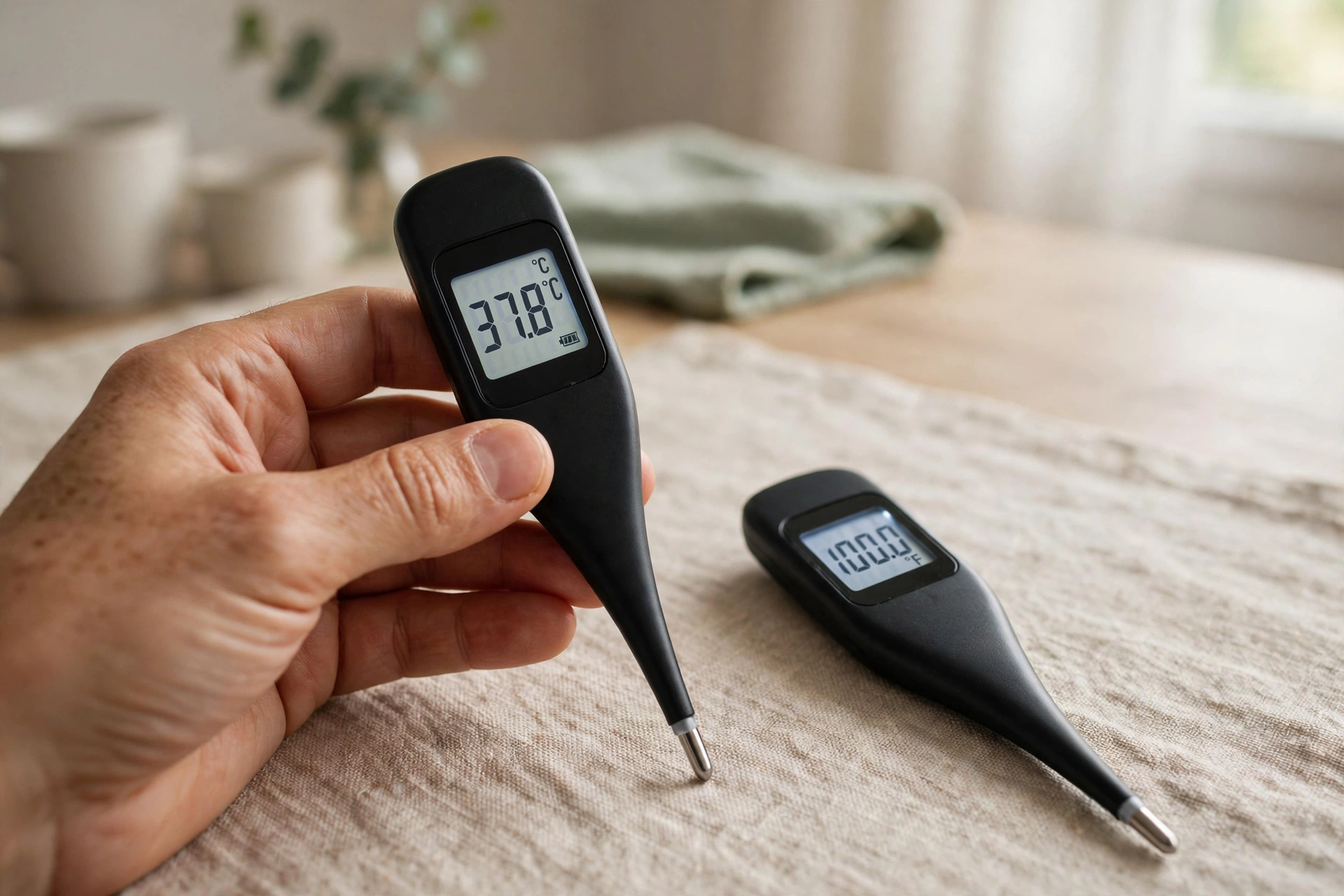

37.5°C is 99.5°F, 37.6°C is 99.7°F, and 37.7°C is 99.9°F. Those three readings sit in an awkward spot: above the familiar 37°C average, yet below the 38°C (100.4°F) line that the NHS and several other major health services use as the usual fever threshold. That is exactly why they cause so much second-guessing — they are not clearly normal, and they are not clearly a fever either.
This guide converts all three, shows the working, and explains what each reading means in plain terms — including why two respected sources can seem to disagree about whether 37.5°C counts as a fever at all. It is general information only, not advice about your own health: a single number never diagnoses anything on its own.
The Three Conversions at a Glance
| Celsius | Fahrenheit (exact) | Fahrenheit (one decimal) | Distance below the 38°C fever line |
|---|---|---|---|
| 37.5°C | 99.50°F | 99.5°F | 0.5°C below |
| 37.6°C | 99.68°F | 99.7°F | 0.4°C below |
| 37.7°C | 99.86°F | 99.9°F | 0.3°C below |
| 38.0°C | 100.40°F | 100.4°F | The fever threshold itself |
The gap between the three readings is tiny — just 0.1°C, or about 0.2°F, between neighbours — but the way people talk about them changes across that small range: 37.5°C is often called the top of normal, 37.7°C slightly raised.
If you only need one of these numbers in the other direction, our guide to 36.7°C to Fahrenheit works through a single normal-range reading the same careful way.
How Each Conversion Works
Every conversion on this page uses the same formula:
°F = (°C × 9/5) + 32
Multiply by 1.8 if you prefer decimals — 9/5 and 1.8 are the same number. The only step people get wrong is the order: multiply first, then add 32. Adding 32 first, or forgetting it, is how a sensible reading turns into a nonsense one.
37.5°C to Fahrenheit: 99.5°F
Multiply 37.5 by 1.8 to get 67.5, then add 32: 67.5 + 32 = 99.5. So 37.5°C = 99.5°F exactly, with no rounding needed. This is the cleanest of the three conversions, and the one most often quoted: 99.5°F is the figure that turns up in discussions of low-grade fever, which we come to below.
37.6°C to Fahrenheit: 99.7°F
Multiply 37.6 by 1.8 to get 67.68, then add 32: 67.68 + 32 = 99.68. Rounded to one decimal place — the way most thermometers display it — that is 99.7°F. If your thermometer shows 99.7°F, converting back gives about 37.6°C, allowing for the rounding. Do not be thrown by the second decimal: 99.68°F and 99.7°F are the same reading, one unrounded and one rounded.
37.7°C to Fahrenheit: 99.9°F
Multiply 37.7 by 1.8 to get 67.86, then add 32: 67.86 + 32 = 99.86. Rounded to one decimal place, that is 99.9°F — a tenth of a degree below 100°F, and half a degree Fahrenheit below the 100.4°F fever line. A display reading 99.9°F looks alarming because it sits just under 100, but in Celsius terms it is still 0.3°C short of the fever threshold.
For the full range rather than just these three, our Celsius to Fahrenheit conversion chart covers weather and fever temperatures in one table.
Are 37.5, 37.6 and 37.7°C a Fever?
The honest answer is that it depends on which definition you use — and that disagreement is real, not a mistake in your thermometer.
By the usual fever line: no, not yet
The NHS describes a high temperature in adults as usually 38°C or above, and MedlinePlus likewise says a temperature over 100.4°F (38°C) most often means a fever. On that widely used line, none of the three readings in this article is a fever: 37.7°C, the highest of them, is still 0.3°C below it.
By the low-grade band: 37.5°C is where it starts
Some clinicians use a separate band for a slight elevation. Cleveland Clinic notes that many healthcare providers consider a body temperature between 99.5°F (37.5°C) and 100.3°F (37.9°C) to be a low-grade fever — a temperature slightly above normal that can mean the immune system has been mildly activated. On that reading, 37.5°C is the first step into the low-grade band, and 37.6°C and 37.7°C sit inside it.
Why MedlinePlus sounds like it says both things
MedlinePlus also notes that an adult probably has a fever when the temperature is above 99°F to 99.5°F (37.2°C to 37.5°C), depending on the time of day. That is not a contradiction of its own 100.4°F line so much as a different way of framing the same grey zone: the body runs warmer in the evening than in the morning, so a reading that would be unremarkable late in the day can be more notable first thing. The two statements together point to the same conclusion — 37.5°C to 37.7°C is a borderline range, and context decides how much weight to give it.
Do not call 37.5°C to 37.7°C a full fever on the NHS definition, and do not dismiss it as nothing either. Treat it as slightly raised, note when and how it was taken, and watch what happens next.
Why the Same Number Can Mean Different Things
A thermometer gives you a number, not a diagnosis. Four things change how that number should be read.
Time of day
Body temperature is normally lowest in the early morning and highest in the evening, according to MedlinePlus. A reading of 37.7°C at 7 in the morning is a different picture from the same reading at 7 in the evening, when the body is naturally at its warmest. If you are tracking a temperature, take readings at roughly the same times of day so you are comparing like with like.
Where and how you measure
Mouth, armpit, ear, and forehead readings do not always agree. Rectal and ear readings typically run higher than oral readings, while forehead and armpit readings typically run lower — Cleveland Clinic puts each gap at roughly 1°F (about 0.6°C). Technique matters too: the NHS guidance on taking a temperature stresses placing the thermometer correctly and following its instructions. If a reading surprises you, re-take it carefully in the same spot with the same thermometer before drawing any conclusion.
Your own usual temperature
MedlinePlus gives the average normal body temperature as 98.6°F (37°C), with a normal range from 97°F (36.1°C) to 99°F (37.2°C). But averages hide individual variation: some healthy adults habitually run cooler, others warmer. A person whose usual temperature is 36.4°C has risen further to reach 37.7°C than a person whose usual is 37.1°C. If you know your own baseline, it tells you more than the population average does.
How you feel alongside the number
The NHS makes a point worth repeating: you may feel hot, cold, or shivery and have a high temperature even when the thermometer reads below 38°C. Symptoms, and how a reading changes over hours, matter more than any single digit. A steady 37.5°C in a person who feels fine is a different situation from a temperature climbing from 37.5°C toward 38°C in someone who feels increasingly unwell.
What to Do With a Reading in This Range
None of this is medical advice, and it does not replace a clinician who knows your history. As general information, though, the sensible steps are straightforward.
Note it, then recheck it
Write down the reading, the time, and where you measured it. Rest for a few minutes first — activity, a hot drink, and heavy clothing can all nudge a reading upward for a short while — then re-measure in the same spot. One careful recheck settles more arguments than three hurried readings on three different devices.
Watch the direction, not just the digit
A temperature that holds at 37.5°C and then falls is a different story from one that climbs through 37.7°C toward 38°C. The same applies in reverse: a reading that was 38°C yesterday and is 37.6°C today is moving the right way. Trends over a day tell you far more than any isolated number.
Know when to seek care
The NHS advises asking for an urgent GP appointment or help from NHS 111 if a high temperature is not getting better with home treatment, or is getting worse. The same principle applies here in general terms: if a temperature keeps rising, stays raised, or comes with symptoms that worry you, talk to your clinician or pharmacist promptly rather than waiting for the number to cross a particular line. They can judge the reading alongside your symptoms and history, which no conversion table can do.
Common Mix-Ups With These Temperatures
Reading 37.7°C as 38°C
On a small display, 37.7 and 38.0 look alike at a glance, and 99.9°F looks like 100°F. Double-check the display before reacting: 37.7°C is 0.3°C below the fever line, and 99.9°F is 0.5°F below 100.4°F. A misread digit is the most common reason a borderline reading gets treated as a fever.
Treating rounded numbers as exact
37.6°C is 99.68°F, shown as 99.7°F; 37.7°C is 99.86°F, shown as 99.9°F. Converting 99.7°F back gives 37.61°C, not exactly 37.6°C — that tiny gap is rounding, not error. When you convert back and forth, expect a hundredth or two of drift and do not chase it.
Comparing readings from different thermometers
An oral reading of 37.5°C and a forehead reading of 37.5°C are not the same measurement, even though the digits match. Stick to one device and one site when you are tracking a temperature over time; switching devices mid-track creates apparent rises and falls that are really just device differences.
Assuming 37.5°C means the same thing for a child
Thresholds differ by age and measurement site — for example, MedlinePlus gives different fever cut-offs for children depending on whether the temperature is taken rectally, orally, or under the arm. This article’s framing is for adults. For a child, use paediatric guidance and talk to a clinician rather than applying the adult lines above.
The Bottom Line
37.5°C is 99.5°F, 37.6°C is 99.7°F, and 37.7°C is 99.9°F. By the usual 38°C (100.4°F) fever line, none of them is a fever yet — but all three sit in the slightly-raised band that many clinicians call low-grade, starting at 37.5°C. The number alone does not settle it: time of day, measurement site, your own baseline, and how you feel all shape what a reading in this range means.
This article is general information only, not medical advice for any individual situation. If you feel unwell, if a temperature stays raised or keeps climbing, or if you are ever unsure what a reading means for you or a child in your care, talk to your clinician or pharmacist.
Sources: NHS guidance on high temperature (fever) in adults; MedlinePlus Medical Encyclopedia on body temperature norms and on fever; Cleveland Clinic on what counts as a fever and low-grade fever. Links to all three are included above.
What is 37.5°C in Fahrenheit?
37.5°C is 99.5°F. Work it out as (37.5 × 9/5) + 32 = 99.5, with no rounding needed.
What is 37.6°C in Fahrenheit?
37.6°C is 99.7°F. The exact figure is 99.68°F, which rounds to 99.7°F on a one-decimal display: (37.6 × 1.8) + 32 = 99.68.
What is 37.7°C in Fahrenheit?
37.7°C is 99.9°F. The exact figure is 99.86°F, which rounds to 99.9°F: (37.7 × 1.8) + 32 = 99.86.
Are 37.5, 37.6 and 37.7°C a fever?
Not by the usual fever line: the NHS counts a high temperature in adults as usually 38°C (100.4°F) or above, so all three sit below it. But many clinicians call 99.5°F to 100.3°F (37.5°C to 37.9°C) a low-grade fever, so treat these readings as slightly raised, not as a full fever and not as nothing.
Why does my temperature read 37.7°C in the evening but lower in the morning?
Body temperature is normally lowest in the early morning and highest in the evening, according to MedlinePlus, so the same person can quite naturally read lower on waking and nearer 37.7°C later in the day. Track readings at similar times of day, in the same spot, with the same thermometer, and talk to your clinician if a temperature stays raised or keeps climbing.
