
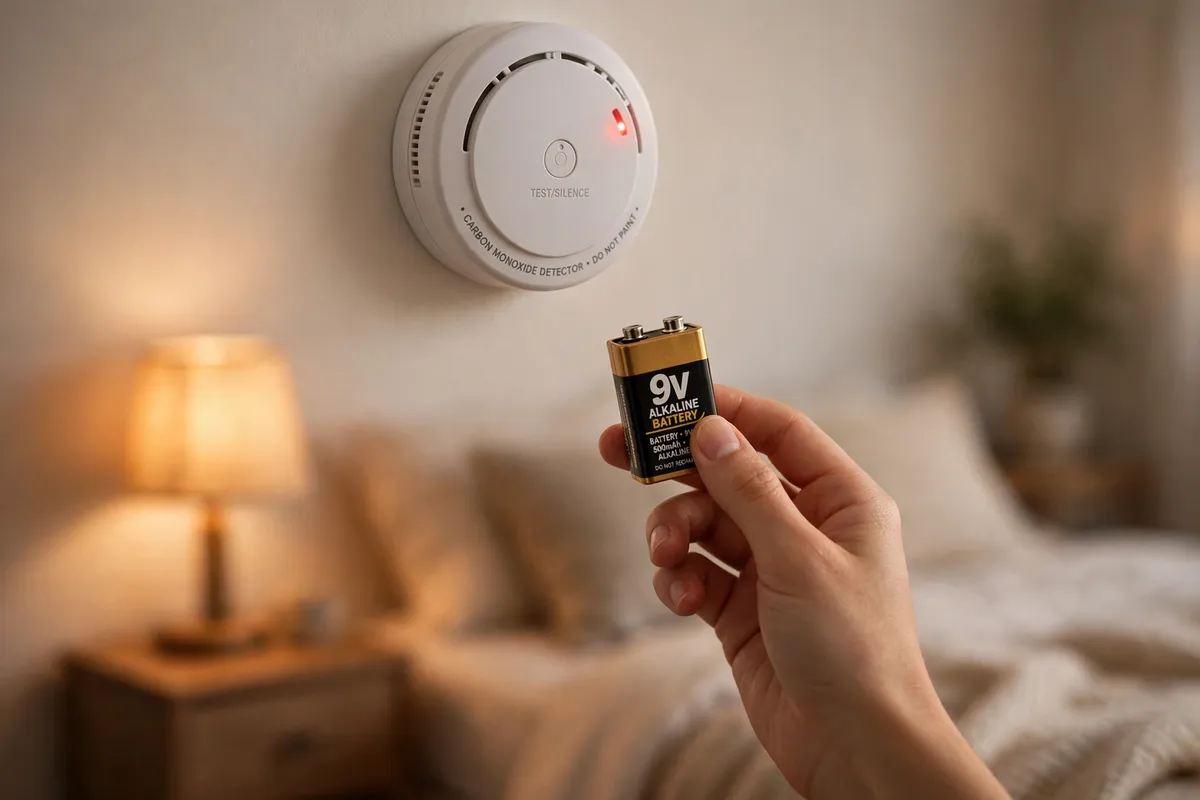

It’s 3 a.m. and something on the wall is chirping. You stand in the dark, half asleep, trying to work out whether the noise means danger or just a dying battery. A carbon monoxide detector alarm beeping in the middle of the night is the worst moment to start learning what the sounds mean — so let’s settle it now, while the house is quiet.
A detector only makes a few different sounds, and each one means something specific. Learn them once, and you can tell in thirty seconds whether to get out or just grab a battery.
First, Listen for 30 Seconds: Alarm or Chirp?
Before you touch anything, listen to the rhythm. A real alarm is loud — about 85 decibels — and repeats without stopping: four quick beeps, a short pause, then four beeps again. A maintenance chirp is one short peep, once every 30 to 60 seconds, then silence.
Four beeps means skip ahead to the emergency steps below. A lone chirp every minute or so means you have time to think — but don’t ignore it. A chirping detector is asking for help, and a detector that can’t do its job is the same as no detector at all.
What Each Beep Pattern Means
Most detectors sold in the US follow the same basic language, set by the UL 2034 safety standard:
Four beeps, a pause, then four beeps again — carbon monoxide detected
The emergency alarm. The sensor has picked up a dangerous level of carbon monoxide. Get everyone out and call 911 from outside — don’t wait to see if it stops.
One chirp every 30 to 60 seconds — low battery
The most common sound, and the least scary. Swap in a fresh battery of the right type — most units take a 9-volt battery or two or three AAs — then press the test button to confirm the chirp is gone.
Five chirps every minute — end of life
The sensor inside wears out. When it does, the unit chirps in a set of five, about once a minute, to tell you its working life is over. A new battery won’t fix this. The whole unit needs replacing.
Three chirps about once a minute — a fault or sensor error
Usually a failed sensor, dust in the chamber, or a power problem on a hardwired model. Check your manual — this pattern varies more between brands than any other — and replace the unit if a fresh battery and a reset don’t clear it.
Kidde vs First Alert: Same Alarm, Different Chirps
Here’s the gap almost every guide skips: the two brands in most American homes don’t use identical signals. The emergency alarm is the same on both, but the maintenance chirps differ — and mixing them up is how people replace a battery three times on a dead sensor.
| Signal | Kidde | First Alert |
|---|---|---|
| Carbon monoxide detected | 4 quick beeps, 5 seconds of silence, repeating | 4 beeps, pause, repeating |
| Low battery | 1 chirp every 60 seconds; display models show “Lb” | 1 beep every minute, often with a blinking red light |
| End of life | Chirp every 30 seconds, from 7 years after first power-up; some models chirp twice every 30 seconds and show “End” | 5 beeps every minute; newer voice models say “replace” out loud |
| Malfunction | 1 chirp every 30 seconds — call Kidde support at 1-800-880-6788 | Varies by model; combo units chirp 3 times about every 45 seconds |
On a Kidde, a chirp every 30 seconds can mean either a fault or the end of the unit’s life — the manual and the date on the back settle which one. First Alert’s newer alarms talk: if yours says “carbon monoxide” or “low battery” out loud, believe the words over the beep count. Both companies publish the exact patterns for every model — Kidde’s support page and First Alert’s beep guide list them model by model.
If You Hear the Four-Beep Alarm, Do This Now
Don’t second-guess a full alarm. Treat it as real until a professional tells you otherwise.
1. Get everyone out — people and pets
Leave through the nearest door. Don’t stop to open windows or hunt for the source — opening windows delays your exit and thins out the gas before firefighters can measure it.
2. Call 911 from outside
Call from fresh air — your front yard, a neighbour’s house, anywhere outside the building. Tell the dispatcher your carbon monoxide alarm is sounding, and mention anyone who feels ill so the crew arrives ready.
3. Stay out until you’re told it’s safe
Don’t go back in for a phone charger or anything else. Firefighters will check the air with their own meters. If the alarm stops while you’re outside, that changes nothing — levels rise and fall, and the house can still be dangerous.
4. Mention any symptoms to the responders
Headache, dizziness, nausea, confusion — tell them, even if the feeling seems mild. It helps them judge how serious the exposure was.
The Symptoms Worth Knowing
Carbon monoxide is colourless, odourless and tasteless, so the symptoms are often the only other warning you get. The CDC lists the most common as headache, dizziness, weakness, upset stomach or vomiting, chest pain and confusion. Early poisoning often feels like the flu — except there’s no fever. That’s the clue most people miss. If several people (or pets) in the same home start feeling ill at the same time, the CDC calls that a real warning sign.
Two details deserve more attention. Symptoms often ease outside and come back indoors — if your headache fades on the porch and returns in the kitchen, take that seriously. And people who are asleep or intoxicated can die from carbon monoxide poisoning before they ever notice symptoms, according to the CDC. That’s why detectors belong outside bedrooms.
The CDC reports more than 400 Americans die each year from unintentional carbon monoxide poisoning not linked to fires, and more than 100,000 visit an emergency department. If you feel ill and suspect carbon monoxide, get to fresh air and call 911 — or Poison Control at 1-800-222-1222 for free, confidential advice around the clock.
How to Stop a Chirping Detector, Step by Step
Once you’re sure the sound is a chirp and not the four-beep alarm, work through these steps in order. Most carbon monoxide alarm beeping stops at step one.
1. Replace the battery
Swap in a fresh battery of the exact type printed on the label — usually 9-volt, AA or AAA. Don’t use a battery from the junk drawer: a half-used one will chirp again within days, and you’ll be back on the ladder at 3 a.m.
2. Press and hold the test or reset button
Hold it for five to ten seconds, as your manual directs. If the chirp returns within a few minutes, the battery wasn’t the problem.
3. Clean the dust out
Dust in the sensor chamber is a surprisingly common cause of false chirps. Take the unit down, run a soft brush or vacuum nozzle gently over the vents, and put it back. While it’s down, check the date stamped on the back.
4. Check the date on the back
Every detector has a manufacture date or a “replace by” date on its label. Most last five to ten years. If yours is past that date, no battery or reset will bring it back — the sensor itself has expired.
5. Replace the unit
If a fresh battery, a reset, a cleaning and a date check haven’t silenced it, the sensor has failed. Buy a replacement with a UL 2034 listing on the box — sealed 10-year lithium models never need a battery change, while replaceable-battery models are cheaper but need fresh batteries once or twice a year. A combination smoke and carbon monoxide unit uses three beeps for smoke and four for carbon monoxide. If it’s hardwired, check the breaker first, and call an electrician if you’re not comfortable with mains wiring.
What the Number on the Display Means
Some detectors show a number on a small display: the carbon monoxide level in parts per million (ppm). Zero is normal. Low numbers in the teens or twenties can show up briefly when a gas stove has been running a while — say, during a long session of cooking a big batch of meals — and usually clear once the burners are off and the room airs out. The alarm itself sounds at higher sustained levels, so a number on the screen without an alarm is worth watching, not panicking over.
Peak level memory shows the highest reading since the last reset — handy if the alarm went off while you were out. Alarm memory is the flip side: some units keep flashing or chirping once a minute after an alarm. One warning: if the display shows a steady number and the four-beep alarm is sounding, leave. Don’t stand there reading the screen.
Where Carbon Monoxide Comes From in Your Home
Carbon monoxide shows up whenever fuel burns without enough oxygen to finish the job: a furnace with a cracked heat exchanger or a blocked vent, a gas water heater venting poorly, a gas stove or fireplace, a car left running in a closed garage, or a portable generator or charcoal grill used too close to the house.
The sneaky ones are the blocked vents: an appliance can seem to run perfectly well while its exhaust has nowhere to go. Annual servicing catches a cracked heat exchanger or a loose vent pipe long before it becomes a 3 a.m. alarm. Never run a generator inside a home or garage, even with the door open — keep it at least 20 feet from windows, doors and vents. The same goes for charcoal grills and camp stoves: outdoors only, always.
Where to Put Detectors — and How Long They Last
The US Consumer Product Safety Commission recommends at least one carbon monoxide alarm on every level of your home, including the basement, plus one outside each sleeping area. Keep detectors at least 15 feet from fuel-burning appliances, so normal puffs of exhaust don’t set them off. Don’t mount one above or next to a stove, or inside a bathroom where steam causes false readings. Put one near an attached garage, but not inside it. Height matters less than with a smoke alarm: carbon monoxide mixes evenly through the air.
Most detectors last five to ten years; sealed-battery models are usually rated for ten. Test yours monthly with the test button, and change replaceable batteries when the clocks change in spring and autumn — the routine the CDC recommends. When you replace one detector, check the others too: units installed together tend to expire together. Add the check to your next room-by-room pass through the house and it takes five minutes.
After the All-Clear: Don’t Just Reset and Forget
Once firefighters say it’s safe to go back in, the job isn’t finished. Fire crews handle the immediate danger; finding out what produced the gas is someone else’s job. Before you use the furnace, water heater or any gas appliance again, call a qualified heating contractor or your gas company and have the equipment inspected. A technician can test the combustion, check the vent pipes for blockages or corrosion, and find the actual cause — not just confirm the air is clear right now. A detector that keeps chirping or alarming on and off, fresh battery or not, deserves the same call.
Who to Call: 911, the Gas Company, or an Electrician?
- Four-beep alarm, or anyone feels ill: 911, from outside. Every time. No exceptions.
- Chirp that stops with a new battery: nobody. You’re done — just test the unit and note the date.
- Chirp that won’t stop, or a unit past its date: replace the detector yourself if it’s battery-powered; call an electrician if it’s hardwired.
- Alarm went off, firefighters cleared the house, and you want to know why: your gas company or a qualified heating contractor, before you switch any fuel-burning appliance back on.
- Questions about symptoms that aren’t an emergency: Poison Control, 1-800-222-1222, free and confidential around the clock.
A beeping carbon monoxide detector is either a small job or an emergency, and the sound itself tells you which. Learn the patterns now, while the house is quiet — not at 3 a.m. when the chirping starts.
Why is my carbon monoxide detector beeping every 30 seconds?
A chirp every 30 to 60 seconds usually means the battery is low — swap in a fresh battery of the right type and press the test button. If the chirp keeps going with a new battery, check the date on the back: on many models, including Kidde, a chirp every 30 seconds also signals a fault or the end of the unit’s life, which means the whole detector needs replacing.
Can a carbon monoxide detector go off for no reason?
It can seem that way, but there’s almost always a cause: a low battery, a sensor past its expiry date, dust in the chamber, steam or humidity near a bathroom, or a power blip on a hardwired unit. If the alarm sounds the full four-beep pattern, treat it as real and get out — never assume it’s a false alarm.
How do I stop my carbon monoxide detector from beeping?
First confirm it’s a chirp, not the four-beep emergency alarm. Then replace the battery, hold the test/reset button for 5 to 10 seconds, and clean dust from the vents. If it still chirps, check the manufacture date on the back — a unit past its 5-to-10-year life needs replacing, not another battery.
How long do carbon monoxide detectors last?
Most last 5 to 10 years, depending on the model; sealed-battery units are usually rated for 10 years. The sensor degrades over time and can’t be repaired, so check the date on the back and replace the whole unit when it expires — even if it still looks fine.
Should I call 911 if my carbon monoxide alarm goes off?
Yes. If you hear the four-beep alarm pattern, get everyone (including pets) out of the house and call 911 from outside. Don’t go back in until firefighters say it’s safe, and don’t try to find the source yourself. If anyone feels ill, mention the symptoms to the dispatcher.
