
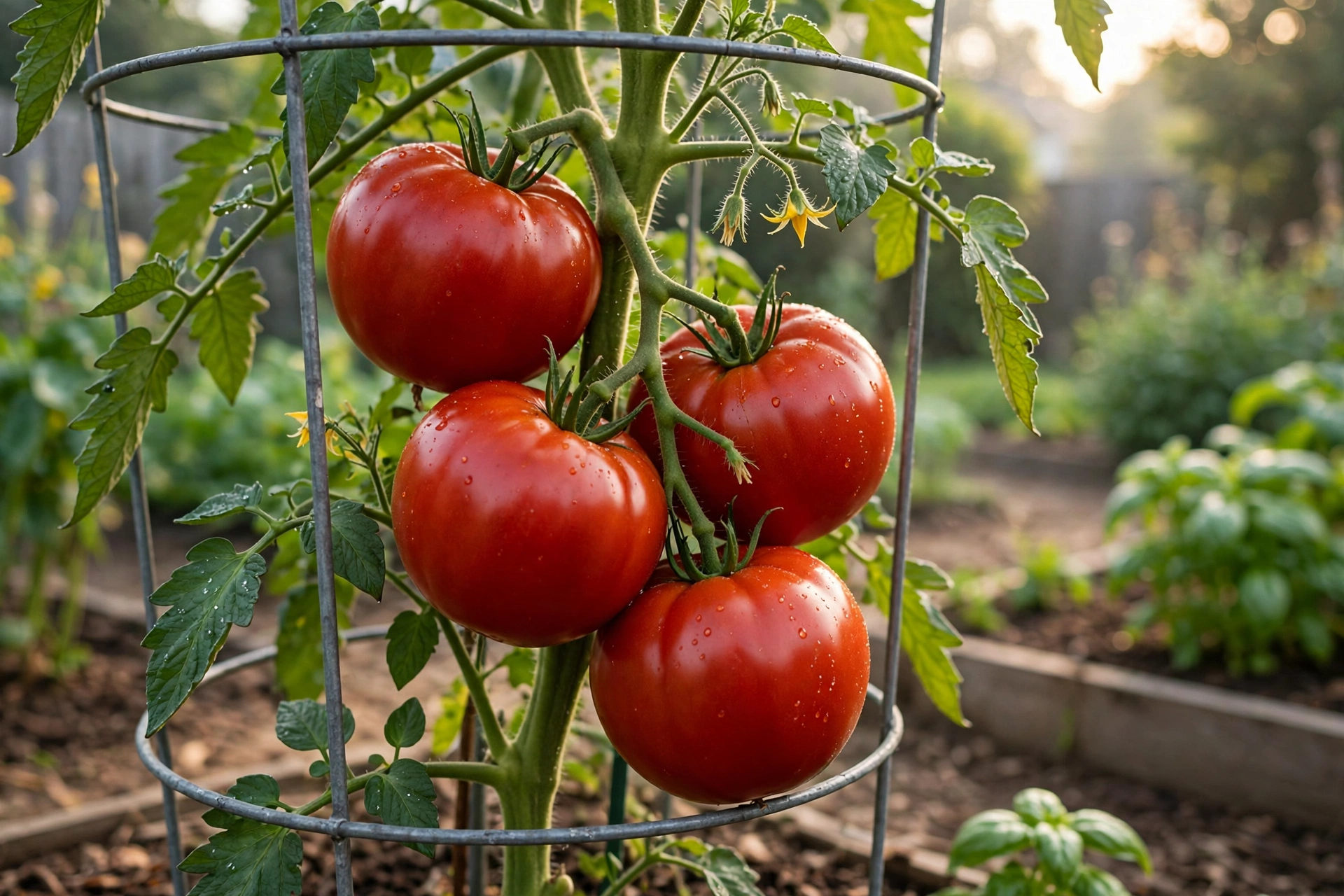

If you want one tomato plant that fills the kitchen all summer, plant a Big Boy: the classic slicer, big, round and deep red, heavy enough that one fruit covers a sandwich. One healthy plant keeps you in tomatoes from midsummer to the first frost.
This guide covers the whole season in plain terms: when to start seeds, how to plant them, how much water they really need, and what to do when things go wrong. It also covers the bits most guides skip: seed-packet disease codes, Big Boy vs Better Boy, and growing one in a pot.
Big Boy Tomato at a Glance
| Detail | What to expect |
|---|---|
| Type | F1 hybrid slicer, indeterminate |
| Days to first ripe fruit | About 78 days from transplant |
| Fruit size | 10 to 16 ounces, up to 1 pound |
| Plant size | Vines 6 to 10 feet long; 24 to 36 inches wide |
| Sun | Full sun, 6 to 8 hours a day |
| Soil | Rich, well-drained, pH 6.0 to 6.8 |
| Spacing | 24 to 36 inches apart, rows 3 to 4 feet apart |
| Water | About 1 to 2 inches a week, steady and deep |
| Harvest | From midsummer until the first frost |
What Is a Big Boy Tomato?
Big Boy is a hybrid slicer tomato from Burpee, first released in 1949. It was bred by Dr. Oved Shifriss, a geneticist who ran Burpee’s vegetable research at Fordhook Farms in Bucks County, Pennsylvania, and it became the first hybrid tomato home gardeners embraced. Retired Extension horticulturist Gerald Klingaman tells the full story.
The fruit is what made it famous. Smooth, globe-shaped, deep red, with thick walls and meaty flesh. The flavour is old-fashioned and balanced, sweet with enough tang. Most fruit weighs 10 to 16 ounces, and a strong plant can grow fruit up to a pound each. Cornell University’s variety database agrees: 78 days, 10–16 oz, indeterminate. That is roughly two to the pound, so one or two plants feed most families.
Big Boy is an indeterminate variety, which means the vine keeps growing and setting fruit all season instead of ripening everything at once. It also means the plant needs real support. A flimsy wire cone will not hold it once the fruit starts coming in, so plan for a heavy-duty cage or a tall stake from day one. Before you buy seeds, know this: Big Boy is an F1 hybrid, not an heirloom. You cannot save seeds from this year’s fruit and expect the same tomato next year, so buy fresh seed each spring.
How to Grow Big Boy Tomatoes
1. Start seeds indoors, 6 to 8 weeks before the last frost
Sow seeds about a quarter inch deep in seed-starting mix, two or three seeds per cell. Tomato seeds germinate best in warm soil, between 75 and 90°F, and usually sprout in about six days. Give them strong light at once: a windowsill is rarely enough, and a cheap LED grow light a few inches above them works far better. Once they have true leaves, snip off the weaker ones in each cell. When they outgrow the tray, move each into its own four-inch pot.
2. Harden the seedlings off for a week
About a week before planting day, carry the seedlings outside for a few hours a day, starting in shelter and giving them more sun as the week goes on. Bring them in at night. This stops transplant shock, the main reason young plants stall after planting.
3. Plant outside after the last frost, and plant deep
Wait until night temperatures stay above 50°F. Tomatoes are tender plants, and cold soil can stunt them for the whole season. They can be damaged below 43°F.
Dig the hole deeper than the pot, strip the bottom leaves, and bury the stem halfway: the buried stem grows extra roots. Leave the top leaves above the ground. Space plants 24 to 36 inches apart, rows 3 to 4 feet apart; crowded plants stay damp, which invites disease. In containers, use a 10-gallon pot minimum.
4. Cage or stake on planting day
Put the support in the same day you plant: a heavy-duty cage looks silly around a small seedling, but the vine fills it fast, and a stake driven in later can stab the roots. Tie the main stem loosely as it grows. Pinch off suckers, the small shoots in the V between stem and leaf branch, while they are small, keep one main stem (or one plus a single strong low sucker), and thin the first clusters to three or four tomatoes for bigger fruit.
Watering, Feeding and Mulch
Water deep and steady, at the base
Big Boy tomatoes want about 1 to 2 inches of water a week, delivered deeply and evenly. Water the soil around the base, not the leaves. Steadiness matters more than volume. A plant that goes dry for days and then gets a flood is the one that cracks its fruit and develops blossom end rot. In hot weather, potted plants may need water every day, while plants in the ground often do fine with a deep soak once or twice a week. Water in the morning so any splashes dry quickly.
Feed lightly, and go easy on nitrogen
Work compost or slow-release fertilizer into the top few inches before planting, then feed a balanced tomato feed every few weeks. The mistake is too much nitrogen: it grows a huge, leafy plant with very few tomatoes. If your plant looks lush but has no flowers, excess nitrogen is the first suspect.
Mulch to keep the soil even
Spread an inch or so of compost or straw over the soil once the plants are in. Mulch holds moisture in, stops soil splashing onto lower leaves, and feeds the soil as it breaks down: the cheapest way to prevent the watering swings behind most tomato problems.
Growing Big Boy Tomatoes in a Pot
Big Boy works in containers, but only in a big one: a 10-gallon pot minimum, a half whiskey barrel or large grow bag better. Anything smaller dries out too fast, and a thirsty Big Boy drops flowers and rots its fruit ends.
Fill the pot with a light potting mix, not garden soil. Garden soil packs down in a pot and suffocates the roots. A mix based on coco coir or peat moss with perlite drains well and holds air. Give it six hours of direct sun and set the cage in at planting time. Check the soil daily in summer, water until it runs out of the drainage holes, and feed a little more often than you would in the ground, because every watering washes nutrients out of the pot. One plant per pot: two will fight each other all season.
Big Boy vs Better Boy vs Beefsteak
| Variety | Days to harvest | Fruit | Story |
|---|---|---|---|
| Big Boy | About 78 days | 10 to 16 oz, smooth globe | The original, released by Burpee in 1949 |
| Better Boy | About 68 to 72 days | 12 oz or more, smooth globe | Bred in 1964 from a cross of Teddy Jones and Big Boy |
| Beefsteak | Varies by type | Large, often ribbed and meaty | A type, not one variety; many are heirlooms |
Better Boy is Big Boy’s own offspring, created in 1964 by crossing the heirloom Teddy Jones with Big Boy. It ripens about a week earlier and carries broader disease resistance. One plant famously produced 342 pounds in a single season in 1987. If your summers are short, Better Boy is the safer pick.
Beefsteak is not a single variety but a type: big, meaty, often ribbed fruit. Many beefsteaks are heirlooms, which means richer flavour and no disease resistance at all. Big Boy sits in the middle: hybrid reliability with flavour close to the old slicers. Pick Big Boy for the classic sandwich tomato, Better Boy if your season is short or disease has beaten your tomatoes before, and a beefsteak heirloom if flavour matters more to you than reliability.
What the Letters on the Seed Packet Mean
Tomato tags carry letter codes for disease resistance: V for Verticillium wilt, F for Fusarium wilt, N for root-knot nematodes, T for tobacco mosaic virus. A variety marked VFN resists all three of the first group. Big Boy’s resistance shows why you should read the packet rather than the marketing. Burpee’s own disease chart codes Big Boy as resistant to Alternaria stem canker, while many seed sellers list it as VFN. Codes vary a little by seller, so check the packet you hold. Resistance is not immunity: it means the plant can fight off that disease in normal conditions. Good watering and airflow still do most of the work.
Trouble Spots: 5 Problems and Their Fixes
Blossom end rot: black, sunken patches on the bottom of the fruit
This is not a disease and it does not spread. It is a calcium problem inside the fruit, and the usual cause is not a lack of calcium in the soil: uneven watering stops calcium reaching the fruit while it grows. Keep the soil evenly moist from fruit set, mulch to hold it, and pick off affected fruit; the next set usually comes in clean once watering steadies. Foliar calcium sprays do very little. Illinois Extension explains the cause and the fix in plain terms.
Cracked fruit after a dry spell
A tomato that goes dry and then gets a sudden soak swells faster than its skin can stretch. The fix is the same as for blossom end rot: steady water and mulch. Cracked fruit is still fine to eat if you pick it right away and cut the split part off.
Hornworms stripping the leaves
Tomato hornworms are big green caterpillars that can strip a plant overnight. Look for missing leaves and dark droppings below, then hand-pick them off and check leaf undersides, where they hide by day.
Lots of leaves, no fruit
Too much nitrogen is the usual cause, often from fresh manure or lawn fertilizer. Cut back the feeding. Heat can also stall fruit set: when nights stay very hot, flowers drop without setting fruit, and production picks up when the weather cools.
Harvesting and Ripening
Count forward from planting day: the first ripe Big Boy usually appears about 78 days after transplanting. A healthy plant then keeps producing for around ten weeks, often giving 50 to 100 tomatoes. That is why two plants can feed a family and still leave a pile for the neighbours.
Pick when a tomato is fully coloured and gives slightly under a gentle press. To pick early, take fruit at the breaker stage, when the blossom end first blushes, and ripen it on the counter out of direct sunlight. It colours up in a few days and tastes far better than a tomato picked hard and green.
Do not refrigerate fresh tomatoes. Cold dulls their flavour and turns the flesh mealy. Keep them on the counter, stem side down, and use them within a few days. A big harvest stores best as sauce or roasted tomatoes, and a slow roast at 180°C (350°F) is a good use for the glut. If the harvest outruns your cooking, plan your weekly meals around it.
Big Boy earned its place the hard way: big fruit, steady harvests, and a plant that forgives a beginner’s mistakes. Give it sun, space, steady water, and something strong to climb, and it will pay you back all summer.
How long do Big Boy tomatoes take to grow?
About 78 days from transplanting to the first ripe fruit. After that, the plant keeps producing for around ten weeks, until the first frost.
How big do Big Boy tomatoes get?
Most fruit weighs 10 to 16 ounces, and a strong plant can grow tomatoes up to a pound each. That is roughly two tomatoes to the pound.
Do Big Boy tomatoes need a cage?
Yes. Big Boy is indeterminate, so the vines grow 6 to 10 feet long and keep producing all season. A heavy-duty cage or a tall stake, put in on planting day, is essential.
Can you grow Big Boy tomatoes in a pot?
Yes, but only in a big one: a 10-gallon pot minimum, filled with light potting mix, in at least six hours of sun, with the soil checked daily in summer.
Can you save seeds from Big Boy tomatoes?
No. Big Boy is an F1 hybrid, so seeds saved from this year’s fruit will not grow true to the parent. Buy fresh seed each spring.
