
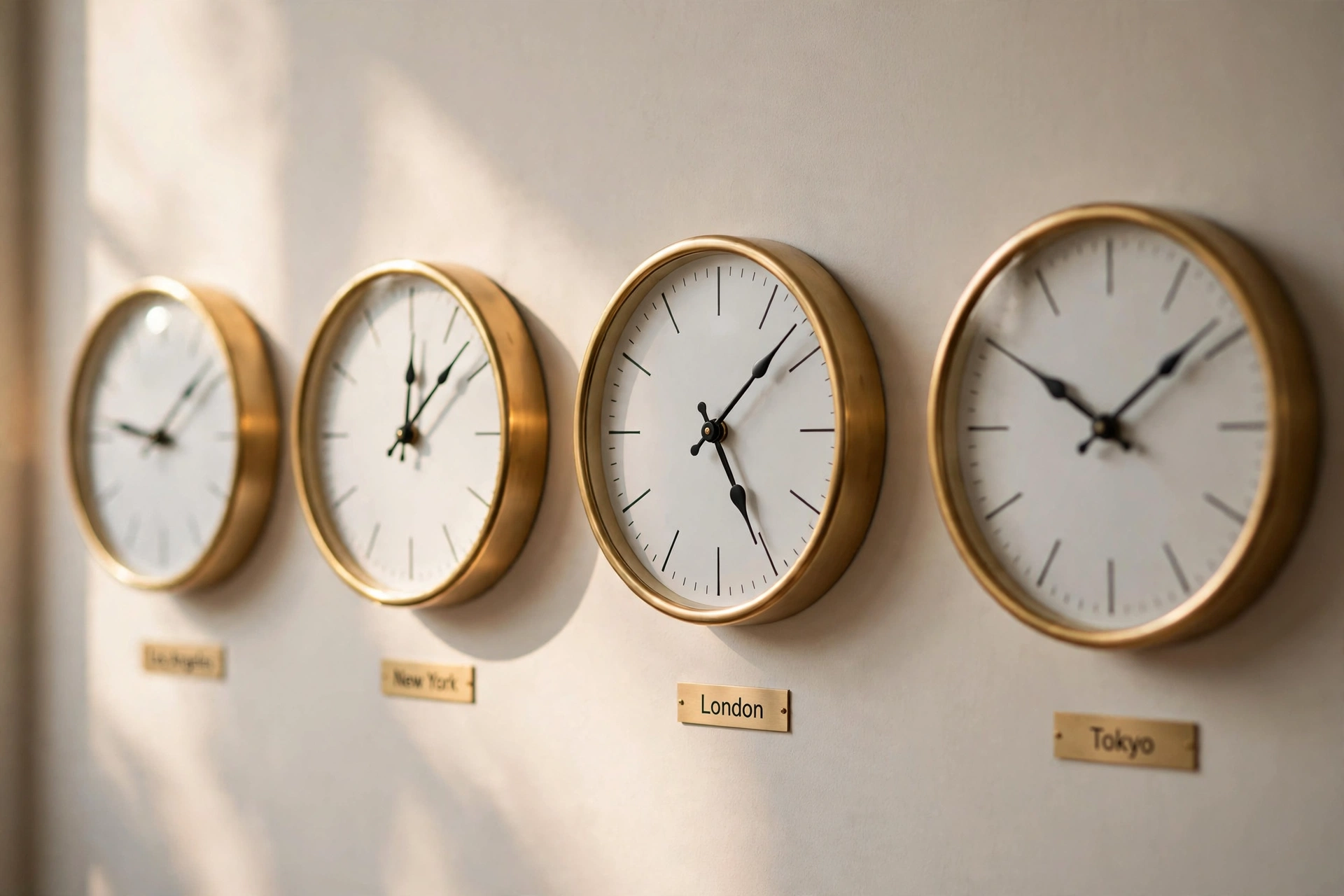

PT means Pacific Time. It is the time zone of the west coast of the United States and Canada — Los Angeles, San Francisco, Seattle, Portland and Vancouver all run on it.
Here is the catch. PT is not one fixed time. It switches between two settings during the year. In winter it is PST, which is 8 hours behind UTC. In summer it is PDT, which is 7 hours behind UTC. So the honest answer to “what time is PT?” is: it depends on the date.
This guide gives you the short answer first, then the simple rule for working out which version is in force today, the switch dates for 2026 and 2027, and a conversion table for the places people actually convert to.
What Does PT Mean?
PT stands for Pacific Time. It is the umbrella name for the whole time zone. PST and PDT are the two seasonal versions of it.
PT — Pacific Time
The general name. Use it when you mean “local time on the west coast” and you do not want to worry about which season it is. A TV listing that says “8 PM PT” is right all year round, because the date decides which offset applies.
PST — Pacific Standard Time
The winter setting. PST is UTC-8, which means 8 hours behind Coordinated Universal Time. It runs from the first Sunday in November to the second Sunday in March.
PDT — Pacific Daylight Time
The summer setting. PDT is UTC-7, which means 7 hours behind UTC. It runs from the second Sunday in March to the first Sunday in November, while daylight saving time is in force.
| Label | Full name | UTC offset | When it applies |
|---|---|---|---|
| PT | Pacific Time | UTC-8 or UTC-7 | All year — the general term |
| PST | Pacific Standard Time | UTC-8 | First Sunday in November to second Sunday in March |
| PDT | Pacific Daylight Time | UTC-7 | Second Sunday in March to first Sunday in November |
Think of it like a jacket. PT is the person. PST is the winter coat. PDT is the summer shirt. Same person, different outfit for the season.
Is It PST or PDT Right Now?
Use this one-line check. Look at today’s date. If it falls between the first Sunday in November and the second Sunday in March, Pacific Time is on PST (UTC-8). For the rest of the year, it is on PDT (UTC-7).
Right now, for example, the calendar says early November 2026. Daylight saving time ended on Sunday, November 1, 2026, so Pacific Time is currently on PST — 8 hours behind UTC. When March 2027 arrives, the clocks will spring forward again and PT will become PDT.
If you need the exact time this second rather than the rule, the fastest check is to search “time in Los Angeles” on Google. The result shows the current time and the correct abbreviation for today. A live clock such as timeanddate.com’s Pacific Time page does the same job.
When Do the Clocks Change?
The United States changes its clocks twice a year, on dates set by federal law. The rule comes from the Uniform Time Act of 1966, and the current schedule has been in place since 2007. The U.S. National Institute of Standards and Technology (NIST) states the rule plainly: daylight saving time begins on the second Sunday in March at 2 a.m. and ends on the first Sunday in November at 2 a.m.
| Year | Spring forward — clocks jump 2 a.m. to 3 a.m. | Fall back — clocks fall 2 a.m. to 1 a.m. |
|---|---|---|
| 2026 | Sunday, March 8 — PST ends, PDT begins | Sunday, November 1 — PDT ends, PST begins |
| 2027 | Sunday, March 14 — PST ends, PDT begins | Sunday, November 7 — PDT ends, PST begins |
Two odd things happen on those Sundays, and both catch people out. On the spring-forward Sunday, 2:30 a.m. simply does not exist — the clock jumps straight from 2:00 to 3:00. On the fall-back Sunday, 1:30 a.m. happens twice. If you ever schedule something for the small hours on a changeover weekend, pick a different time.
How to Convert PT to Other Time Zones
You do not need a converter for the common cases. You need the gap, and the gap only changes when one side moves its clocks and the other does not.
Here is the three-step method. First, work out whether PT is on PST or PDT today using the date rule above. Second, add the gap for the place you want. Third, roll past midnight if the answer goes over 24 hours.
Start with the easy ones. PT is always 3 hours behind Eastern Time, 2 behind Central Time and 1 behind Mountain Time, because those zones change their clocks on the same weekends. So 9 a.m. in Los Angeles is noon in New York, 11 a.m. in Chicago and 10 a.m. in Denver — in January and in July alike. It is the same kind of simple arithmetic as converting temperatures: once you know the offset, the rest is adding and subtracting.
It gets trickier with places that do not follow the U.S. schedule. London and Paris move their clocks on different weekends, and India, Pakistan and Japan never move theirs at all. That is why the gap to those places changes with the season. It also matters when you travel: flight times are always printed in the local time of each airport, so a 9 a.m. departure from Los Angeles and a 5 p.m. arrival in New York can be the same flight — something to keep in mind alongside Southwest’s baggage limits when you plan a trip.
| If it is 9:00 a.m. in Los Angeles… | Winter (PST, UTC-8) | Summer (PDT, UTC-7) |
|---|---|---|
| New York (Eastern) | 12:00 p.m. same day | 12:00 p.m. same day |
| Chicago (Central) | 11:00 a.m. same day | 11:00 a.m. same day |
| Denver (Mountain) | 10:00 a.m. same day | 10:00 a.m. same day |
| UTC | 5:00 p.m. same day | 4:00 p.m. same day |
| London | 5:00 p.m. same day | 5:00 p.m. same day |
| Paris / Berlin | 6:00 p.m. same day | 6:00 p.m. same day |
| India (IST) | 10:30 p.m. same day | 9:30 p.m. same day |
| Pakistan (PKT) | 10:00 p.m. same day | 9:00 p.m. same day |
| Tokyo | 2:00 a.m. next day | 1:00 a.m. next day |
| Sydney | 4:00 a.m. next day | 2:00 a.m. next day |
Notice two things in that table. London stays 8 hours ahead of PT all year, even though both cities move their clocks — they just move in step, so the gap never changes. Sydney is the wild one: the gap swings from 19 hours in winter to 17 in summer, because Australia’s seasons run in reverse and its clocks move the opposite way.
One more trap. For two to three weeks each March, and about one week each autumn, the gap to London is 7 hours, not 8. That is because Europe changes its clocks on the last Sunday of March and the last Sunday of October, while the U.S. changes on the second Sunday of March and the first Sunday of November. If you schedule a London call in that window, double-check the time.
Which Places Use Pacific Time?
California and Washington sit entirely on Pacific Time. So does most of Oregon and most of Nevada. Northern Idaho — the panhandle — is on PT while the south of the state is on Mountain Time. A small corner of Malheur County in eastern Oregon is on Mountain Time, and the Nevada town of West Wendover follows Mountain Time too.
Outside the United States, most of British Columbia uses Pacific Time, and so does Baja California in Mexico, which keeps its clocks in step with California so cross-border business stays simple. Yukon stays on UTC-7 all year round, which matches PDT in summer but leaves it an hour ahead of PST in winter.
One change worth knowing: most of British Columbia stopped falling back in 2026 and now stays on UTC-7 year-round. So Vancouver no longer matches Los Angeles in winter the way it used to. If you schedule with someone in B.C., check their city, not just the zone name.
PT, PST or PDT — Which One Should You Write?
For almost everything you write — emails, meeting invites, event pages, shop hours — write PT. It is the safe choice. The date does the work, and nobody has to remember which season it is.
Use PST or PDT only when the exact offset matters. That means technical documents, server logs, flight paperwork and manual UTC conversions. In those cases the abbreviation is part of the data, not just a label.
The classic mistake is writing PST all year round. It feels like the “real” name of the zone, because it is the one people hear most. But write “10 a.m. PST” on a July invite and you have technically asked people to show up an hour late. In July the zone is on PDT, and a reader who converts literally from PST will land on 11 a.m. local time. PT sidesteps the whole problem.
Common Mistakes With Pacific Time
Assuming Arizona matches PT
Most of Arizona does not observe daylight saving time at all. It stays on Mountain Standard Time (UTC-7) all year. That means Phoenix matches Los Angeles in summer, when PT is also UTC-7, but sits one hour ahead in winter, when PT falls back to UTC-8. The Navajo Nation inside Arizona does observe daylight saving time, so part of the state moves and part does not.
Assuming every country changes clocks together
They do not. The U.S., the U.K. and Europe all change on different weekends, and many countries — India, Pakistan, Japan, China — never change at all. A time gap you memorised in January can be wrong by an hour in March.
Writing a fixed offset into a calendar or system
Hard-coding UTC-8 for “Pacific” is wrong for about eight months of the year. Calendars and software should store the place — America/Los_Angeles — and let the system work out the offset for the date. That is how your phone gets it right without you thinking about it.
What PT Does Not Mean
Outside time zones, PT is also shorthand for other things — physical therapy, part-time work, a personal trainer. In a schedule, a flight time or a TV listing, PT almost always means Pacific Time. If you see it in a medical or job context, it means something else entirely. Context decides.
The Short Version
PT is Pacific Time, the west coast’s time zone. In winter it runs as PST (UTC-8); in summer it runs as PDT (UTC-7). The clocks spring forward on the second Sunday in March and fall back on the first Sunday in November. When you write a time for other people, write PT and let the date sort out the rest.
Sources: the switch dates and UTC offsets in this guide follow the NIST Local Time FAQs and the U.S. Department of Transportation’s daylight saving time rules. Zone definitions follow the Pacific Time Zone entry, and the IANA time zone database (iana.org/time-zones) is the reference behind the America/Los_Angeles rules.
Is PT the same as PST?
Not quite. PT is the general name for Pacific Time. PST is the winter version of it (UTC-8), used from the first Sunday in November to the second Sunday in March. In summer the same zone runs as PDT (UTC-7). So PT equals PST in winter and PDT in summer.
What time is it in PT right now?
Check today’s date. If it is between the first Sunday in November and the second Sunday in March, PT is on PST (UTC-8). The rest of the year it is on PDT (UTC-7). For the exact time this second, search “time in Los Angeles” on Google.
How many hours is PT behind Eastern Time?
Three hours, all year. PT and ET change their clocks on the same weekends, so the gap never changes. 9 a.m. in Los Angeles is always noon in New York.
When do the clocks change in 2027?
In 2027, Pacific Time springs forward on Sunday, March 14, when PST ends and PDT begins, and falls back on Sunday, November 7, when PDT ends and PST begins. Both changes happen at 2 a.m. local time.
Does Arizona use Pacific Time?
No. Most of Arizona stays on Mountain Standard Time (UTC-7) all year and does not observe daylight saving time. Phoenix matches Los Angeles in summer but is one hour ahead in winter. The Navajo Nation inside Arizona is the exception — it does observe daylight saving time.
