
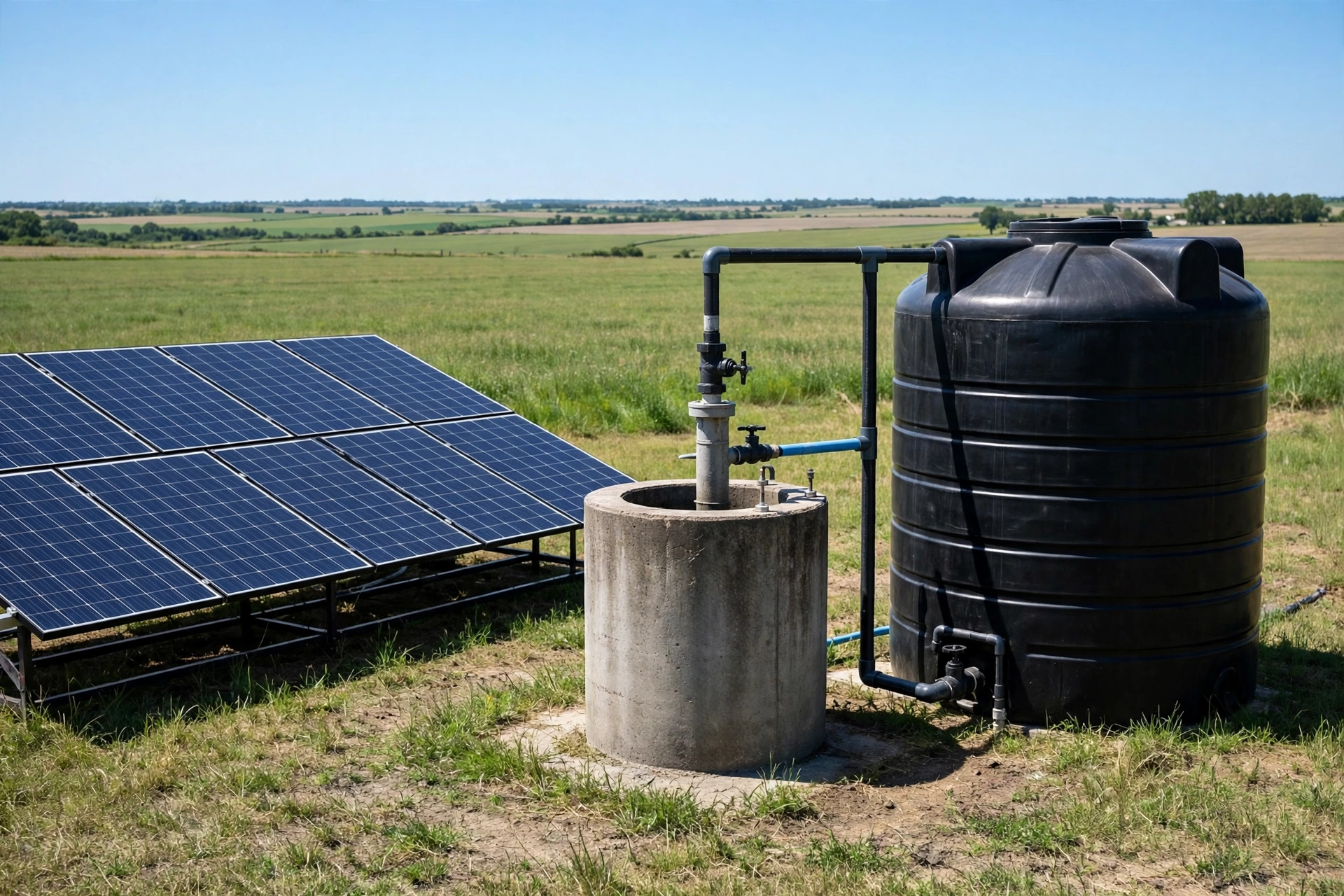

If your home, cabin, or farm sits far from the nearest power line, getting water out of the ground gets expensive fast. A grid connection can cost tens of thousands of dollars; a generator needs fuel, oil changes, and someone to start it. A solar well pump skips all of that — it runs your well on sunlight, with no monthly power bill and no fuel to haul.
Ranchers have pumped water with the sun for decades; what is new is how cheap and reliable the equipment has become. A small kit now costs less than extending a power line by a few hundred feet.
What Is a Solar Well Pump?
A solar well pump is a water pump powered by solar panels instead of the grid or a generator. Panels near the wellhead make direct-current (DC) electricity, a controller feeds it to a pump sitting down inside the well, and the pump pushes water up into a storage tank, a trough, or your pipes.
A complete system has five parts: the solar panels, the pump controller, the pump itself, the drop pipe and cable, and a storage tank. The tank is the part people forget — it is your battery, except it never wears out.
How Does a Solar Well Pump Work?
The process has four steps, and it repeats every sunny day without anyone touching it.
Step 1: The panels make DC power
Sunlight hits the panels and they produce direct-current electricity. More sun means more power, so the pump runs hardest around midday and slows in the morning, evening, and under cloud.
Step 2: The controller matches power to the pump
The controller takes whatever the panels are producing and shapes it into what the pump motor needs. On a bright day it runs the pump at full speed; on a grey day it slows the pump down instead of stopping it. A good controller matters more than a big panel array — it keeps water moving in poor light.
Step 3: The pump lifts the water
The submersible pump pushes water up the drop pipe. A pump built to lift water 500 feet moves far fewer gallons per minute than one lifting from 100 feet — lift and flow are always a trade-off.
Step 4: The tank stores the water
Water flows into a storage tank. A float switch stops the pump when the tank is full and restarts it when the level drops. At night, or on a cloudy morning, you draw from the tank instead of the well.
DC vs AC Solar Well Pumps
| DC solar pump | AC solar pump | |
|---|---|---|
| How it runs | Straight from the panels through a controller, no inverter | Panels feed an inverter, which powers a standard AC pump |
| Best for | Cabins, livestock, garden watering | Larger homes, irrigation, high flow |
| Cost | Lower — simpler electronics | Higher — the inverter adds cost and a small efficiency loss |
| Flow | Moderate; suits typical household and farm use | Higher; matches conventional pump output |
| Night use | Storage tank or small battery bank | Storage tank, batteries, or grid backup |
Most small and mid-size systems use DC pumps because they are simpler, cheaper, and more efficient on solar. AC makes sense when you need high flow or you already own a good AC pump. Some pumps, like the Grundfos SQFlex, accept both AC and DC, which gives you a fallback if the sun disappears for a week.
How to Size a Solar Well Pump
Sizing is where most solar pump projects go wrong. The guides all list the same factors, but few work through a real example. Here is one.
The worked example: a family of four
Say four people live in the house, and the water sits 200 feet down. A household uses roughly 50 to 100 gallons per person per day, so four people need about 300 gallons a day. Your area gets about five peak sun hours — hours of full-strength sun — on an average day.
That means the pump must move 300 gallons in five hours — just 1 gallon per minute while it runs. A small 200-watt solar water well pump delivers about 5 gallons per minute from 150 feet down, so it covers the whole day’s water in about an hour of good sun. Two panels, around 200 to 400 watts total, is enough for a house like this.
The same logic works in reverse. Bigger numbers — a deep well, a big family, a garden, livestock — need more panel watts and a bigger pump. Size for your worst season, not your sunniest month. A system sized for July will leave you short in January.
The four numbers you need before you buy
Every pump seller will ask for these — get them from your well record or a local well driller before you shop.
1. Depth to water, not total well depth
What matters is how far down the water surface sits, plus the lift from the wellhead to your highest tap or tank. That total is the total dynamic head, and it decides the pump — not the depth of the hole.
2. Daily water need
Count everyone in the house, then add livestock, garden, and irrigation — and be honest about peak days, not averages.
3. Casing diameter
Most submersible solar pumps are 4 inches wide and need a 4-inch or larger casing. If yours is smaller, check before you order — some pumps will not fit.
4. Peak sun hours
About three hours a day in a cloudy Pacific Northwest winter, six or more in the desert Southwest. Your panel count depends on this more than anything else.
The lift-versus-flow trap
One number on a pump’s spec sheet can mislead you. A centrifugal solar pump rated for 150 gallons per minute at 37 feet of lift may deliver only 8 gallons per minute at 410 feet. Same pump family, same panels — the deeper the lift, the thinner the flow. Always read the pump curve at your depth, never the headline flow number.
How Much Does a Solar Well Pump Cost?
Typical installed costs, from cost guides updated in late 2026:
| System type | Best for | Installed cost |
|---|---|---|
| Small DC solar pump kit | Livestock, garden, cabin | $1,500–$3,000 |
| Mid-size DC household system | Small home, moderate daily use | $3,000–$5,000 |
| AC solar pump with inverter | Full household, higher flow | $4,000–$6,000+ |
| Household system + battery backup | Water at night and on cloudy days | $5,000–$8,000+ |
| Large / agricultural system | Irrigation, large properties | $6,000–$12,000+ |
Well depth drives the price more than anything else. Angi’s 2026 cost data puts most systems at $1,200 to $3,000, averaging near $2,000 — but a well 300 to 400 feet deep can push the bill to $3,500–$10,000. Many kits exclude the panels, so check before comparing prices: panels run about $1 to $1.50 per watt, and a household system typically needs 400 to 1,200 watts. Professional installation adds $800 to $2,000; deep wells are best left to a well driller.
Does it pay for itself?
Work it out with round numbers. A grid-powered well pump costs about $15 to $50 a month in electricity, or $200 to $600 a year. Against a $4,000 solar system, simple payback is roughly 7 to 15 years on electricity alone — about 5 to 12 years counting rising rates and the longer life of a DC solar pump. Slow, if your only goal is saving on the power bill.
But electricity savings are rarely the whole story. For an off-grid property, the alternative is often extending a power line, which can cost $15,000 to $50,000 or more — against that, a solar pump pays for itself on day one. One comparison at 500 gallons a day put the five-year total at $2,118 for solar, $5,175 for a grid pump, $10,350 for a windmill, and $10,400 for a generator — and the generator needed 530 hours of someone’s time over those five years, against 15 for solar. The full cost comparison is worth reading before you decide.
Do Solar Well Pumps Work at Night or on Cloudy Days?
Not directly — a solar pump needs sunlight. But most systems are built so that hardly matters.
The usual answer is a storage tank. One holding one to two days of water — typically 500 to 1,000 gallons for a household — covers most cloudy stretches. Put it uphill from the house and gravity feeds your taps at night without a single battery. Cheaper than a battery bank, and it never wears out.
Batteries are the other option. They add $1,000 to $3,000 or more and need replacing: lead-acid lasts 3 to 7 years, lithium iron phosphate (LiFePO4) lasts 8 to 15. They make sense only if you must pump at night or need water on demand around the clock. A third option is a hybrid: a solar pump fills the tank by day, with your existing grid pump as backup. Our guide to optimized battery charging explains the same charge-and-hold idea on the devices you already own.
When a Solar Well Pump Is NOT Worth It
Solar is not the answer for every well.
If your well is shallow, your home is already on the grid, and your pump costs $15 a month to run, a solar system will take a very long time to pay back. A standard grid pump replacement costs $1,200 to $3,500 — less than most solar systems — and works at 2 a.m. in January without a tank or a battery.
Solar is also a poor fit when water demand is huge and constant, when the site gets little sun for months, or when the well is extremely deep. In those cases a grid pump — or a hybrid that uses solar for part of the load — is the honest answer.
The rule of thumb is simple. Solar is worth it when your property is off-grid or far from power lines, when you want water during power cuts, when your rates are high, or when you use a lot of water for irrigation or livestock. If none of those apply, keep your money.
Can a Solar Pump Replace Your Regular Well Pump?
Yes, for many homes. DC solar pumps handle typical household use, and AC systems can match a conventional pump’s output. The key is sizing to your well depth and daily water use — not buying the cheapest kit and hoping.
If you already have a working grid pump, keep it. A solar pump filling a tank by day, with the old pump as backup, gives you most of the savings — and water even if the sun disappears for a week. The Sunhub solar well pump guide walks through the same sizing steps in more detail.
What Can Go Wrong?
Solar well pumps are simple, but not trouble-free.
Sand and grit in the water
Sand wears out pump parts fast. If your well water carries sand, you need a pump built for it or a sand separator — and you need to know before you buy.
Running dry
A pump that runs with no water to move will burn out. Every decent controller has dry-run protection that shuts the pump down when the water level drops — make sure yours does, and never bypass it.
A casing that is too small
Most submersible solar pumps need a 4-inch casing. Measure yours, or check the well record, before ordering — a pump that will not fit is an expensive paperweight.
Freezing
The pump sits below the frost line, but pipes, valves, and the tank can freeze. Insulate exposed pipework and drain what you can before winter.
Shade on the panels
A tree shading one panel in the afternoon can cut the whole array’s output. Site the panels where nothing grows into their sun path, and clean them twice a year — dust costs real gallons.
How long does each part last?
| Part | Typical life |
|---|---|
| DC submersible pump | 15–20+ years with clean water |
| Solar panels | 25+ years |
| Controller | 10–15 years |
| Lead-acid batteries (if used) | 3–7 years |
| Lithium (LiFePO4) batteries (if used) | 8–15 years |
The pump is the part you will replace first, and pulling it from a deep well is the expensive bit. Buy quality, keep sand out, and never let it run dry.
Is There Any Help Paying for One?
Yes — more than most people realise. In the United States, the USDA’s Natural Resources Conservation Service (NRCS) helps farmers and ranchers install solar-powered livestock watering systems through its Environmental Quality Incentives Program (EQIP), which can reimburse a percentage of the cost. One Georgia project found a power line to a pasture could cost about $20,000, against roughly $8,000 for solar. Ask your local NRCS office what cost-share is available — the NRCS story of one Iowa farmer’s solar watering system shows how the program works in practice.
Some states and utilities also offer rebates or tax credits for solar pumping, particularly for farm use, and a federal tax credit may apply to installations that meet its requirements. Check your state’s current programs before you buy, and keep every receipt.
Is a Solar Well Pump Right for You?
You probably want one if:
Your property is off-grid, or the power line would cost more than the pump. You lose water every time the grid goes down. You water livestock or a garden far from the house — a solar pump feeding a drip line keeps tomatoes watered while you are away. Or your rates are high and you use a lot of water.
You probably do not if:
Your well is shallow, grid-connected, and cheap to run. Your demand is huge and constant. Or your site gets little winter sun and you have no room for a tank.
Start with your well details — depth to water, daily usage, casing size — then get two or three quotes. A solar water well pump is a quiet, low-maintenance way to own your water supply, but only when the numbers fit. Get the sizing right, size the tank for a day or two of water, and the sun will do the rest.
How many solar panels do I need for a well pump?
A typical household system needs 400 to 1,200 watts of panels, roughly two to four panels. Small livestock kits run on just two panels. Size by your well depth and daily gallons, not by a rule of thumb.
Can a solar well pump run at night?
Not directly — it needs sunlight. Most systems pump into a storage tank by day and feed the house by gravity at night. Batteries are the other option, but they cost more and wear out.
How deep can a solar well pump work?
Deep-well solar submersibles reach 400 to 800 feet of lift or more. Helical-rotor models like the Grundfos SQFlex are rated to about 820 feet. Deeper wells need more panel wattage and cost more.
How long do solar well pumps last?
Quality DC submersible pumps last 15 to 20 years or more, panels last 25 years or more, and controllers last 10 to 15 years. Batteries, if you use them, need replacing every 3 to 15 years depending on the type.
Do I need a battery with a solar well pump?
Usually no. Storing water in a tank is cheaper and lasts longer than storing electricity in batteries. Add batteries only if you must pump at night or need water on demand around the clock.
